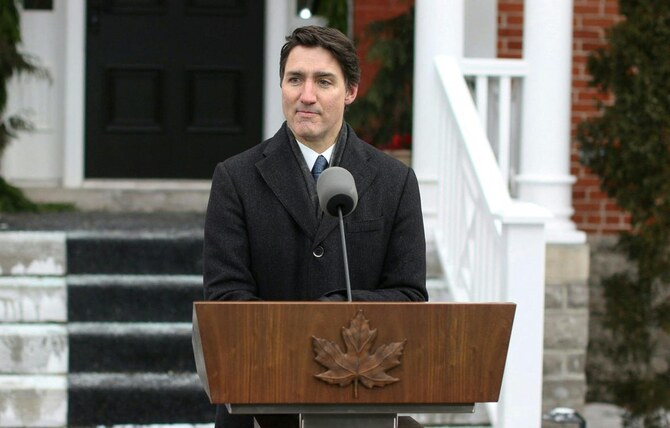
TORONTO: Canadian Prime Minister Justin Trudeau announced his resignation after facing an increasing loss of support both within his party and in the country.
Now Trudeau’s Liberal Party must find a new leader while dealing with US President-elect Donald Trump’s threats to impose steep tariffs on Canadian goods and with Canada’s election just months away.
Trudeau said Monday he plans to stay on as prime minister until a new party leader is chosen.
He could not recover after Finance Minister Chrystia Freeland, long one of his most powerful and loyal ministers, resigned from the Cabinet last month.
Trudeau, the 53-year-old scion of Pierre Trudeau, one of Canada’s most famous prime ministers, became deeply unpopular with voters over a range of issues, including the soaring cost of food and housing as well as surging immigration.
What’s next for Canada?
A new Canadian leader is unlikely to be named before Trump is inaugurated on Jan. 20.
The political upheaval comes at a difficult moment for Canada. Trump keeps calling Canada the 51st state and has threatened to impose 25 percent tariffs on all Canadian goods if the government does not stem what Trump calls a flow of migrants and drugs into the US — even though far fewer of them cross the border from Canada than from Mexico, which Trump has also threatened with tariffs.
Trump also remains preoccupied with the US trade deficit with Canada, erroneously calling it a subsidy. Canada’s ambassador to Washington, Kirsten Hillman, has said the US had a $75 billion trade deficit with Canada last year. But she noted that a third of what Canada sells to the US are energy exports and that there is a deficit when oil prices are high.
If Trump applies tariffs, a trade war looms. Canada has vowed to retaliate.
When will there be a new prime minister?
The Liberals need to elect a new leader before Parliament resumes March 24 because all three opposition parties say they will bring down the Liberal government in a no-confidence vote at the first opportunity, which would trigger an election. The new leader might not be prime minister for long.
A spring election would very likely favor the opposing Conservative Party.
Who will be the next prime minister?
It’s not often that central bank governors get compared to rock stars. But Mark Carney, the former head of the Bank of Canada, was considered just that in 2012 when he was named the first foreigner to serve as governor of the Bank of England since it was founded in 1694. The appointment of a Canadian won bipartisan praise in Britain after Canada recovered faster than many other countries from the 2008 financial crisis. He gained a reputation along the way as a tough regulator.
Few people in the world have Carney’s qualifications. He is a highly educated economist with Wall Street experience who is widely credited with helping Canada dodge the worst of the 2008 global economic crisis and helping the UK manage Brexit. Carney has long been interested in entering politics and becoming prime minister but lacks political experience.
Freeland is also a front-runner. Trudeau told Freeland last month he no longer wanted her to serve as finance minister but that she could remain deputy prime minister and the point person for US-Canada relations. An official close to Freeland said Freeland couldn’t continue serving as a minister knowing she no longer enjoyed Trudeau’s confidence. The official spoke on condition of anonymity as they were not authorized to speak publicly on the matter. The person added it’s far too early to make declarations but said Freeland would talk to her colleagues this week and discuss next steps.
After she resigned, Trump called Freeland “totally toxic” and “not at all conducive to making deals.” Freeland is many things that would seem to irritate Trump: a liberal Canadian former journalist. She is a globalist who sits on the board of the World Economic Forum. Freeland, who is of Ukrainian heritage, also has been a staunch supporter of Ukraine in its war against Russia.
Another possible candidate is the new finance minister, Dominic LeBlanc. The former public safety minister, and a close friend of Trudeau, LeBlanc recently joined the prime minister at a dinner with Trump at Mar-a-Lago. LeBlanc was Trudeau’s babysitter when Trudeau was a child.
Is it too late for the Liberals?
Recent polls suggest the Liberals’ chances of winning the next election look slim. In the latest poll by Nanos, the Liberals trail the opposition Conservatives 47 percent to 21 percent.
“Trudeau’s announcement might help the Liberals in the polls in the short run and, once a new leader is selected, things could improve further at least for a little while but that would not be so hard because, right now, they’re so low in the polls,” said Daniel Béland, a political science professor at McGill University in Montreal.
“Moreover, because Trudeau waited so long to announce his resignation, this will leave little time to his successor and the party to prepare for early elections,” Béland said.
Many analysts say Conservative leader Pierre Poilievre will form the next government. Poilievre, for years the party’s go-to attack dog, is a firebrand populist who blamed Canada’s cost of living crisis on Trudeau. The 45-year-old Poilievre is a career politician who attracted large crowds during his run for his party’s leadership. He has vowed to scrap a carbon tax and defund the Canadian Broadcasting Corporation.


![]()

Canada’s Liberals look for a new prime minister as Trump threatens tariffs and an election looms
Short Url
https://arab.news/jg3z9
Canada’s Liberals look for a new prime minister as Trump threatens tariffs and an election looms
- A new Canadian leader is unlikely to be named before Trump is inaugurated on Jan. 20


Latest updates


Recommended


© 2026 SAUDI RESEARCH & PUBLISHING COMPANY, All Rights Reserved And subject to Terms of Use Agreement.