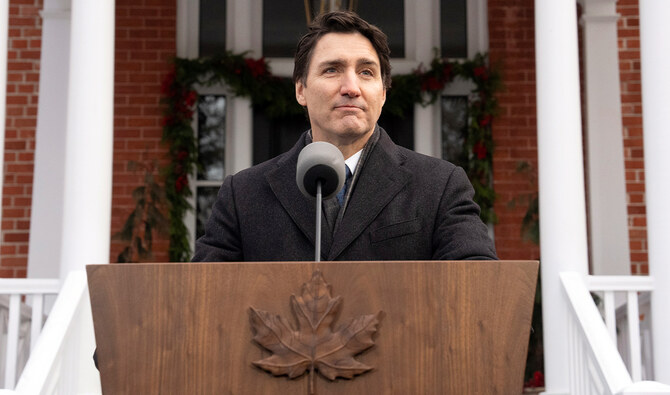
Canadian Prime Minister Justin Trudeau has announced his resignation, telling the nation that “internal battles” mean he “cannot be the best option” in the next election.
Trudeau said Monday he has asked the president of his Liberal Party to begin the process to select a new leader. He has faced rising discontent over his leadership, and the abrupt departure of his finance minister late last year signaled growing turmoil within his government.
Parliament will be suspended until March 24. It had been due to resume Jan. 27. The timing will allow for a Liberal Party leadership race.
Trudeau had been the second-youngest prime minister in Canada’s history when he was elected in 2015, and he had been planning to run for a fourth term in next year’s election even as discontent in his party grew. He said that “I have always been driven by my love for Canada” and repeatedly described himself as a fighter.
Here’s the latest:
A HOPEFUL FOR PRIME MINISTER THANKS TRUDEAU
One person likely to seek power in the Liberal Party after Canadian Prime Minister Justin Trudeau’s resignation is Mark Carney, the former head of the Bank of Canada and later the Bank of England.
Carney has long been interested in entering politics and becoming prime minister, and Trudeau tried to recruit him to join his government.
Carney in a post on X thanked Trudeau for his contributions and sacrifices. He adds: “Wishing you the best for your next chapters.”
TRUDEAU SAYS CANADA NEEDS A RESET IN POLITICS
Canadian Prime Minister Justin Trudeau says Canada deserves a Parliament that functions. He took questions after announcing his resignation Monday morning.
Trudeau said Parliament has been “entirely seized” by what he called obstruction and a total lack of productivity. He said this has been the longest-serving minority government in Canadian history.
And in some of his final comments to the media, Trudeau shared his thoughts on opposition Conservative leader Pierre Poilievre. He said Poilievre has a “very small vision” for Canada, describing it as “stopping the fight against climate change,” backing off on “strength in diversity” and “attacking journalists.”
TRUDEAU ANNOUNCES HIS RESIGNATION
Canadian Prime Minister Justin Trudeau has announced his resignation, telling the media that “internal battles” mean he “cannot be the best option” in the next election.
Trudeau says he has asked the president of his Liberal Party to begin the process to select a new leader. He has faced rising discontent over his leadership, and the abrupt departure of his finance minister late last year signaled growing turmoil within his government.
Shortly before he spoke, an official familiar with the matter said Parliament will be suspended until March 24. It had been due to resume Jan. 27. The timing will allow for a Liberal Party leadership race. The official spoke on condition of anonymity because they were not authorized to speak about the matter publicly.
FIRST, SOME BACKGROUND
Trudeau came to power in 2015 after 10 years of Conservative Party rule, and had initially been praised for returning the country to its liberal past. But the 53-year-old leader, the son of Pierre Trudeau, one of Canada’s most famous prime ministers, became deeply unpopular with voters in recent years over a range of issues, including the soaring cost of food and housing, and surging immigration.
The political upheaval comes at a difficult moment for Canada internationally. US President-elect Donald Trump has threatened to impose 25 percent tariffs on all Canadian goods if the government does not stem what Trump calls a flow of migrants and drugs in the US
That’s even though far fewer of each crosses into the US from Canada than from Mexico, which Trump has also threatened.


![]()

Canadian Prime Minister Justin Trudeau announces his resignation
Short Url
https://arab.news/55tsy
Canadian Prime Minister Justin Trudeau announces his resignation
- Trudeau said Monday he has asked the president of his Liberal Party to begin the process to select a new leader
- He has faced rising discontent over his leadership, and the abrupt departure of his finance minister late last year
Latest updates


© 2026 SAUDI RESEARCH & PUBLISHING COMPANY, All Rights Reserved And subject to Terms of Use Agreement.