

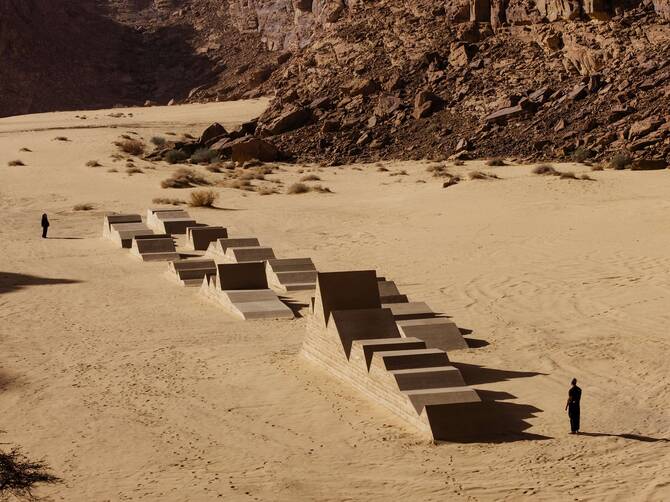

ALULA: “Dreams were time limitless, and dreams were space without measure,” the great Lebanese American poet Khalil Gibran once wrote, a statement that has inspired the curation of the current edition of Desert X AlUla. Curated by Wejdan Reda and Zoé Whitley, with artistic direction by Neville Wakefield and Raneem Farsi, the show’s theme is “Space Without Measure.” Eleven site-specific installations local and international artists will be on display until Feb. 28.
Sara Abdu
‘A Kingdom Where No One Dies: Contours of Resonance’
The Saudi-born artist of Yemeni heritage has contributed an installation that resembles a mountain range, but is actually a representation of the sound waves produced by her recital of the verses that compose the structure of the work: “Conceal all borders/Feel the earth beneath you/Stand still/Be rooted/And remember/Your first home/Her womb/Now breathe/You are in the kingdom/Where no one dies.”
While Gibran’s work dissolves the distance between spirit and matter, Abdu’s dissolves the distance between belonging and estrangement. The piece is created using sand from both Saudi and Yemen, combined to create a self-portrait, in a sense, as a response to a recurring question on the artist’s mind: What shapes our sense of belonging and constructs identity?
“The work converts the sound of the verse into a tangible form; a form that is maybe fragile, but also very grounded in the land itself. I wanted to create something that emerges from the land rather than being placed upon it,” Abdu told Arab News.
Mohammed Al-Saleem
‘The Thorn, AlShuruf Unit, The Triangles, Flower Bud, and Al Ahilla’
Thanks to a loan from the Riyadh Art collection and The Royal Commission for Riyadh City, the show includes five rare sculptures from the Eighties by the influential late Saudi modernist, their geometric forms ascending skywards, each saturated with symbolism inspired by desert landscapes and celestial motifs. “This is the first time that his work is actually presented in the landscape that he was representing throughout his works and his paintings,” Reda said.
Tarek Atoui
‘The Water Song’
The Lebanese-born artist and composer’s immersive sound-based installation is a continuation of the Bayt Al Hams project that was presented at last year’s festival. The horn-like structures, partially buried in the sand, are meant to be heard more than seen. The site looks like a half-excavated archaeological dig and, according to Reda, “responds to the environment, to the air, to water as well, to omit these sounds and to create a sonic experience. He wanted also to create a work that looks like it's a relic of the past. It's an archaeological find, but it’s also an immersive sound experience.”

Tarek Atoui, Desert X AlUla 2026. (Courtesy of Lance Gerber)
Mohammad Alfaraj
‘What Was the Question Again?’
The Saudi artist’s contribution is centered on a palm tree made of many grafted trunks, including moringa, orange, jujube, and other species, and “tries to accompany the landscape instead of overcome it,” he told Arab News. “Just a little mascara on the eyes.”
Books, water canals, doors, palm trunks, stones all come together like a maze, inviting visitors to discover the desert just as Alfaraj does every time he sets foot on its sand.
“How can you create something from the crumbs of the world? I think its an act of prayer, an act of hope,” he says. “There are a lot of things to be done in the maze when you walk in. There are sculptures that ask you questions or want you to make a circle or draw a line. There’s a musicality. One of the gestures people are encouraged to do is take water from water channels and water the plants.”

Mohammad Alfaraj, Desert X AlUla 2026. (Courtesy of Lance Gerber)
Héctor Zamora
‘Tar HyPar’
The Mexican artist’s large metal installation is intended to be an interactive work. It is fitted with various tablas (Indian hand drums) that resound around the valley, bouncing off the surrounding mountains, when played.
“Depending on the size of the drum, you get a different tone,” Zamora told Arab News. “The drums are a very important part of culture here, for ceremonies, and in day-to-day life, and in that way the artwork is looking to get a really close connection to the local community. But the drum is also a universal instrument — basic but strong — used all over the world and this opens up possibilities for everyone to interact and enjoy the artwork.”

Hector Zamora, Tar HyPar, Desert X AlUla 2026. (Courtesy of Lance Gerber)
Maria Magdalena Campos-Pons
‘Imole Red’
The Cuban-born artist showcases golden palm-like structures that emerge from the ground, surrounding a colorful representation of the arid-adapted allium plants that are found in areas around AlUla. Scattered with coral and seashells — an acknowledgement that the area was, many millennia ago, an ocean — the piece is a meditative site that acts as a small expression of time. “I love that the allium is petite, miniscule, almost miniature in this landscape. But then I wanted to bring it in this monumentality and also create a conversation about time,” Campos-Pons tells Arab News. “But time cannot be situated. Does that little oasis belong to past, present, or future times? My hope is that when people are there, those questions emerge.”

Maria Magdalena Campos-Pons, Desert X AlUla 2026. (Courtesy of Lance Gerber)


