Nearly 300 killed in militant attacks in Pakistan’s Balochistan province in 2024 — official data

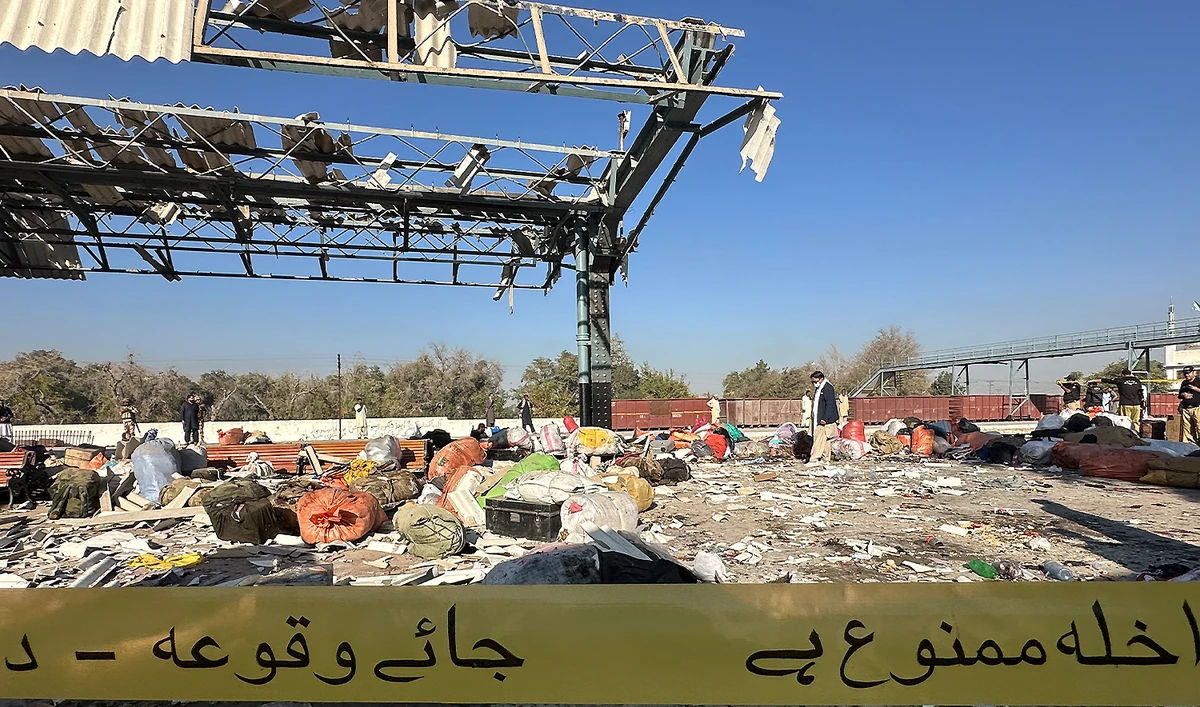
Security personnel inspect the blast site at a railway station, a day after an explosion allegedly by Pakistani separatists in Quetta, in Pakistan's Balochistan province, on November 10, 2024. (AN photo)
Short Url
Updated 26 December 2024
Follow

Nearly 300 killed in militant attacks in Pakistan’s Balochistan province in 2024 — official data

  • Balochistan witnessed a rise in separatist violence, reporting 563 attacks in which over 500 were injured
  • Security analysts say only genuine political process can establish long-term peace in restive Balochistan

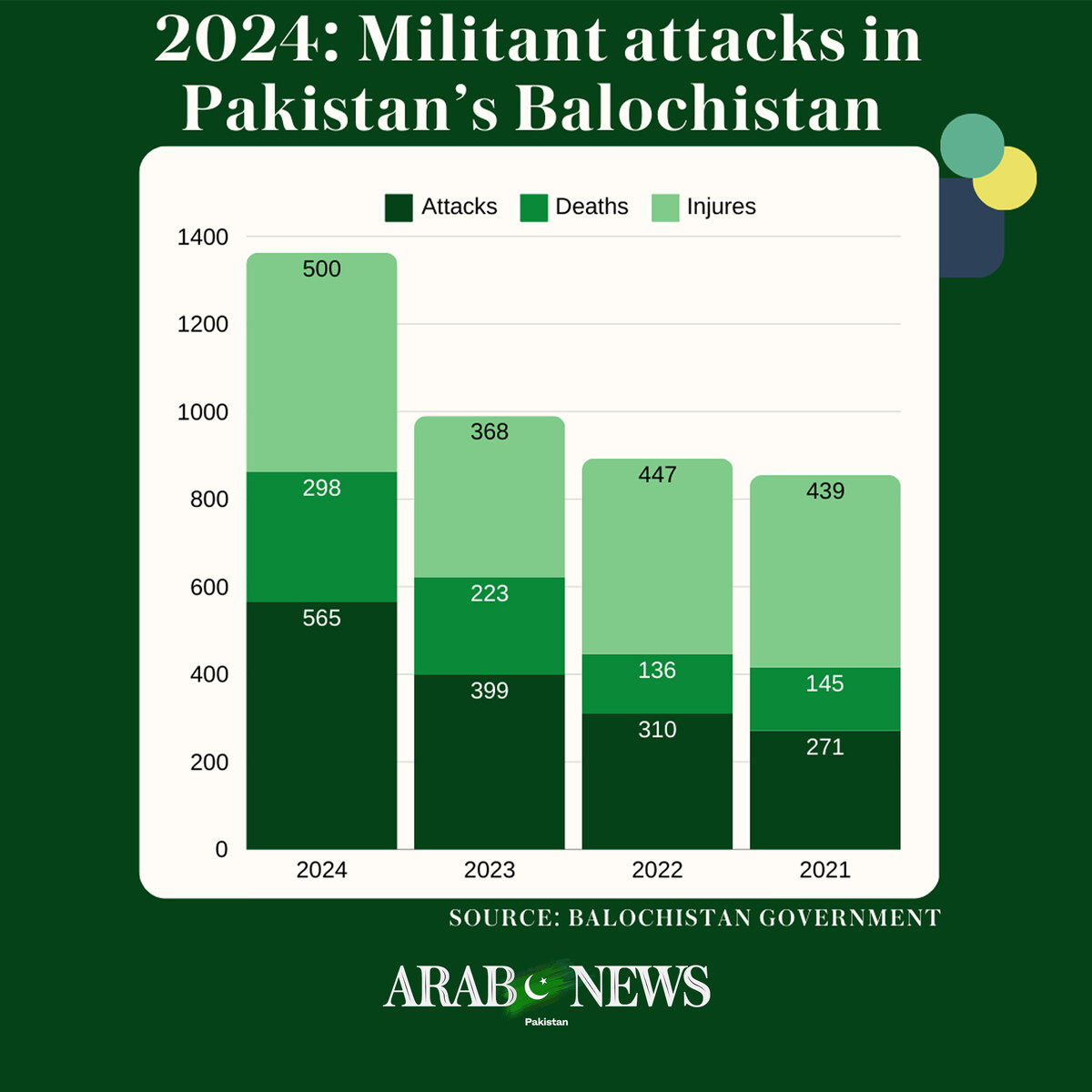
QUETTA: Pakistan’s volatile Balochistan province witnessed a dramatic surge in militant violence in 2024, as government data exclusively obtained by Arab News on Wednesday revealed nearly 300 people, including civilians and soldiers, were killed in over 550 attacks reported across various districts of the province this year.

Most attacks were carried out by Baloch separatist groups, primarily the Balochistan Liberation Army (BLA), which also launched coordinated assaults, including suicide bombings, targeting Pakistani security forces and Chinese nationals in the southern region of the country.

Balochistan, sharing porous borders with Afghanistan to the north and Iran to the west, has experienced a low-level insurgency by Baloch separatist and other armed groups for the last two decades.

These groups accuse Islamabad of exploiting the province’s mineral resources without benefitting its people, claims the government denies, asserting it has initiated several development projects to bring the region on par with other provinces.

“296 people including the civilians and soldiers of Pakistan’s armed forces were killed and more than 500 were injured in 563 attacks reported in Balochistan from January 1st to December 20th, 2024,” the provincial home department’s annual report, exclusively obtained by Arab News, said.
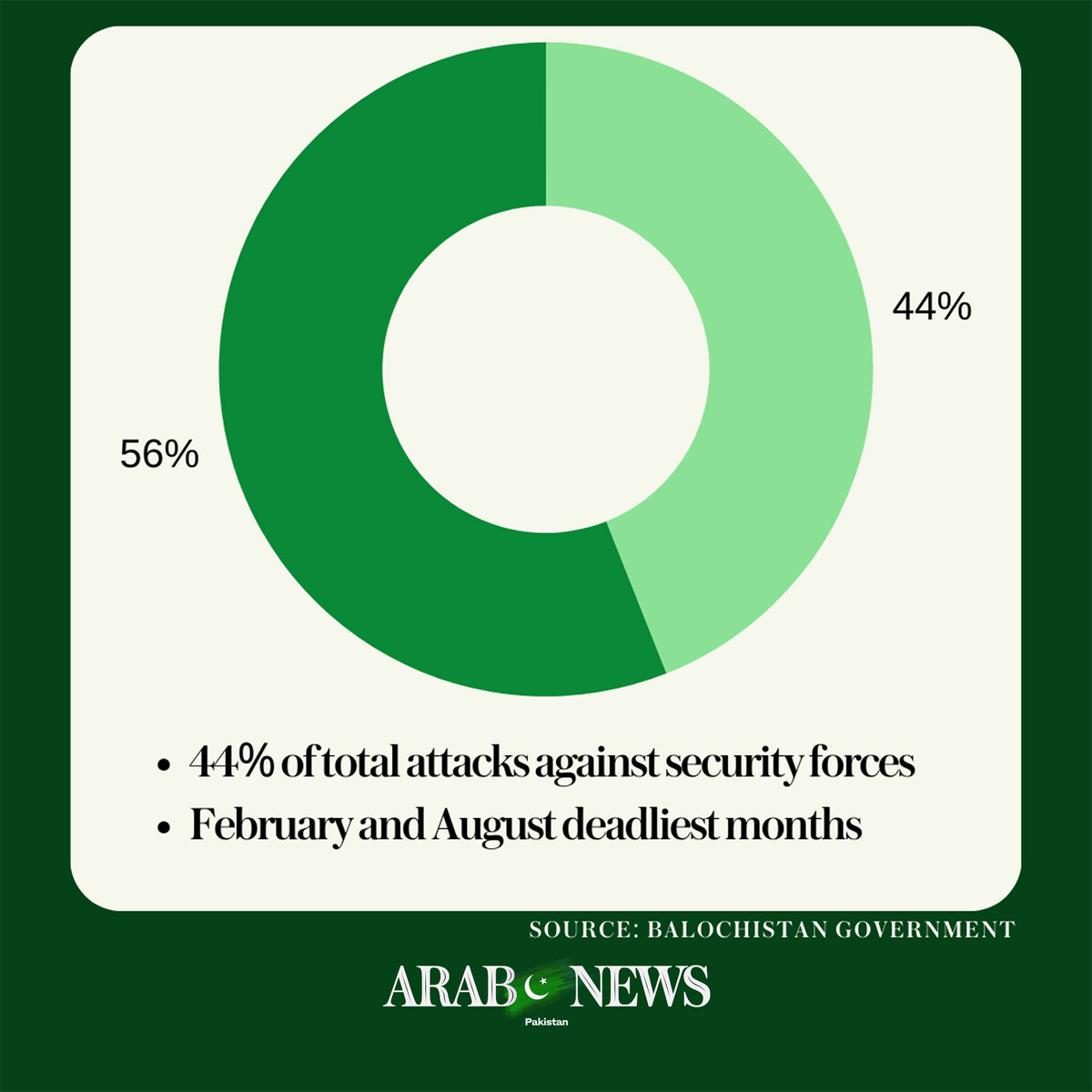
“44 percent of the total attacks were reported against Pakistan’s armed forces operating in Balochistan including the Pakistan Army, Frontier Corps (FC) Balochistan, Police, Levies, and Pakistan Coast Guards, while 81 settlers (people from other provinces) and 37 civilians were killed in dozens of attacks this year,” it added.

The official data revealed that February and August, months when Pakistan held general elections and celebrated its independence, were the deadliest, with 187 attacks of varying nature and scale reported across Balochistan, claiming 119 lives.
Last month, Pakistan announced a “comprehensive military operation” against Baloch separatists and their hideouts in the mountainous region following a deadly suicide bombing at the crowded railway station in Quetta, which killed more than two dozen people, including Pakistan Army soldiers.

Shahid Rind, the provincial spokesperson, confirmed the annual number of attacks and casualties while speaking to Arab News.

“The provincial government has been implementing the decisions made in the federal apex committee meeting in November alongside the objectives of its own provincial action plan to counter this new wave of terrorism in Balochistan,” he said.

“The provincial administration, together with federal and provincial law enforcing agencies, will move as the whole of the government to impart a sense security among the masses, foreign investors and business community,” he continued.

POLITICAL PROCESS

Speaking to Arab News, Abdul Basit, a research fellow at the S. Rajaratnam School of International Studies in Singapore, called 2024 a year of offensive guerrilla warfare from defensive guerrilla warfare by the Baloch militant groups.

“The separatist groups showed a new trend of coordinated attacks and taking over the provincial highways for hours,” he said.

“Balochistan needs a genuine political process for long-term peace because the ethnic Baloch nation has lost trust in the political process,” he continued. “Instead of empowering dummy leadership in Balochistan, the state has to work with genuine leadership that has roots in the masses.”

Safdar Sial, a research analyst at the Pakistan Institute for Peace Studies (PIPS), agreed with him, pointing out that the Pakistani authorities had mainly relied on “kinetic operations” and the frequency of military actions was likely to intensify further.

However, he added that it was important to adopt the political approach to prevent recruitment by the militant organizations.

“Government should take soft and political measures to alienate Baloch insurgents from the Baloch masses,” he said.
Pakistan FM discusses regional situation with Saudi counterpart, urges restraint and dialogue

Updated 5 sec ago
Follow

Pakistan FM discusses regional situation with Saudi counterpart, urges restraint and dialogue

  • This is the second time the two foreign ministers have spoken since the Arab Coalition targeted weapon shipments on Yemen’s Mukalla port
  • Saudi Arabia’s foreign ministry has invited factions in south Yemen to hold a dialogue in Riyadh to ‘discuss just solutions to southern cause’

ISLAMABAD: Pakistan’s foreign minister, Ishaq Dar, discussed the regional situation with his Saudi counterpart, Prince Faisal bin Farhan, and called for restraint and dialogue to resolve issues, the Pakistani foreign office said late Friday, amid tensions prevailing over Yemen.

This is the second time the two foreign ministers have spoken this week since the Saudi Arabia-led Coalition to Support Legitimacy in Yemen carried out a “limited” airstrike on Dec. 30, targeting two shipments of smuggled weapons and military equipment sent from the Emirati port of Fujairah to Mukalla in southern Yemen.

A coalition forces spokesperson said the weapons were meant to support the Southern Transitional Council (STC) forces, backed by the United Arab Emirates (UAE), in Yemen’s Hadramaut and Al-Mahra “with the aim of fueling the conflict.” The UAE has since announced withdrawal of its remaining troops from Yemen, rejecting any actions that could threaten the Kingdom or undermine regional stability.

In their telephonic conversation late Friday, the Pakistani and Saudi foreign ministers discussed the latest situation in the region, according to the Pakistani foreign office.

“FM [Dar] stressed that all concerned in the region must avoid any escalatory move and advised to resolve the issues through dialogue and diplomacy for the sake of regional peace and stability,” it added.

Separately, Saudi Arabia’s foreign ministry invited factions in south Yemen to hold a dialogue in Riyadh to “discuss just solutions to the southern cause.”

The ministry statement said the conference in the Saudi capital had been requested by Rashad Al-Alimi, President of the Yemeni Presidential Leadership Council, and the Kingdom urged all factions to participate “to develop a comprehensive vision” that would fulfill the aspirations of the southern people.

Disregarding previous agreements with the Arab Coalition, the STC separatist group launched a sweeping military campaign early in December, seizing the governorates of Hadramaut along the Saudi border and the eastern governorate of Al-Mahra in Yemen’s border with Oman. It also took control of the strategic PetroMasila oilfields, which account for a massive portion of Yemen’s remaining oil wealth.

The advance has raised the spectre of the return of South Yemen, a separate state from 1967 to 1990, while dealing a hammer-blow to slow-moving peace negotiations with Iran-backed Houthi rebels.

Saudi Arabia said the STC action poses a direct threat to the Kingdom’s national security, and regional stability. The Kingdom has reiterated the only way to bring the southern cause to a resolution is through dialogue.

On Thursday, Pakistan’s foreign office expressed solidarity with Saudi Arabia and reaffirmed Islamabad’s commitment to the Kingdom’s security, amid rising tensions in Yemen.

“Pakistan expresses complete solidarity with the Kingdom of Saudi Arabia and reaffirms its commitment to security of the Kingdom,” Pakistani foreign office spokesperson Tahir Andrabi told reporters at a weekly news briefing.

“Pakistan maintains its firm support for the resolution of Yemen issue through dialogue and diplomacy and hopes that Yemen’s people and regional powers work together toward inclusive and enduring settlement of the issue, safeguarding regional stability.”

Pakistan and Saudi Arabia signed a landmark defense pact in September last year, according to which aggression against one country will be treated as an attack against both. The pact signaled a push by both governments to formalize long-standing military ties into a binding security commitment.