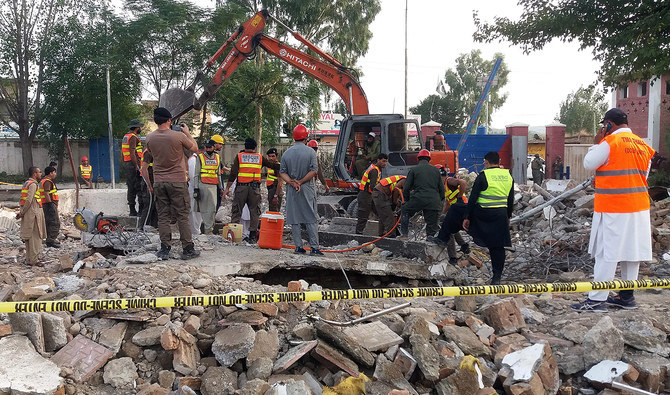
ISLAMABAD: Pakistan witnessed an increase of 17 percent in militants that hit the country in the year 2023, the Pak Institute for Peace Studies (PIPS) reported this week, amid a renewed wave of violence in the South Asian country.
This was the third year in a row when the number of militant attacks and consequent casualties surged in Pakistan, according to the Islamabad-based research and advocacy think-tank.
A total of 306 militant attacks took place in Pakistan in 2023, including 23 suicide bombings, which killed 693 people and injured 1,124 others.
“These attacks marked an increase of 17 percent from the year before, and the number of people killed in these attacks also represented an increase of 65 percent from those killed in similar attacks during the previous year,” the PIPS report read.
“As many as 330 personnel of security forces and law enforcement agencies were martyred in the reported terrorist attacks in 2023 including 26 FC men, 176 policemen, 110 army officials, 11 Levies, five unspecified paramilitary soldiers, and two Rangers; another 518 personnel of security and law enforcement agencies were also injured.”
Similarly, 260 civilians lost their lives and another 559 were wounded in these attacks, according to the PIPS report.
Meanwhile, 103 militants were killed and another 47 were injured, either in suicide blasts they perpetrated, or in security forces’ retaliatory fire following some attacks.
Pakistan saw a sharp rise in militant attacks in its northwestern and southwestern parts that border Afghanistan over the last one year, which particularly increased after the Tehreek-e-Taliban Pakistan (TTP) called off its months-long truce with the government in Islamabad in November 2022.
The militant group, which is said to have sanctuaries in neighboring Afghanistan, is separate from but a close ally of the Afghan Taliban. The surge in violence led Islamabad to order the expulsion of all illegal foreigners, mostly Afghans, in October last year.
PIPS said “religiously inspired” militant groups such as the TTP and Daesh (Islamic State) perpetrated a combined total of 208 attacks in 2023, which killed 579 people and injured 938 others.
“Different Baloch and Sindhi nationalist insurgent groups carried out 86 attacks – as compared to 79 such attacks in 2022 – which claimed 90 lives and wounded another 151 people,” the report read.
“Meanwhile, compared to four in 2022, 12 sectarian-related terrorist attacks were recorded in 2023 that claimed 24 lives and inflicted injuries on another 35 people.”
About 93 percent of all these militant attacks were concentrated in Pakistan’s northwestern Khyber Pakhtunkhwa and southwestern Balochistan provinces.


![]()

Pakistan recorded 17% increase in militant attacks in 2023 — report
Short Url
https://arab.news/gms7z
Pakistan recorded 17% increase in militant attacks in 2023 — report
- A total of 306 militant attacks took place in Pakistan in 2023, including 23 suicide bombings
- These attacks killed 693 people, injured 1,124 others, the Pak Institute for Peace Studies says
Latest updates


© 2026 SAUDI RESEARCH & PUBLISHING COMPANY, All Rights Reserved And subject to Terms of Use Agreement.