Iran’s Pezeshkian says Tehran ready to work with world powers to resolve nuclear standoff

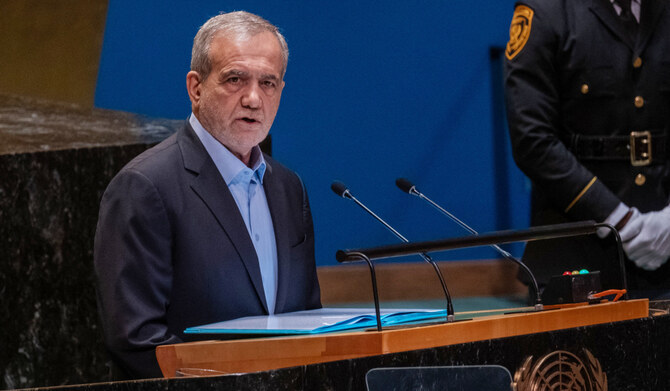
Iranian President Masoud Pezeshkian addresses world leaders during the United Nations General Assembly (UNGA) at the United Nations headquarters on September 24, 2024 in New York City. (AFP)
Short Url
Updated 25 September 2024
Follow

Iran’s Pezeshkian says Tehran ready to work with world powers to resolve nuclear standoff

  • Iran has brokered ongoing secret talks between Russia and Yemen’s Houthi rebels to transfer anti-ship missiles to that militant group, three Western and regional sources said, a development that highlights Tehran’s deepening ties to Moscow

UNITED NATIONS: Iran is ready to end its nuclear standoff with the West, Iranian President Masoud Pezeshkian told the United Nations General Assembly on Tuesday, while calling for an end to Russia’s war in Ukraine through dialogue.
Iran’s clerical establishment hopes to see an easing of US sanctions that have crippled the country’s economy.
Then-President Donald Trump abandoned Tehran’s 2015 nuclear pact with six world powers in 2018 and reimposed tough sanctions on Iran. Efforts to revive the pact have failed.
Tehran’s relations with the West have worsened since the Iranian-backed Hamas militant group attacked southern Israel on Oct. 7 and as Tehran has increased its support for Russia’s war in Ukraine.
Pezeshkian, a relatively moderate politician who took office in August promising a pragmatic foreign policy, criticized Iran’s arch-foe Israel for what he called “its genocide in Gaza.”
“It is imperative that the international community should immediately ... secure a permanent ceasefire in Gaza and bring an end to the desperate barbarism of Israel in Lebanon, before it engulfs the region and the world,” he said.
An Israeli airstrike on Beirut killed a senior commander of the Iranian-backed Hezbollah militant group in Lebanon on Tuesday as cross-border rocket attacks by both sides increased fears of a full-fledged war.
“We seek peace for all and have no intention of conflict with any country ... Iran opposes war and emphasizes the need for an immediate cessation of military conflict in Ukraine,” Pezeshkian said.
Russia has cultivated closer ties with Iran since the start of its war with Ukraine and has said it is preparing to sign a wide-ranging cooperation agreement with the Islamic state.
Iran has brokered ongoing secret talks between Russia and Yemen’s Houthi rebels to transfer anti-ship missiles to that militant group, three Western and regional sources said, a development that highlights Tehran’s deepening ties to Moscow.


Famed Jerusalem stone still sells despite economic woes

Updated 7 sec ago
Follow

Famed Jerusalem stone still sells despite economic woes

  • Quarries account for 4.5% of Palestinian GDP and employ nearly 20,000 workers
  • Palestinian Authority, which exercises partial civilian control over some of the West Bank, is on the brink of bankruptcy

SAIR, West Bank: Despite the catastrophic state of the Palestinian economy, Faraj Al-Atrash, operator of a quarry in the occupied West Bank, proudly points to an armada of machines busy eating away at sheer walls of dusty white rock that stretch into the distance.

“This here is considered the main source of revenue for the entire region,” Atrash said at the site near the town of Beit Fajjar, close to the city of Hebron.
The quarry is a source of Jerusalem stone, the famed pale rock used throughout the Holy Land and beyond for millennia and which gives much of the region its distinctive architectural look. But Atrash, in his fifties, said “our livelihood is constantly under threat.”
“Lately, I feel like the occupation (Israel) has begun to fight us on the economic front,” he said.
Atrash fears the confiscation of the quarry’s industrial equipment, the expansion of Israeli settlements and the Palestinian financial crisis.
The Palestinian territories are “currently going through the most severe economic crisis ever recorded,” according to a UN report.
“There are problems with exports and market access because we used to export most of the stone to Israel, and after the Gaza war begun, we ran into difficulties,” explained Ibrahim Jaradat, whose family has owned a quarry for more than 40 years near Sair, also near Hebron.
Public services are functioning worse than ever, Atrash said, adding that fixed costs such as water and electricity had soared.
Quarries account for 4.5 percent of Palestinian GDP and employ nearly 20,000 workers, according to the Hebron Chamber of Commerce.
Around 65 percent of exports are destined for the Israeli market, where some municipalities mandate the use of Jerusalem stone. “The people who buy the stones from us to resell them to construction sites are mostly Israelis,” said Abu Walid Riyad Gaith, a 65-year-old quarry operator. He lamented a lack of solidarity from Arab countries, which he said do not buy enough of the rock.
Most of the roughly 300 quarries in the West Bank are located in Area C, land which falls under full Israeli authority and covers the vast majority of its settlements.
“Many (Israeli) settlers pass through here, and if Israel annexes Palestine, it will start with these areas,” said one operator.
The physical demands of working in a quarry are intense, but for many Palestinians there are few other options as the West Bank’s economy wilts.
“We are working ourselves to death,” Atrash said, pointing to his ten laborers moving back and forth in monumental pits where clouds of dust coat them in a white film.
In the neighboring quarry, blinking and coughing as he struggled with the intense work was a former geography teacher.
With the Palestinian Authority’s budget crisis meaning he was no longer receiving his salary, he had looked for work in the only local place still hiring.
All the laborers said they suffered from back, eye and throat problems. “We call it white gold,” said Laith Derriyeh, employed by a stonemason, “because it normally brings in substantial amounts of money. But today everything is complicated; it’s very difficult to think about the future.”
He added: “People have no money, and those who do are afraid to build,” he added.