UNITED NATIONS: The UN chief warned world leaders on Tuesday that Lebanon was on “the brink” as clashes escalated between Israel and Hezbollah, ahead of US President Joe Biden’s final appearance at the global body’s signature annual event.
The gathering of dozens of world leaders, the high point of the diplomatic calendar, comes as Lebanese authorities say Israeli strikes killed 558 people — 50 of them children.
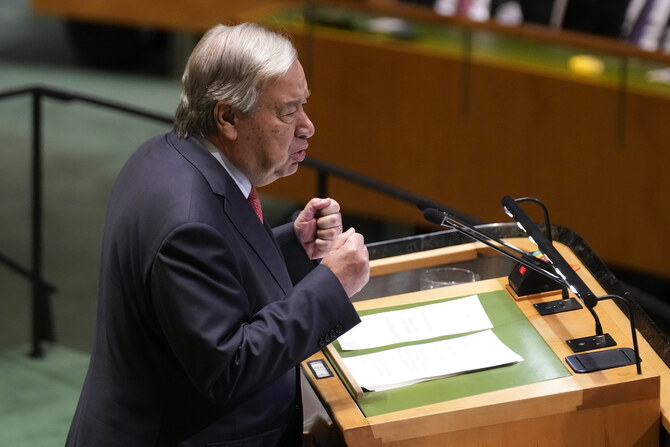
“We should all be alarmed by the escalation. Lebanon is at the brink,” UN Secretary-General Antonio Guterres said.
The annual flurry of speeches and face-to-face diplomacy kicked off as Lebanon’s Prime Minister Najib Mikati headed to New York after UN Security Council member France called for an emergency meeting on the crisis.
As the toll in Lebanon climbed and focus shifted away from the situation in Gaza, Iran’s President Masoud Pezeshkian condemned “senseless and incomprehensible” inaction by the UN against Israel.
The EU’s top diplomat Josep Borrell warned “we are almost in a full-fledged war.”
The United States, Israel’s closest ally, again warned against a full-blown ground invasion of Lebanon, with a senior US official promising to bring “concrete” ideas for de-escalation to the UN this week.
It is unclear what progress can be made to defuse the situation in Lebanon as efforts to broker a ceasefire in Gaza, which Israel has relentlessly pounded since October 2023, have come to nothing.
Guterres cautioned against “the possibility of transforming Lebanon (into) another Gaza,” calling the situation in the embattled Palestinian territory a “non-stop nightmare.”
Israel’s ambassador to the UN, Danny Danon hit back at the UN chief, calling the General Assembly debate an “annual charade of hypocrisy.”
“When the UN Secretary General speaks about the release of our hostages, the UN assembly is silent, but when he speaks about the suffering in Gaza, he receives thunderous applause,” Danon said.
Since last year’s annual gathering, when Sudan’s civil war and Russia’s Ukraine invasion dominated, the world has faced an explosion of crises.
The October 7 attack by Palestinian Islamist group Hamas on Israel and the ensuing violence in the Middle East has exposed deep divisions in the global body.
Richard Gowan of the International Crisis Group think tank said he expected many leaders to “warn that the UN will become irrelevant globally if it cannot help make peace.”
With Israel’s leader Benjamin Netanyahu and Palestinian president Mahmud Abbas expected to address the General Assembly this week, there could be combustible moments.
Abbas took his seat alongside the Palestinian delegation in alphabetical order for the first time after the delegation received upgraded privileges in the assembly in May.
On Tuesday, representatives of Turkiye, Jordan, Qatar, Iran and Algeria are slated to take the podium to press for a Gaza ceasefire after nearly one year of war.
“The level of impunity in the world is politically indefensible and morally intolerable,” Guterres said in his speech to the General Assembly, adding that “a growing number of governments and others feel entitled to a ‘get out of jail free’ card.”
Ukraine will also be on the agenda Tuesday when President Volodymyr Zelensky addresses a UN Security Council meeting on Russia’s war on Ukraine.
“I invite all leaders and nations to continue supporting our joint efforts for a just and peaceful future,” Zelensky told the UN on Monday.
“Putin has stolen much already, but he will never steal the world’s future.”
It is unclear if the grand diplomatic gathering can achieve anything for the millions mired in conflict, poverty and climate crisis globally.
“Any real diplomacy to reduce tensions will take place behind the scenes,” Gowan said.
“This may be an opportunity for Western and Arab diplomats to have some quiet conversations with the Iranians about the need to stop the regional situation spinning out of control.”
Iraqi Prime Minister Mohammed Shia Al-Sudani has called for an urgent meeting of Arab leaders on the sidelines of the UN General Assembly over the crisis in Lebanon.


![]()

UN chief warns Lebanon on ‘brink’ as world leaders gather
Short Url
https://arab.news/rzjrq
UN chief warns Lebanon on ‘brink’ as world leaders gather
- “We should all be alarmed by the escalation. Lebanon is at the brink,” UN Secretary-General Antonio Guterres said
- Annual flurry of speeches kicked off as Lebanon’s PM Mikati headed to New York after UNSC France called for an emergency meeting on the crisis


Latest updates



© 2026 SAUDI RESEARCH & PUBLISHING COMPANY, All Rights Reserved And subject to Terms of Use Agreement.