

ACWA Power signs deal for major green hydrogen project in Tunisia

1 / 4
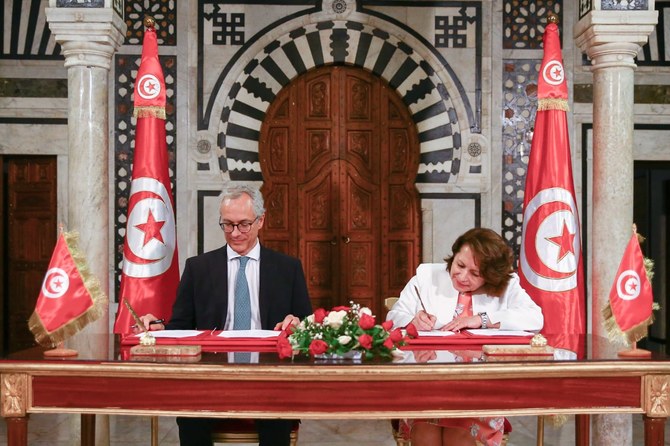
The memorandum of understanding was signed by Fatma Thabet Chiboub, Tunisia’s minister of industry, mines and energy, and Marco Arcelli, CEO of ACWA Power. (Supplied)
2 / 4
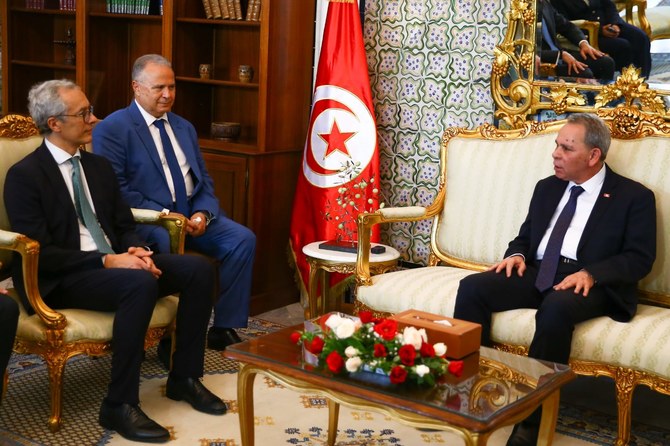
The memorandum of understanding was signed by Fatma Thabet Chiboub, Tunisia’s minister of industry, mines and energy, and Marco Arcelli, CEO of ACWA Power. (Supplied)
3 / 4
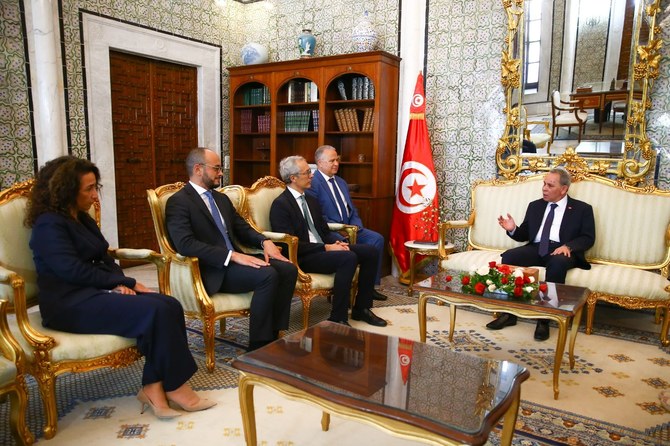
The memorandum of understanding was signed by Fatma Thabet Chiboub, Tunisia’s minister of industry, mines and energy, and Marco Arcelli, CEO of ACWA Power. (Supplied)
4 / 4
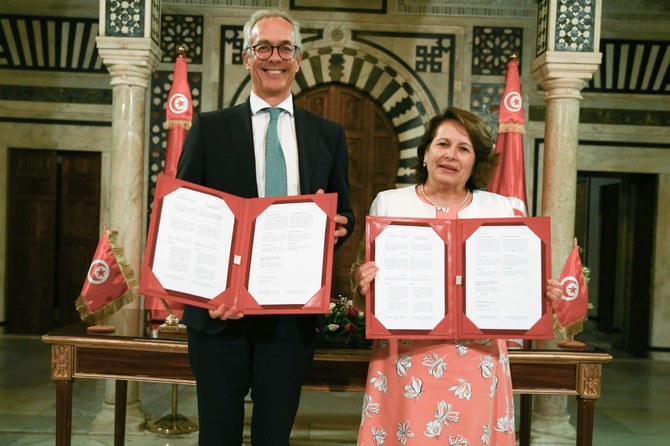
The memorandum of understanding was signed by Fatma Thabet Chiboub, Tunisia’s minister of industry, mines and energy, and Marco Arcelli, CEO of ACWA Power. (Supplied)
Short Url
Updated 02 June 2024
Follow

ACWA Power signs deal for major green hydrogen project in Tunisia

  • Saudi-listed company plans first phase with capacity of 200,000 tons per year powered by 4GW of renewable energy
  • Tunisia envisioned as major site for green hydrogen production and export to Europe

TUNIS: Saudi-listed ACWA Power, the world’s largest private water desalination company and a leader in energy transition, has signed an agreement with the Tunisian government for a project that will produce up to 600,000 tons per year of green hydrogen in three phases, for export to Europe.

The memorandum of understanding was signed by Fatma Thabet Chiboub, Tunisia’s minister of industry, mines and energy, and Marco Arcelli, CEO of ACWA Power.

ACWA Power will develop, operate and maintain 12GW of renewable energy electricity generation units including storage systems and transmission lines, along with water desalination plant, electrolyzers and infrastructures to connect to the main pipeline.

The first phase will involve installing 4GW of renewable energy units, 2GW of electrolyzer capacity, as well as battery storage facilities, to produce 200,000 tons per year of green hydrogen, which will be exported through the South2 Corridor, a hydrogen pipeline initiative led by European TSOs connecting Tunisia to Italy, Austria and Germany.

Commenting on the announcement, Ouael Chouchene, secretary of state for energy transition, said: “This project aligns perfectly with the Tunisian government’s national green hydrogen strategy released in October 2023, which targets an annual production of 8.3 million tons of green hydrogen and byproducts by 2050. We are confident that this agreement with ACWA Power will leverage Tunisia’s strengths, including its strategic geographic location, existing infrastructure, and skilled workforce, to create a more sustainable future for the country.”

The project will play an integral role in supporting Tunisia’s National Strategy for the Development of Green Hydrogen and its Derivatives, which was launched in October 2023. The strategy includes an action plan to export more than 6 million tons of green hydrogen to Europe by 2050.

“We are excited to work with the Tunisian government on this visionary project, bringing our expertise in renewables, desalination and green hydrogen to build a bridge with Europe to help reach its decarbonization targets. This project can also contribute significantly to economic growth, job creation, and sustainable energy solutions, exemplifying our shared vision for a greener future,” Arcelli said.

The agreement highlights ACWA Power’s ambition to rapidly expand its green hydrogen portfolio. Construction is well underway at the NEOM Green Hydrogen Project, a joint venture between ACWA Power, Air Products, and NEOM, to create the world’s first utility-scale green hydrogen plant, capable of producing 1.2 million tons of green ammonia per year.

Work is also underway on ACWA Power’s second green hydrogen project, in Uzbekistan. The first phase of this project will be capable of producing 3,000 tons of green hydrogen per year.


Fitch maintains neutral outlook on GCC corporates 

Updated 12 sec ago
Follow

Fitch maintains neutral outlook on GCC corporates 

RIYADH: Gulf Cooperation Council corporates are expected to see largely stable conditions in 2026 as government-led investment supports earnings, offsetting pressure from lower oil prices and tighter funding conditions, according to a new analysis.

In a report published this week, Fitch Ratings said sustained public-sector capital expenditure — particularly in infrastructure and energy — will continue to underpin regional corporate performance, even as lower oil-price assumptions are likely to constrain public- and private-sector budgets. 

This comes as GCC economies are forecast to grow 4.4 percent in 2026 and 4.6 percent in 2027, driven by stronger non-hydrocarbon activity and rising hydrocarbon output, the World Bank said. 

In its Global Economic Prospects report released earlier this month, the World Bank said non-oil sectors, which account for more than 60 percent of GCC GDP, are expected to be supported by large-scale investment across the region. 

Samer Haydar, Fitch’s head of GCC corporates, said: “We expect sustained public-sector capex to support steady earnings for GCC Corporates in 2026, especially in infrastructure and energy, even as lower oil price assumptions constrain fiscal flexibility.” 

He added: “Sub-investment-grade credits will face low leverage headroom and increased interest-rate sensitivities.” 

Fitch expects non-energy sectors to keep benefiting from state-backed investment programs — especially in Saudi Arabia and the UAE — while projecting GCC non-oil GDP growth of 3.7 percent in 2026, a moderation from 4.2 percent previously. 

The agency also said regulatory reforms tied to diversification are supporting initial public offering activity, with a “robust” pipeline into 2026 supported by policy measures and deep local markets. 

Credit profiles remain largely stable, with Fitch noting that about 95 percent of rated GCC issuers carry Stable Outlooks, and eight upgrades were recorded during 2025, partly linked to sovereign rating actions. 

Ratings across Fitch’s GCC corporate universe span from “AA” to “B”, with government-related entities tending to be larger; Fitch said GREs represented about half of its rated GCC corporates in 2025. 

On balance-sheet metrics, Fitch expects leverage to be modestly higher in 2026, with average leverage at 2.4 times before easing to 2.3x in 2027. 

While strong 2025 earnings provided headroom for sectors including oil and gas, real estate, utilities and telecoms, the agency said industrials, retail and homebuilders typically operate with tighter leverage capacity, leaving less cushion amid still-elevated input and operating costs. 

Funding conditions are expected to remain a key differentiator, Fitch said, adding that GCC issuers pushed their “maturity wall” out to 2028, helped by 2025 bond and sukuk issuance — particularly from UAE and Saudi Arabia-based issuers refinancing maturities early. 

The agency estimates aggregate corporate fixed-income maturities for UAE and Saudi Arabia-based entities at about $50 billion over the next five years, and said persistently higher funding costs are likely to weigh more on high-yield issuers with sizable near-term maturities than on investment-grade peers. 

Fitch also flagged rising capex as a near-term cash-flow constraint. It expects capex intensity to increase in 2026, keeping free cash flow subdued for most GCC corporates, after negative free cash flow peaked in 2025 due to the timing and scale of investment programs. 

Highly rated issuers are increasingly using asset-light approaches — such as joint ventures — to reduce upfront spending, while others may rely on hybrid instruments, equity increases, or asset disposals to manage funding pressures. 

Macro assumptions remain closely tied to the oil backdrop. Fitch forecasts Brent crude will average $63 per barrel in 2026, down from $70 per barrel in 2025, as supply growth — particularly from the Americas — outpaces demand. 

Prices are expected to remain above fiscal breakevens for most GCC producers, though Fitch highlighted exceptions including Bahrain and Saudi Arabia, with Oman only marginally below breakeven. 

Across sectors, Fitch expects GCC property earnings to be underpinned by regional economic expansion and projected average occupancy above 90 percent in 2026, broadly in line with 2025. 

It also pointed to a new Saudi regulatory provision freezing annual rent increases for five years across residential, commercial, and land leases, which it expects to limit landlords’ ability to pass on base rent increases. 

For homebuilders, Fitch expects higher working-capital needs as pre-sales payment plans in prime Dubai locations ease toward 50 percent in 2026 from a peak of 70 percent, while projecting earnings before interest, taxes, depreciation, and amortization margins around 26.8 percent for most UAE-based homebuilders and gross leverage averaging about 2 times. 

Fitch highlighted three key risks to monitor in 2026: potential regional escalation around the Red Sea that could disrupt supply chains and raw material costs; a widening scope of rescaling mega projects in Saudi Arabia; and funding costs staying higher than expected, which could curb access to debt capital markets for non-GRE issuers.