

Fitch maintains neutral outlook on GCC corporates 

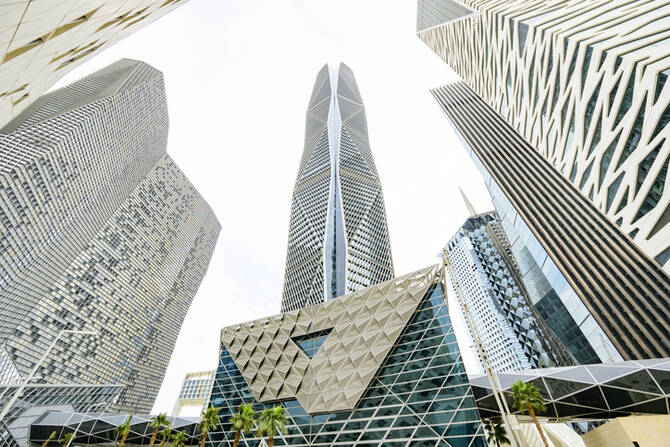
Skyscrapers and corporate business headquarters in King Abdullah Financial District in Riyadh. Getty
Short Url
Updated 29 January 2026
Follow

Fitch maintains neutral outlook on GCC corporates 

RIYADH: Gulf Cooperation Council corporates are expected to see largely stable conditions in 2026 as government-led investment supports earnings, offsetting pressure from lower oil prices and tighter funding conditions, according to a new analysis.

In a report published this week, Fitch Ratings said sustained public-sector capital expenditure — particularly in infrastructure and energy — will continue to underpin regional corporate performance, even as lower oil-price assumptions are likely to constrain public- and private-sector budgets. 

This comes as GCC economies are forecast to grow 4.4 percent in 2026 and 4.6 percent in 2027, driven by stronger non-hydrocarbon activity and rising hydrocarbon output, the World Bank said. 

In its Global Economic Prospects report released earlier this month, the World Bank said non-oil sectors, which account for more than 60 percent of GCC GDP, are expected to be supported by large-scale investment across the region. 

Samer Haydar, Fitch’s head of GCC corporates, said: “We expect sustained public-sector capex to support steady earnings for GCC Corporates in 2026, especially in infrastructure and energy, even as lower oil price assumptions constrain fiscal flexibility.” 

He added: “Sub-investment-grade credits will face low leverage headroom and increased interest-rate sensitivities.” 

Fitch expects non-energy sectors to keep benefiting from state-backed investment programs — especially in Saudi Arabia and the UAE — while projecting GCC non-oil GDP growth of 3.7 percent in 2026, a moderation from 4.2 percent previously. 

The agency also said regulatory reforms tied to diversification are supporting initial public offering activity, with a “robust” pipeline into 2026 supported by policy measures and deep local markets. 

Credit profiles remain largely stable, with Fitch noting that about 95 percent of rated GCC issuers carry Stable Outlooks, and eight upgrades were recorded during 2025, partly linked to sovereign rating actions. 

Ratings across Fitch’s GCC corporate universe span from “AA” to “B”, with government-related entities tending to be larger; Fitch said GREs represented about half of its rated GCC corporates in 2025. 

On balance-sheet metrics, Fitch expects leverage to be modestly higher in 2026, with average leverage at 2.4 times before easing to 2.3x in 2027. 

While strong 2025 earnings provided headroom for sectors including oil and gas, real estate, utilities and telecoms, the agency said industrials, retail and homebuilders typically operate with tighter leverage capacity, leaving less cushion amid still-elevated input and operating costs. 

Funding conditions are expected to remain a key differentiator, Fitch said, adding that GCC issuers pushed their “maturity wall” out to 2028, helped by 2025 bond and sukuk issuance — particularly from UAE and Saudi Arabia-based issuers refinancing maturities early. 

The agency estimates aggregate corporate fixed-income maturities for UAE and Saudi Arabia-based entities at about $50 billion over the next five years, and said persistently higher funding costs are likely to weigh more on high-yield issuers with sizable near-term maturities than on investment-grade peers. 

Fitch also flagged rising capex as a near-term cash-flow constraint. It expects capex intensity to increase in 2026, keeping free cash flow subdued for most GCC corporates, after negative free cash flow peaked in 2025 due to the timing and scale of investment programs. 

Highly rated issuers are increasingly using asset-light approaches — such as joint ventures — to reduce upfront spending, while others may rely on hybrid instruments, equity increases, or asset disposals to manage funding pressures. 

Macro assumptions remain closely tied to the oil backdrop. Fitch forecasts Brent crude will average $63 per barrel in 2026, down from $70 per barrel in 2025, as supply growth — particularly from the Americas — outpaces demand. 

Prices are expected to remain above fiscal breakevens for most GCC producers, though Fitch highlighted exceptions including Bahrain and Saudi Arabia, with Oman only marginally below breakeven. 

Across sectors, Fitch expects GCC property earnings to be underpinned by regional economic expansion and projected average occupancy above 90 percent in 2026, broadly in line with 2025. 

It also pointed to a new Saudi regulatory provision freezing annual rent increases for five years across residential, commercial, and land leases, which it expects to limit landlords’ ability to pass on base rent increases. 

For homebuilders, Fitch expects higher working-capital needs as pre-sales payment plans in prime Dubai locations ease toward 50 percent in 2026 from a peak of 70 percent, while projecting earnings before interest, taxes, depreciation, and amortization margins around 26.8 percent for most UAE-based homebuilders and gross leverage averaging about 2 times. 

Fitch highlighted three key risks to monitor in 2026: potential regional escalation around the Red Sea that could disrupt supply chains and raw material costs; a widening scope of rescaling mega projects in Saudi Arabia; and funding costs staying higher than expected, which could curb access to debt capital markets for non-GRE issuers. 


AI will never replace human creativity, says SRMG CEO 

Updated 30 January 2026
Follow

AI will never replace human creativity, says SRMG CEO 

  • Speaking to Maya Hojeij, senior business anchor at Asharq with Bloomberg, Jomana R. Alrashid expressed pride in SRMG platforms that had absorbed and adopted AI

RIYADH: Jomana R. Alrashid, CEO of Saudi Research and Media Group, highlighted how AI cannot replace human creativity during a session at The Family Office’s “Investing Is a Sea” summit at Shura Island on Friday. 

“You can never replace human creativity. Journalism at the end of the day, and content creation, is all about storytelling, and that’s a creative role that AI does not have the power to do just yet,” Alrashid told the investment summit. 

“We will never eliminate that human role which comes in to actually tell that story, do the actual investigative reporting around it, make sure to be able to also tell you what’s news or what’s factual from what’s wrong ... what’s a misinformation from bias, and that’s the bigger role that the editorial player does in the newsroom.”

Speaking on the topic of AI, moderated by Maya Hojeij, senior business anchor at Asharq with Bloomberg, the CEO expressed her pride in SRMG platforms that had absorbed and adopted AI in a way that was “transformative.”

“We are now translating all of our content leveraging AI. We are also now being able to create documentaries leveraging AI. We now have AI-facilitated fact-checking, AI facilities clipping, transcribing. This is what we believe is the future.”

Alrashid was asked what the journalist of the future would look like. “He’s a journalist and an engineer. He’s someone who needs to understand data. And I think this is another topic that is extremely important, understanding the data that you’re working with,” she said.

“This is something that AI has facilitated as well. I must say that over the past 20 years in the region, especially when it comes to media companies, we did not understand the importance of data.”


The CEO highlighted that previously, media would rely on polling, surveys or viewership numbers, but now more detailed information about what viewers wanted was available. 

During the fireside session, Alrashid was asked how the international community viewed the Middle Eastern media. Alrashid said that over the past decades it had played a critical role in informing wider audiences about issues that were extremely complex — politically, culturally and economically — and continued to play that role. 

“Right now it has a bigger role to play, given the role again of social media, citizen journalists, content creators. But I also do believe that it has been facilitated by the power that AI has. Now immediately, you can ensure that that kind of content that is being created by credible, tier-A journalists, world-class journalists, can travel beyond its borders, can travel instantly to target different geographies, different people, different countries, in different languages, in different formats.”

She said that there was a big opportunity for Arab media not to be limited to simply Arab consumption, but to finally transcend borders and be available in different languages and to cater to their audiences. 


The CEO expressed optimism about the future, emphasizing the importance of having a clear vision, a strong strategy, and full team alignment. 

Traditional advertising models, once centered on television and print, were rapidly changing, with social media platforms now dominating advertising revenue.

“It’s drastically changing. Ultimately in the past, we used to compete with one another over viewership. But now we’re also competing with the likes of social media platforms; 80 percent of the advertising revenue in the Middle East goes to the social media platforms, but that means that there’s 80 percent interest opportunities.” 

She said that the challenge was to create the right content on these platforms that engaged the target audiences and enabled commercial partnerships. “I don’t think this is a secret, but brands do not like to advertise with news channels. Ultimately, it’s always related with either conflict or war, which is a deterrent to advertisers. 

“And that’s why we’ve entered new verticals such as sports. And that’s why we also double down on our lifestyle vertical. Ultimately, we have the largest market share when it comes to lifestyle ... And we’ve launched new platforms such as Billboard Arabia that gives us an entry into music.” 

Alrashid said this was why the group was in a strong position to counter the decline in advertising revenues across different platforms, and by introducing new products.

“Another very important IP that we’ve created is events attached to the brands that have been operating in the region for 30-plus years. Any IP or any title right now that doesn’t have an event attached to it is missing out on a very big commercial opportunity that allows us to sit in a room, exchange ideas, talk to one another, get to know one another behind the screen.” 

The CEO said that disruption was now constant and often self-driving, adding that the future of the industry was often in storytelling and the ability to innovate by creating persuasive content that connected directly with the audience. 

“But the next disruption is going to continue to come from AI. And how quickly this tool and this very powerful technology evolves. And whether we are in a position to cope with it, adapt to it, and absorb it fully or not.”