


Tornadoes pummel US Midwest, killing at least 5 in Iowa

1 / 2
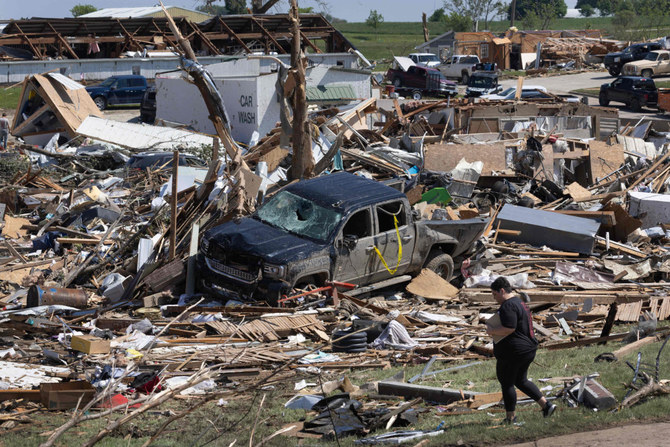
Residents and first responders go through the damage after a tornado tore through town yesterday afternoon on May 22, 2024 in Greenfield, Iowa. (Getty Images/AFP)
2 / 2
An American flag is seen as residents go through the damage after a tornado tore through town yesterday afternoon on May 22, 2024 in Greenfield, Iowa. (Getty Images/AFP)
Short Url
Updated 23 May 2024
Follow

Tornadoes pummel US Midwest, killing at least 5 in Iowa

  • The storms also knocked out power to tens of thousands of people in Illinois and Wisconsin, officials said
  • The tornadoes came at a time when climate change is heightening the severity of storms around the world

GREENFIELD, Iowa: Five people died and at least 35 were hurt as powerful tornadoes ripped through Iowa, with one carving a path of destruction through the small city of Greenfield, officials said Wednesday.

The Iowa Department of Public Safety said Tuesday’s tornadoes killed four people in the Greenfield area, and local officials said a fifth person — a woman whose car was swept away in the wind — was killed by a twister about 25 miles (40 kilometers) away. Officials did not release the names of the victims because they were still notifying relatives.
The Iowa Department of Public Safety said Wednesday it’s believed that the number of people injured is likely higher.
The Greenfield tornado left a wide swath of obliterated homes, splintered trees and crumpled cars in the town of 2,000 about 55 miles (88.5 kilometers) southwest of Des Moines. The twister also ripped apart and crumpled massive power-producing wind turbines several miles outside the city.


A wind turbine lies toppled in the aftermath of tornadoes which ripped through the area yesterday on May 22, 2024 near Prescott, Iowa. (Getty Images/AFP)

Greenfield resident Kimberly Ergish, 33, and her husband dug through the debris field Wednesday that used to be their home, looking for family photos and other salvageable items. There wasn’t much left, she acknowledged.
“Most of it we can’t save,” she said. “But we’re going to get what we can.”
The reality of having her house destroyed in seconds hasn’t really set in, she said.
“If it weren’t for all the bumps and bruises and the achy bones, I would think that it didn’t happen,” she said.
Tuesday’s storms also pummeled parts of Illinois and Wisconsin, knocking out power to tens of thousands of customers in the two states. The severe weather turned south on Wednesday, and the National Weather Service was issuing tornado and flash flood warnings in Texas as parts of the state — including Dallas — were under a tornado watch.
The National Weather Service said initial surveys indicated at least an EF-3 tornado in Greenfield, but additional damage assessment could lead to a more powerful ranking.
The tornado appeared to have been on the ground for more than 40 miles (64 kilometers), AccuWeather Chief Meteorologist Jon Porter said. A satellite photo taken by a BlackSky Technology shows where the twister gouged a nearly straight path of destruction through the town, just south of Greenfield’s center square.
The deadly twister was spawned during a historically bad season for tornadoes in the US, at a time when climate change is heightening the severity of storms around the world. April had the second-highest number of tornadoes on record in the country.
Through Tuesday, there have been 859 confirmed tornadoes this year, 27 percent more than the US sees on average, according to NOAA’s Storm Prediction Center in Norman, Oklahoma. So far, Iowa’s had the most, with 81 confirmed twisters.
On Tuesday alone, the National Weather Service said it received 23 tornado reports, with most in Iowa and one each in Wisconsin and Minnesota.
The tornado that decimated parts of Greenfield brought to life the worst case scenario in Iowa that weather forecasters had feared, Porter said.
“Debris was lifted thousands of feet in the air and ended up falling to the ground several counties away from Greenfield. That’s evidence of just how intense and deadly this tornado was,” Porter said.
People as far as 100 miles (160 kilometers) away from Greenfield posted photos on Facebook of ripped family photos, yearbook pages and other items that were lifted into the sky by the tornado.
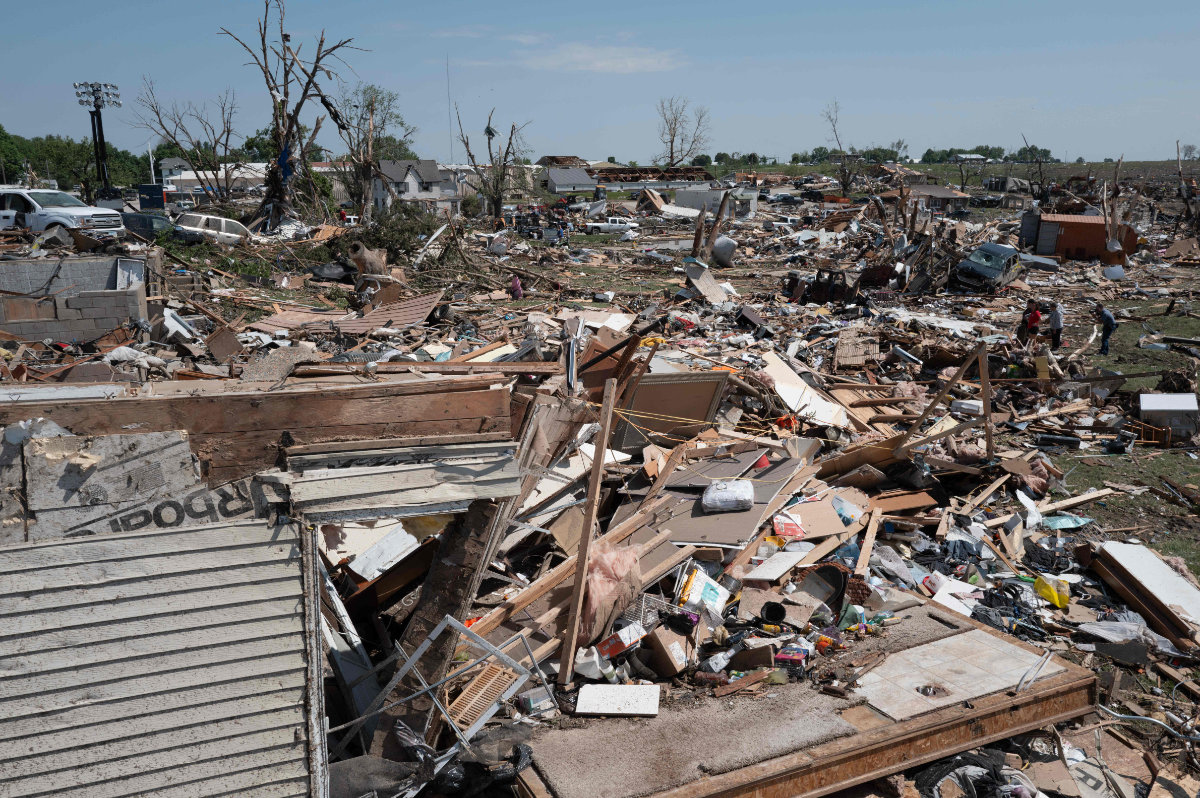


Residents go through the damage after a tornado tore through town yesterday afternoon on May 22, 2024 in Greenfield, Iowa. (Getty Images/AFP)

About 90 miles away, in Ames, Iowa, Nicole Banner found a yellowed page declaring “This Book is the Property of the Greenfield Community School District” stuck to her garage door like a Post-It note after the storm passed.
“We just couldn’t believe it had traveled that far,” she said.
White House Press Secretary Karine Jean-Pierre said FEMA’s administrator would head to Iowa on Thursday and that the White House was in touch with state and local officials. She said they were “praying for those who tragically lost their lives” and wished those injured a “speedy recovery.”
Greenfield’s 25-bed hospital was among the buildings damaged, and at least a dozen people who were hurt had to be taken to facilities elsewhere. Hospital officials said in a Facebook post Wednesday that the hospital will remain closed until it can be further assessed and that full repairs could take weeks or months. The hospital, with the help of other providers, set up an urgent care clinic at an elementary school with primary care services to start there Thursday, the post said.
Residential streets that on Monday were lined with old-growth trees and neatly-appointed ranch-style homes were a chaotic jumble of splintered and smashed remnants by Wednesday. Many of the homes’ basements where residents sheltered lay exposed and front yards were littered with belongings from furniture to children’s toys and Christmas decorations.
Dwight Lahey, a 70-year-old retired truck driver, drove from suburban Des Moines to Greenfield to help his 98-year-old mother. She had taken refuge from the twister in her basement, then walked out through her destroyed garage to a nearby convenience store, Lahey said.
“I don’t know how she got through that mess,” he said. His mom was staying in a hotel, uncertain about where she’ll end up with her home gone, he said.
Roseann Freeland, 67, waited until the last minute to rush with her husband to a concrete room in her basement. Seconds later, her husband opened the door “and you could just see daylight,” Freeland said. “I just lost it. I just totally lost it.”
Tuesday’s destructive weather also saw flooding and power outages in Nebraska, damage from tornadoes in Wisconsin and Minnesota, and dust storms in Illinois that forced two interstates to be closed.
The devastation in Iowa followed days of extreme weather that ravaged much of the middle section of the country, including Oklahoma and Kansas. Last week, deadly storms hit the Houston area, killing at least eight and knocking out power to hundreds of thousands.


Cypriot fishermen battle invasive lionfish and turn them into a tavern delicacy

Updated 7 sec ago
Follow

Cypriot fishermen battle invasive lionfish and turn them into a tavern delicacy

LARNACA: Photis Gaitanos’ rough fingers adroitly untangle the venomous spikes of a lionfish from a net, throwing the exotic-looking creature into an ice-filled rubber bin along with other fish from the day’s catch.
Unlike a few years ago when he would have mostly caught local staples as sea bream, red mullet or bass, the veteran fisherman now hunts for the invasive species that made its way from the Red Sea to the warming waters of the Mediterranean,
Lionfish, with their red and orange-hued stripes and antennae-like barbs that menacingly ward off enemies, threaten to decimate indigenous fish stocks, wreaking havoc on the livelihoods of the roughly 150 professional fishermen in Cyprus.
The prickly fish has even made its way as far north as the Ionian Sea, where Italian authorities have asked the public to photograph and report sightings.
The East Mediterranean has also seen another invasive Red Sea fish in the last decade: the silver-cheeked toadfish. Known as an eating machine whose powerful jaws cut through fishing nets, decimating fishermen’s catch, it has no natural predators off Cyprus, allowing its population to explode.
That toadfish also produces a lethal toxin, making it inedible.
Warmer waters are the culprit
Gaitanos, the 60-year-old fisherman, has fished for years in an area a few kilometers off the coastal town of Larnaca, once famous for its fishing bounty. Now, he says, it’s been more than two years since he’s caught a red mullet, a consumer favorite.
“I have been practicing this profession for 40 years. Our income, especially since these two foreign species appeared, has become worse every year. It is now a major problem (affecting) the future of fishing,” he said. “How can it be dealt with?”
Europe’s General Fisheries Commission for the Mediterranean says with the sea warming some 20 percent faster than the global average, the presence of invasive species “is progressively increasing in the western basin.”
Models show that warmer seas as a result of climate change could see lionfish swarm the entire Mediterranean by the century’s end. Warmer waters and an expanded Suez Canal “have opened the floodgates” to Indo-Pacific species in general, according to Cyprus’ Fisheries Department.
The European Union’s Fisheries Commissioner Costas Kadis, a Cypriot himself, told The Associated Press that more frequent and intense extreme weather, often linked to climate change, could make the Mediterranean more hospitable to invasive species.
And that’s taking a heavy toll on Europe’s fishing industry as fishermen’s catches diminish while their costs shoot up as a result of repairs to fishing gear damaged by the powerful intruders.
“The native marine biodiversity of a specific region, as in the case of Cyprus, faces heightened competition and pressure, with implications for local ecosystems and industries dependent on them,” said Kadis.
Fishermen cry for help
Gaitanos, who inherited his father’s boat in 1986, is not sure the fishermen’s grievances are being handled in a way that can stave off the profession’s decline.
“We want to show the European Union that there’s a big problem with the quantity of the catch as well as the kind of fish caught, affected by the arrival of these invasive species and by climate change,” he said.
Some EU-funded compensation programs have been enacted to help fishermen. The latest, enforced last year, pays fishermen about 4.73 euros ($5.5) per kilogram (2.2 pounds) to catch toadfish to control their number. The toadfish are then sent to incinerators.
Another project, RELIONMED, which began in 2017, recruits some 100 scuba divers to cull lionfish around wrecks, reefs and marine protected areas. The Cyprus Fisheries Department says surveys show that frequent culls could buy time for native species to recover, but it’s not a permanent fix.
Some try eating the problem
What local fishermen are hoping will catch on with the fish-loving public is a new campaign to serve lionfish as a delicacy after its poisonous spines are carefully removed.
Kadis, the EU Fisheries commissioner, said a social media campaign that began in 2021, #TasteTheOcean, had top European chefs and influencers plugging invasive species as a tasty alternative to the more commonly consumed fish. Renowned Cypriot chef Stavris Georgiou worked up a lionfish recipe of his own.
For most Cypriots, local taverns with their rich meze menus that feature numerous plates different fish is the way to go. Although eating lionfish has been slow to catch on, many tavernas and fish restaurants have started to introduce it as part of their menu.
The bonus is that lionfish is now priced competitively compared to more popular fish like sea bass. At the Larnaca harbor fish market, lionfish cost less than half as much as more popular fish like sea bass.
“By incorporating invasive species such as lionfish into our diet, we can turn this challenge into an opportunity for the fisheries sector and at the same time help limit the environmental threat caused by these species,” Kadis said
Stephanos Mentonis, who runs a popular fish tavern in Larnaca, has included lionfish on his meze menu as a way to introduce the fish to a wider number of patrons.
Mentonis, 54, says most of his customers aren’t familiar with lionfish. But its meat is fluffy and tender, and he says it can hold up against perennial tavern favorites like sea bream.
“When they try it, it’s not any less tasty than any other fish,” he said.