

Parts of northern India scorched by extreme heat with New Delhi on high alert

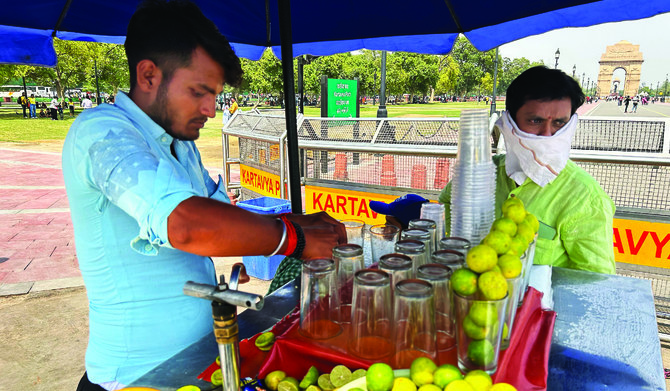
A roadside vendor sells iced lemonade in New Delhi, India, Saturday. (AP)
Short Url
Updated 18 May 2024
Follow

Parts of northern India scorched by extreme heat with New Delhi on high alert

NEW DELHI: Parts of northwest India sweltered under scorching temperatures on Saturday, with the capital New Delhi under a severe weather alert as extreme temperatures strike parts of the country.
India’s weather department expects heat wave conditions to persist across the north for the next few days, and has put several states on high alert. On Friday, parts of New Delhi reported up to 47.1 degrees Celsius. The nearby states of Punjab, Haryana and Rajasthan also saw temperatures soar and are likely to stay high over the next few days, said Soma Sen Roy, a scientist at the India Meteorological Department.
Roy cautioned people against going outdoors under the afternoon sun, drink lots of water and wear loose-fitting clothes while those who are especially vulnerable like the elderly should stay indoors.
The extreme temperatures in northern India coincide with a six-week-long general election, with experts worried that the heat wave could increase health risks as people wait in long lines to cast their vote or candidates campaign aggressively in the outdoors. One minister fainted due to heat last month while addressing an election rally in Maharashtra state.
Satish Kumar, a 57-year-old rickshaw driver in the capital, said his work was suffering because of the heat. “People are not coming outside, (markets) are nearly empty,” he said.
Pravin Kamath, a 28-year-old who runs a cart selling cold drinks, complained that it was so hot he could hardly stand being outdoors. “But I must work. What can I do? I am poor so I have to do it.”
The main summer months — April, May and June — are always hot in most parts of India before monsoon rains bring cooler temperatures. But the heat has become more intense in the past decade and is usually accompanied by severe water shortages, with tens of millions of India’s 1.4 billion people lacking running water.

A study by World Weather Attribution, an academic group that examines the source of extreme heat, found that a searing heat wave in April that struck parts of Asia was made at least 45 times more likely in some parts of the continent by climate change.


Somalia’s capital votes in first step toward restoring universal suffrage

Updated 1 sec ago
Follow

Somalia’s capital votes in first step toward restoring universal suffrage

MOGADISHU: Residents of Somalia’s capital Mogadishu will vote on Thursday ​in municipal elections meant to pave the way for the East African country’s first direct national polls in more than half a century.
With the exception of votes in the semi-autonomous region of Puntland and the breakaway region of Somaliland, Somalia last held direct elections in 1969, months before military general, Mohamed Siad Barre, took power in a coup.
After years of civil ‌war that ‌followed Barre’s fall in 1991, indirect elections ‌were ⁠introduced ​in ‌2004. The idea was to promote consensus among rival clans in the face of an Islamist insurgency, although some Somalis say politicians prefer indirect elections because they create opportunities for corruption.
Under the system, clan representatives elect lawmakers, who then choose the president. The president, in turn, has been responsible for appointing Mogadishu’s mayor.
The vote in Mogadishu, a ⁠city of some 3 million people where security conditions have improved in recent years ‌despite continuing attacks by Al-Qaeda-linked al ‍Shabab militants, is seen as ‍a test run for direct elections at the national level.
Around ‍1,605 candidates are running on Thursday for 390 posts in Mogadishu’s district councils, said Abdishakur Abib Hayir, a member of the National Electoral Commission. Council members will then choose a mayor.
“It shows Somalia is standing ​on its feet and moving forward,” Hayir told Reuters. “After the local election, elections can and will take place in ⁠the entire country.”
A 2024 law restored universal suffrage ahead of federal elections expected next year. However, President Hassan Sheikh Mohamud reached a deal in August with some opposition leaders stipulating that while lawmakers would be directly elected in 2026, the president would still be chosen by parliament.
Opposition parties have argued the rapid introduction of a new electoral system would benefit Mohamud’s re-election prospects.
They also question whether the country is safe enough for mass voting given Al-Shabab’s control over vast areas of the countryside and regular strikes ‌on major population centers.