Somalia’s capital votes in first step toward restoring universal suffrage
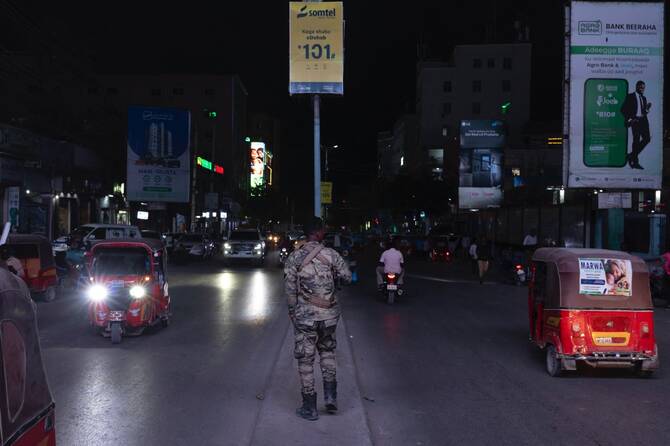
A Somali police officer patrols along a busy street at night in Mogadishu, Somalia. (AFP)
Short Url
Updated 25 December 2025
Follow

Somalia’s capital votes in first step toward restoring universal suffrage

  • After years of civil ‌war that ‌followed Barre’s fall in 1991, indirect elections ‌were ⁠introduced ​in ‌2004

MOGADISHU: Residents of Somalia’s capital Mogadishu will vote on Thursday ​in municipal elections meant to pave the way for the East African country’s first direct national polls in more than half a century.
With the exception of votes in the semi-autonomous region of Puntland and the breakaway region of Somaliland, Somalia last held direct elections in 1969, months before military general, Mohamed Siad Barre, took power in a coup.
After years of civil ‌war that ‌followed Barre’s fall in 1991, indirect elections ‌were ⁠introduced ​in ‌2004. The idea was to promote consensus among rival clans in the face of an Islamist insurgency, although some Somalis say politicians prefer indirect elections because they create opportunities for corruption.
Under the system, clan representatives elect lawmakers, who then choose the president. The president, in turn, has been responsible for appointing Mogadishu’s mayor.
The vote in Mogadishu, a ⁠city of some 3 million people where security conditions have improved in recent years ‌despite continuing attacks by Al-Qaeda-linked al ‍Shabab militants, is seen as ‍a test run for direct elections at the national level.
Around ‍1,605 candidates are running on Thursday for 390 posts in Mogadishu’s district councils, said Abdishakur Abib Hayir, a member of the National Electoral Commission. Council members will then choose a mayor.
“It shows Somalia is standing ​on its feet and moving forward,” Hayir told Reuters. “After the local election, elections can and will take place in ⁠the entire country.”
A 2024 law restored universal suffrage ahead of federal elections expected next year. However, President Hassan Sheikh Mohamud reached a deal in August with some opposition leaders stipulating that while lawmakers would be directly elected in 2026, the president would still be chosen by parliament.
Opposition parties have argued the rapid introduction of a new electoral system would benefit Mohamud’s re-election prospects.
They also question whether the country is safe enough for mass voting given Al-Shabab’s control over vast areas of the countryside and regular strikes ‌on major population centers.


Indonesia reaffirms Yemen’s territorial integrity, backs stability efforts amid tensions

Updated 01 January 2026
Follow

Indonesia reaffirms Yemen’s territorial integrity, backs stability efforts amid tensions

  • Statement comes after Saudi Arabia bombed a UAE weapons shipment at Yemeni port city
  • Jakarta last week said it ‘appreciates’ Riyadh ‘working together’ with Yemen to restore stability

JAKARTA: Indonesia has called for respect for Yemen’s territorial integrity and commended efforts to maintain stability in the region, a day after Saudi Arabia bombed a weapons shipment from the UAE at a Yemeni port city that Riyadh said was intended for separatist forces. 

Saudi Arabia carried out a “limited airstrike” at Yemen’s port city of Al-Mukalla in the southern province of Hadramout on Tuesday, following the arrival of an Emirati shipment that came amid heightened tensions linked to advances by the UAE-backed Southern Transitional Council in the war-torn country. 

In a statement issued late on Wednesday, the Indonesian Ministry of Foreign Affairs said it “appreciates further efforts by concerned parties to maintain stability and security,” particularly in the provinces of Hadramout and Al-Mahara. 

“Indonesia reaffirms the importance of peaceful settlement through an inclusive and comprehensive political dialogue under the coordination of the United Nations and respecting Yemen’s legitimate government and territorial integrity,” Indonesia’s foreign affairs ministry said. 

The latest statement comes after Jakarta said last week that it “appreciates the efforts of the Kingdom of Saudi Arabia, as well as other relevant countries, working together with Yemeni stakeholders to de-escalate tensions and restore stability.” 

Saudi Arabia leads the Coalition to Restore Legitimacy in Yemen, which includes the UAE and was established in 2015 to combat the Houthi rebels, who control most of northern Yemen. 

Riyadh has been calling on the STC, which initially supported Yemen’s internationally recognized government against the Houthi rebels, to withdraw after it launched an offensive against the Saudi-backed government troops last month, seeking an independent state in the south.  

Indonesia has also urged for “all parties to exercise restraint and avoid unilateral action that could impact security conditions,” and has previously said that the rising tensions in Yemen could “further deteriorate the security situation and exacerbate the suffering” of the Yemeni people. 

Indonesia, the world’s biggest Muslim-majority country, maintains close ties with both Saudi Arabia and the UAE, which are its main trade and investment partners in the Middle East.