Trump-backed candidate Nasry Asfura declared winner of Honduras’ presidential vote

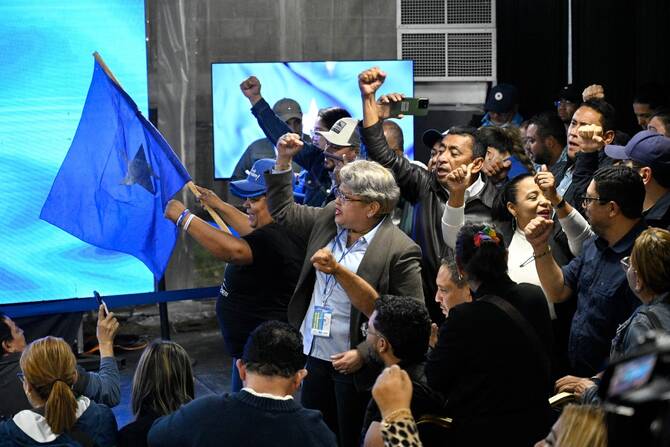
Supporters of Honduras presidential candidate Nasry Asfura of the National Party react at the party headquarters in Tegucigalpa, Dec. 23, 2025. (AFP)
Short Url
Updated 25 December 2025
Follow

Trump-backed candidate Nasry Asfura declared winner of Honduras’ presidential vote

  • The election is continuing Latin America’s swing to the right, coming just a week after Chile chose the far-right politician José Antonio Kast as its next president

TEGUCIGALPA: Trump-backed candidate Nasry Asfura won Honduras’ presidential election, the country’s electoral authorities said Wednesday afternoon, ending a weeks-long count that has whittled away at the credibility of the Central American nation’s fragile electoral system.
The election is continuing Latin America’s swing to the right, coming just a week after Chile chose the far-right politician José Antonio Kast as its next president.
Asfura, of the conservative National Party received 40.27 percent of the vote in the Nov. 30, edging out four-time candidate Salvador Nasralla of the conservative Liberal Party, who finished with 39.39 percent of the vote.
Asfura, the former mayor of Honduras’ capital Tegucigalpa, won in his second bid for the presidency, after he and Nasralla were neck-and-neck during a weeks-long vote count that fueled international concern.
On Tuesday night a number of electoral officials and candidates were already fighting and contesting the results of the election.
The results were a rebuke of the current leftist leader, and her governing democratic socialist Liberty and Re-foundation Party, known as LIBRE, whose candidate finished in a distant third place with 19.19 percent of the vote.
Asfura ran as a pragmatic politician, pointing to his popular infrastructure projects in the capital. Trump endorsed the 67-year-old conservative just days before the vote, saying he was the only Honduran candidate the US administration would work with.
Nasralla has maintained that the election was fraudulent and called for a recount of all the votes just hours before the official results were announced.
On Tuesday night, he addressed Trump in a post on X, writing: “Mr. President, your endorsed candidate in Honduras is complicit in silencing the votes of our citizens. If he is truly worthy of your backing, if his hands are clean, if he has nothing to fear, then why doesn’t he allow for every vote to be counted?”
He and others opponents of Asfura have maintained that Trump’s last-minute endorsement was an act of electoral interference that ultimately swung the results of the vote.
The unexpectedly tumultuous election was also marred by a sluggish vote count, which fueled even more accusations.
The Central American nation was stuck in limbo for more than three weeks as vote counting by electoral authorities lagged, and at one point was paralyzed after a special count of final vote tallies was called, fueling warnings by international leaders.
Ahead of the announcement, Organization of American States Secretary General Albert Rambin on Monday made an “urgent call” to Honduran authorities to wrap up a special count of the final votes before a deadline of Dec. 30. The Trump administration warned that any attempts to obstruct or delay the electoral count would be met with “consequences.”
For the incumbent, progressive President Xiomara Castro, the election marked a political reckoning. She was elected in 2021 on a promise to reduce violence and root out corruption.
She was among a group of progressive leaders in Latin American who were elected on a hopeful message of change in around five years ago but are now being cast out after failing to deliver on their vision. Castro said last week that she would accept the results of the elections even after she claimed that Trump’s actions in the election amounted to an “electoral coup.”
But Eric Olson, an independent international observer during the Honduran election with the Seattle International Foundation, and other observers said that the rejection of Castro and her party was so definitive that they had little room to contest the results.
“Very few people, even within LIBRE, believe they won the election. What they will say is there’s been fraud, that there has been intervention by Donald Trump, that we we should tear up the elections and vote again,” Olson said. “But they’re not saying ‘we won the elections.’ It’s pretty clear they did not.”


Justice Department sees no basis for civil rights probe in Minnesota ICE shooting, official says

Updated 5 sec ago
Follow

Justice Department sees no basis for civil rights probe in Minnesota ICE shooting, official says

  • And on Tuesday, Deputy Attorney General Todd Blanche said in a statement that “there is currently no basis for a criminal civil rights investigation”

WASHINGTON: The Justice Department does not believe there is currently any basis to open a criminal civil rights investigation into the killing of a woman by a US Immigration and Customs Enforcement officer in Minneapolis, a top department official said Tuesday.
The decision to keep the Justice Department’s Civil Rights Division out of the investigation into the fatal shooting of Renee Good marks a sharp departure from past administrations, which have moved quickly to probe shootings of civilians by law enforcement officials for potential civil rights offenses.
While an FBI probe is ongoing, lawyers in the Civil Rights Division were informed last week that they would not play a role in the investigation at this time, according to two people familiar with the matter who spoke on the condition of anonymity to discuss internal department deliberations.
And on Tuesday, Deputy Attorney General Todd Blanche said in a statement that “there is currently no basis for a criminal civil rights investigation.” The statement, first reported by CNN, did not elaborate on how the department had reached a conclusion that no investigation was warranted.
Federal officials have said that the officer acted in self-defense and that the driver of the Honda was engaging in “an act of domestic terrorism” when she pulled forward toward him.
The quick pronouncement by administration officials before any meaningful investigation could be completed has raised concerns about the federal government’s determination to conduct a thorough review of the chain of events precipitating the shooting. Minnesota officials have also raised alarm after federal officials blocked state investigators from accessing evidence and declared that Minnesota has no jurisdiction to investigate the killing.
Also this week, roughly half a dozen federal prosecutors in Minnesota resigned and several supervisors in the criminal section of the Civil Rights Division in Washington gave notice of their departures amid turmoil over the federal probe, according to people familiar with the matter.
Among the departures in Minnesota is First Assistant US Attorney Joseph Thompson, who had been leading the sprawling investigation and prosecution of fraud schemes in the state, two other people said. At least four other prosecutors in the Minnesota US attorney’s office joined Thompson in resigning amid a period of tension in the office, the people said. The people spoke on the condition of anonymity to discuss personnel matters.
They are the latest in an exodus of career Justice Department attorneys who have resigned or been forced out over concerns over political pressure or shifting priorities under the Trump administration. Hundreds of Justice Department lawyers have been fired or have left voluntarily over the last year.
Minnesota Democratic lawmakers criticized the departures, with Sen. Amy Klobuchar, a member of the Senate Judiciary Committee, calling the resignations “a loss for our state and for public safety” and warning that prosecutions should not be driven by politics. Gov. Tim Walz said the departures raised concerns about political pressure on career Justice Department officials.
The resignations of the lawyers in the Civil Rights Division’s criminal section, including its chief, were announced to staff on Monday, days after lawyers were told the section would not be involved in the probe. The Justice Department on Tuesday said those prosecutors had requested to participate in an early retirement program “well before the events in Minnesota,” and added that “any suggestion to the contrary is false.”
Founded nearly 70 years ago, the Civil Rights Division has a long history of investigating shootings by law enforcement even though prosecutors typically need to clear a high bar to mount a criminal prosecution.
In prior administrations, the division has moved quickly to open and publicly announce such investigations, not only to reflect federal jurisdiction over potential civil rights violations but also in hopes of soothing community angst that sometimes accompanies shootings involving law enforcement.
“The level of grief, tension and anxiety on the ground in Minnesota is not surprising,” said Kristen Clarke, who led the Civil Rights Division under the Biden administration. “And historically the federal government has played an important role by being a neutral and impartial agency committing its resources to conducting a full and fair investigation, and the public loses out when that doesn’t happen,” she said.
In Minneapolis, for instance, the Justice Department during the first Trump administration opened a civil rights investigation into the 2020 death of George Floyd at the hands of city police officers that resulted in criminal charges. The Minneapolis Police Department was separately scrutinized by the Biden administration for potential systemic civil rights violations through what’s known as a “pattern or practice” investigation, a type of police reform inquiry that is out of favor in the current Trump administration Justice Department.