Nepal latest to ban Indian spice brands over safety concerns

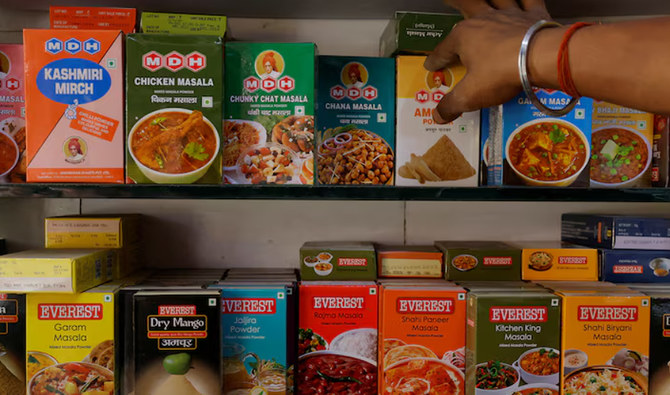
A man adjusts the spice boxes of MDH and Everest on the shelf of a shop at a market in New Delhi, India, April 29, 2024. (REUTERS)
Short Url
Updated 18 May 2024
Follow

Nepal latest to ban Indian spice brands over safety concerns

  • Hong Kong, Singapore last month banned products from Everest and MDH after tests detected presence of ethylene oxide
  • Besides its use as a pesticide, ethylene oxide is used to sterilize medical equipment and as a sterilising agent in spices

KATMANDU: Nepal has become the latest jurisdiction to ban the import and sale of two popular Indian spice brands after reports that some of their products contained a cancer-causing pesticide, officials said Friday.
Hong Kong and Singapore last month banned products from Everest and MDH — two brands popular in India and exported worldwide — after tests detected the presence of ethylene oxide, according to media reports.
Besides its use as a pesticide, ethylene oxide is used to sterilize medical equipment and as a sterilising agent in spices to prevent illnesses caused by salmonella and E. Coli bacteria.
Regular exposure to the colorless and odourless compound increases the “risk of cancers of the white blood cells,” according to the US Environmental Protection Agency.
Matina Joshi Vaidya, chief of Nepal’s Department of Food Technology and Quality Control, told AFP that the Himalayan country had also decided to halt the sale of the spice blends.
“It is an issue of public health,” she said. “We have its banned import and sale from Thursday.”
Nepal has banned four products — three variants produced by MDH and one by Everest.
“We do not have the lab resources to run the tests in the country. The ban will be lifted when Indian authorities declare it safe,” Vaidya said.
Everest and MDH are India’s top two spice brands with a market share of 16 and 10 percent respectively in 2022, according to consumer research monitor Statista.
Both companies have put out statements denying their products pose a health hazard to consumers after the Singapore and Hong Kong import bans.
“We clarify and state unequivocally that these claims are untrue and lack any substantiating evidence,” MDH said last month on social media platform X.
India’s food regulation agency has asked for state authorities to carry out random testing of spice products, broadcaster NDTV reported.


Russia pledges support for Venezuela against US ‘hostilities’

Updated 4 sec ago
Follow

Russia pledges support for Venezuela against US ‘hostilities’

  • Russian foreign minister expresses 'solidarity with the Venezuelan leadership and people'
  • US has seized two oil tankers linked to the country and is pursuing a third
CARACUS: Russia on Monday expressed “full support” for Venezuela as the South American country confronts a blockade of sanctioned oil tankers by US forces deployed in the Caribbean.
The pledge from Moscow, itself embroiled in the war in Ukraine, came on the eve of a UN Security Council (UNSC) meeting Tuesday to discuss the mounting crisis between Caracas and Washington.
In a phone call, the foreign ministers of the allied nations blasted the US actions, which have included strikes on alleged drug-trafficking boats and more recently the seizure of two oil tankers.
A third ship was being pursued, a US official told AFP on Sunday.
“The ministers expressed their deep concern over the escalation of Washington’s actions in the Caribbean Sea, which could have serious consequences for the region and threaten international shipping,” the Russian foreign ministry said of the call between Sergei Lavrov and Venezuelan counterpart Yvan Gil.
“The Russian side reaffirmed its full support for and solidarity with the Venezuelan leadership and people in the current context,” it added in a statement.
US forces have since September launched strikes on boats that Washington claims, without providing evidence, were trafficking drugs in the Caribbean and eastern Pacific Ocean.
More than 100 people have been killed — some of them fishermen, according to their families and governments.
US President Donald Trump on December 16 also announced a blockade of “sanctioned oil vessels” sailing to and from Venezuela.
Trump claims Caracas under President Nicolas Maduro is using oil money to finance “drug terrorism, human trafficking, murder and kidnapping.”
He has also accused Venezuela of taking “all of our oil” — in an apparent reference to the country’s nationalization of the petroleum sector, and said: “we want it back.”
Caracas, in turn, fears Washington is seeking regime change, and has accused Washington of “international piracy.”
Moscow’s statement said Lavrov and Gil agreed in their call to “coordinate their actions on the international stage, particularly at the UN, in order to ensure respect for state sovereignty and non-interference in internal affairs.”
Russia and China, another Venezuela ally, backed Caracas’s request for a UNSC meeting to discuss what it called “the ongoing US aggression.”

- Russia’s ‘hands full’ -

On Telegram, Venezuela’s Gil said he and Lavrov had discussed “the aggressions and flagrant violations of international law being perpetrated in the Caribbean: attacks on vessels, extrajudicial executions, and illicit acts of piracy carried out by the United States government.”
Gil said Lavrov had affirmed Moscow’s “full support in the face of hostilities against our country.”
Last week, US Secretary of State Marco Rubio brushed aside Moscow’s stated support for Caracas.
Washington, he said, was “not concerned about an escalation with Russia with regards to Venezuela” as “they have their hands full in Ukraine.”
US-Russia relations have soured in recent weeks as Trump has voiced frustration with Moscow over the lack of a resolution to the Ukraine war.
Gil on Monday also read a letter on state TV, signed by Maduro and addressed to UN member nations, warning the US blockade “will affect the supply of oil and energy” globally.