

Out on bail, firebrand Indian politician poses fresh challenge for Modi

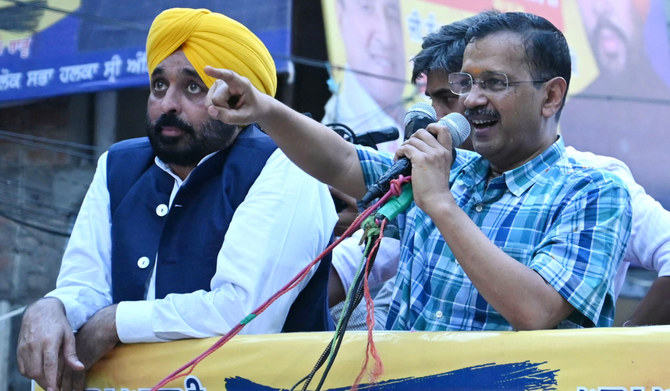
Chief minister of the capital Delhi and Aam Aadmi Party (AAP) leader Arvind Kejriwal (R) and Punjab's chief minister Bhagwant Mann (L) address supporters at a roadshow in Amritsar on May 16, 2024, ahead of the fifth phase of voting in Indiaís general election. (AFP)
Short Url
Updated 17 May 2024
Follow

Out on bail, firebrand Indian politician poses fresh challenge for Modi

  • Kejriwal’s Aam Aadmi Party is in power in the Delhi region and in the northern state of Punjab, which together account for just 20 seats in parliament, out of the 543 being contested

NEW DELHI: Firebrand Indian politician Arvind Kejriwal has hit the ground running since his surprise release from detention in the midst of a contentious general election, energizing the opposition as it challenges Prime Minister Narendra Modi.
The Supreme Court gave 55-year-old Kejriwal, who is also the chief minister of the national capital territory of Delhi, bail in a graft case on May 10 and he wasted no time in getting on the campaign trail.
“I have only one request from you; we all have to come together to save the country from dictatorship. I am fighting this dictatorship with all my might,” he told a jubilant crowd soon after walking out of Delhi’s Tihar jail, clearly referring to Modi.

HIGHLIGHTS

• Delhi voters have mixed reactions to his campaign.

• Kejriwal will generate sympathy but victory unsure, analysts say.

Kejriwal is part of the INDIA alliance led by the Congress Party and one of its biggest crowd-pullers. Analysts say while his campaigning will give fresh impetus to the opposition, they are unsure if that will translate into any significant victories against the ruling Bharatiya Janata Party, which is tipped to return to power.
Kejriwal’s Aam Aadmi Party is in power in the Delhi region and in the northern state of Punjab, which together account for just 20 seats in parliament, out of the 543 being contested.
“He may be able to generate some sympathy vote, but would that be enough to change the outcome of the election?” said Rahul Verma, a fellow at the New Delhi-based Center for Policy Research think tank.
“The BJP led in Delhi by 20 percentage points on an average in each seat, so it needs a substantial amount of swing for BJP to start losing seats in Delhi,” Verma added.
Still, Kejriwal has the ability to embarrass the BJP.
A day after his release, he said Modi, central to the ruling party’s campaign, would not be prime minister beyond 2025 when he turns 75, and would hand over the reins to Home (Interior) Minister Amit Shah.
“Modi made the rule in BJP that whoever turns 75 will be retired. So I ask BJP, who will be your prime minister?” Kejriwal said. “Modi is not seeking for votes for himself, but for Amit Shah...who will fulfil Modi’s guarantees then?“
The BJP scrambled to deny the suggestion that flag-bearer Modi would retire.

ANTI-GRAFT CRUSADER
India began voting on April 19 in the seven-phase election in which Modi, 73, is seeking to be the second prime minister to win a third straight term since independence leader Jawaharlal Nehru.
Delhi goes to the polls on May 25 and Punjab on June 1. Results are due on June 4.
Kejriwal is an anti-corruption crusader-turned-politician with a reputation of being a street-fighter. He projects himself as a messiah of the working class through AAP’s focus on health care, schools and subsidies, and has a high profile image in the media, allowing him to punch above his weight, analysts say.
The Enforcement Directorate, India’s financial crime-fighting agency, arrested him on March 21 in connection with corruption allegations related to the capital territory’s liquor policy.
Kejriwal has dismissed the graft allegations against him as an attempt by Modi’s government to destroy his party and damage the opposition. Modi and the BJP have denied the charges.
Delhi’s voters had mixed reactions to his campaign.
“Giving bail to Kejriwal is like adding fuel to the fire (for the opposition),” said Irshad, 35, a barber in Delhi’s Jahangirpuri area, who gave only his first name. “He’s a genuine leader.”
In the Model Town locality of the capital, vegetable vendor Surya Bali, 33, asked: “If he was not corrupt, why would they send him to jail?“
Some were undecided who they would vote for, including Madhuri Akshay Rajput, 30, a tailor in another part of the city. “Whether Kejriwal has done something wrong or not, going to jail dents your image,” she said. “What’s the point of voting? Nothing has changed.”


Bangladesh halts controversial relocation of Rohingya refugees to remote island

Updated 13 sec ago
Follow

Bangladesh halts controversial relocation of Rohingya refugees to remote island

  • Administration of ousted PM Sheikh Hasina spent about $350m on the project
  • Rohingya refuse to move to island and 10,000 have fled, top refugee official says

DHAKA: When Bangladesh launched a multi-million-dollar project to relocate Rohingya refugees to a remote island, it promised a better life. Five years on, the controversial plan has stalled, as authorities find it is unsustainable and refugees flee back to overcrowded mainland camps.

The Bhasan Char island emerged naturally from river sediments some 20 years ago. It lies in the Bay of Bengal, over 60 km from Bangladesh’s mainland.

Never inhabited, the 40 sq. km area was developed to accommodate 100,000 Rohingya refugees from the cramped camps of the coastal Cox’s Bazar district.

Relocation to the island started in early December 2020, despite protests from the UN and humanitarian organizations, which warned that it was vulnerable to cyclones and flooding, and that its isolation restricted access to emergency services.

Over 1,600 people were then moved to Bhasan Char by the Bangladesh Navy, followed by another 1,800 the same month. During 25 such transfers, more than 38,000 refugees were resettled on the island by October 2024.

The relocation project was spearheaded by the government of former Prime Minister Sheikh Hasina, who was ousted last year. The new administration has since suspended it indefinitely.

“The Bangladesh government will not conduct any further relocation of the Rohingya to Bhasan Char island. The main reason is that the country’s present government considers the project not viable,” Mizanur Rahman, refugee relief and repatriation commissioner in Cox’s Bazar, told Arab News on Sunday.

The government’s decision was prompted by data from UN agencies, which showed that operations on Bhasan Char involved 30 percent higher costs compared with the mainland camps in Cox’s Bazar, Rahman said.

“On the other hand, the Rohingya are not voluntarily coming forward for relocation to the island. Many of those previously relocated have fled ... Around 29,000 are currently living on the island, while about 10,000 have returned to Cox’s Bazar on their own.”

A mostly Muslim ethnic minority, the Rohingya have lived for centuries in Myanmar’s western Rakhine state but were stripped of their citizenship in the 1980s and have faced systemic persecution ever since.

In 2017 alone, some 750,000 of them crossed to neighboring Bangladesh, fleeing a deadly crackdown by Myanmar’s military. Today, about 1.3 million of them shelter in 33 camps in the coastal Cox’s Bazar district, making it the world’s largest refugee settlement.

Bhasan Char, where the Bangladeshi government spent an estimated $350 million to construct concrete residential buildings, cyclone shelters, roads, freshwater systems, and other infrastructure, offered better living conditions than the squalid camps.

But there was no regular transport service to the island, its inhabitants were not allowed to travel freely, and livelihood opportunities were few and dependent on aid coming from the mainland.

Rahman said: “Considering all aspects, we can say that Rohingya relocation to Bhasan Char is currently halted. Following the fall of Sheikh Hasina’s regime, only one batch of Rohingya was relocated to the island.

“The relocation was conducted with government funding, but the government is no longer allowing any funds for this purpose.”

“The Bangladeshi government has spent around $350 million on it from its own funds ... It seems the project has not turned out to be successful.”