Israel army says two Thai hostages held in Gaza are dead

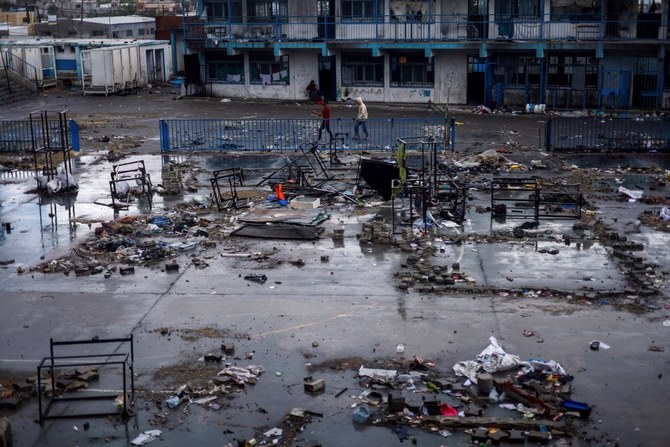
Palestinians walk at a nearly deserted school used as a shelter by displaced people who fled Rafah after Israeli forces launched a ground and air operation. (Reuters)
Short Url
Updated 16 May 2024
Follow

Israel army says two Thai hostages held in Gaza are dead

  • There are now six Thai hostages being held in Gaza

JERUSALEM: The Israeli army said Thursday that two Thai hostages earlier believed to be alive in Gaza were killed in the October 7 attack and their bodies are being held in the Palestinian territory.
“We informed the families of two kidnapped Thai citizens, who worked in agriculture in the plantations near Kibbutz Beeri, that they were murdered in the terrorist attack on October 7 and their bodies are being held by Hamas,” said army spokesman Daniel Hagari.
There are now six Thai hostages being held in Gaza, according to an AFP tally based on Israeli figures.
Thailand has about 30,000 citizens in Israel, most of whom work in the agricultural sector.
Hamas’s October 7 attack on southern Israel resulted in the deaths of more than 1,170 people, mostly civilians, according to an AFP tally of Israeli official figures.
Israel’s military retaliation has killed at least 35,272 people, also mostly civilians, according to the health ministry in the Hamas-run Gaza Strip.


GCC states ‘face reliance on Saudi Arabia for food imports’

Updated 59 min 21 sec ago
Follow

GCC states ‘face reliance on Saudi Arabia for food imports’

  • With 70 percent of food coming through Strait of Hormuz, analysts warn of inevitable shortages

DUBAI: Some Gulf states may have to rely on overland food deliveries from Saudi Arabia if the US-Israel-Iran war continues to disrupt shipping through the Strait of Hormuz and restrict regional airspace, analysts warned on Thursday.
The region is up to 90 percent dependent on food imports, and price surges and scarcity of some goods are expected.
“With over 70 percent of GCC foodstuffs being imported through the Strait of Hormuz, Gulf states face shortages if the war persists,” said Neil ​Quilliam of the Chatham House think tank. 
“While GCC countries have taken steps to diversify suppliers and ensure sufficient stores to withstand disruption, this can only last several months. At this point, price increases ​and longer lead times will start to hit the markets.”
Commodities analyst Ishan Bhanu said: “The biggest immediate effect will be due to the blockade of Jebel Ali in Dubai, serving about 50 million people. Qatar, Kuwait, Bahrain and Iraq effectively become landlocked and will depend on overland routes through Saudi Arabia.”
Bottlenecks are yet to show and the UAE has said its strategic reserves of vital goods cover four to six months of needs. It urged residents to report unjustified price increases through a dedicated hotline.
Supermarket staff ​throughout the Gulf said shelves remain largely stocked, though suppliers are taking longer to replenish certain products. Iran’s strikes on the Gulf since Saturday prompted panic buying in supermarkets, a dry run for what could come. 
“Perception of risk matters, and even if stocks are sufficient now, public runs on supermarkets can spook the public,” Quilliam said.