CALIFORNIA: Police in riot gear surrounded arm-in-arm protesters Friday at the University of California, Santa Cruz, to remove an encampment and barricades where pro-Palestinian demonstrations have blocked the main entrance to the campus this week.
Many people were arrested, the university said.
Campus, local and state police swarmed the protesters, and video from local news stations showed officers telling people to leave, then taking away signs and part of a barricade. There appeared to be some pushing and shoving between police and protesters. Officers carried zip ties and appeared to detain a few people.
“For weeks, encampment participants were given repeated, clear direction to remove the encampment and cease blocking access to numerous campus resources and to the campus itself,” Scott Hernandez-Jason, a spokesperson for the university, said in a statement Friday.
“They were notified that their actions were unlawful and unsafe. And this morning they were also given multiple warnings by law enforcement to leave the area and disperse to avoid arrest. Unfortunately, many refused to follow this directive and many individuals are being arrested,” Hernandez-Jason said.
The university did not have the exact number of arrests by Friday afternoon. Chancellor Cynthia Larive said in a letter to the community Friday that some demonstraters remained at the entrance.
She said that the road blockades, “with fortified and chained barricades made of pallets and other materials, and other unlawful actions, disrupted campus operations and threatened safety, including delaying access of emergency vehicles.”
It wasn’t known if anyone was injured. The university was holding classes remotely Friday.
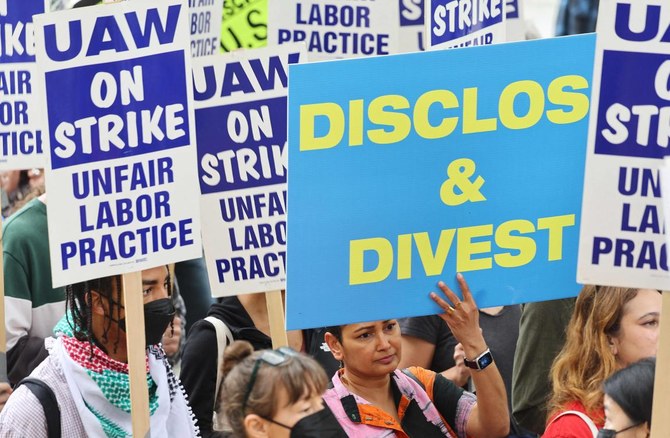
Graduate student workers at UC Santa Cruz continued a strike that began last week over the university system’s treatment of pro-Palestinian protesters. The strike will expand to three more campuses next week, their union said Friday.
The strikes began May 20 at UC Santa Cruz, and then extended to UCLA and UC Davis. Members at UC Santa Barbara and UC San Diego will walk out on June 3 and at UC Irvine on June 5, UAW Local 4811 said. Union members include graduate teaching assistants, researchers and other academic employees.
Protest camps sprang up across the US and in Europe this spring as students demanded their universities stop doing business with Israel or companies that they say support its war in Gaza. Organizers seek to amplify calls to end Israel’s war with Hamas, which they describe as a genocide against the Palestinians.
The Associated Press has recorded at least 83 incidents since April 18 in which arrests were made at campus protests across the US More than 3,025 people have been arrested at 62 colleges and universities. The figures are based on AP reporting and statements from universities and law enforcement agencies.
The confrontation in California came a day after arrests at a pro-Palestinian encampment at a Detroit campus and a student walkout during commencement at the Massachusetts Institute of Technology.
On Thursday, police in riot gear removed fencing and broke down tents erected last week on green space near the undergraduate library at Wayne State University in Detroit. At least 12 people were arrested.
President Kimberly Andrews Espy cited health and safety concerns and disruptions to campus operations. Staff were encouraged to work remotely this week, and in-person summer classes were suspended.
The camp, she said, “created an environment of exclusion — one in which some members of our campus community felt unwelcome and unable to fully participate in campus life.”
An outdoor commencement ceremony went uninterrupted Friday at MIT in Cambridge, near Boston. On Thursday, some graduates walked out of another ceremony, disrupting it for 10 to 15 minutes. They wore keffiyehs, the checkered scarves that represent Palestinian solidarity, over their caps and gowns, chanted “free, free Palestine,” and held signs that said, “All eyes on Rafah.”
“There is going to be no business as usual as long as MIT holds research projects with the Israeli Ministry of Defense,” said David Berkinsky, 27, who earned a doctorate degree in chemistry and walked out. “There are no graduates in Gaza. There are no universities left in Gaza left because Israeli has bombed every single one.”
Some people at the event swore at the protesters and yelled, “Good riddance to Hamas terror fans.” A pro-Palestinian encampment at MIT was cleared in early May.


![]()

Police arrest ‘many’ at Israel-Hamas war protest at UC Santa Cruz, school says
Short Url
https://arab.news/pwt7g
Police arrest ‘many’ at Israel-Hamas war protest at UC Santa Cruz, school says
- Campus, local and state police swarmed the protesters, and video from local news stations showed officers telling people to leave
- There appeared to be some pushing and shoving between police and protesters


Latest updates


Recommended


© 2026 SAUDI RESEARCH & PUBLISHING COMPANY, All Rights Reserved And subject to Terms of Use Agreement.