Gaza aid not reaching the population: UN

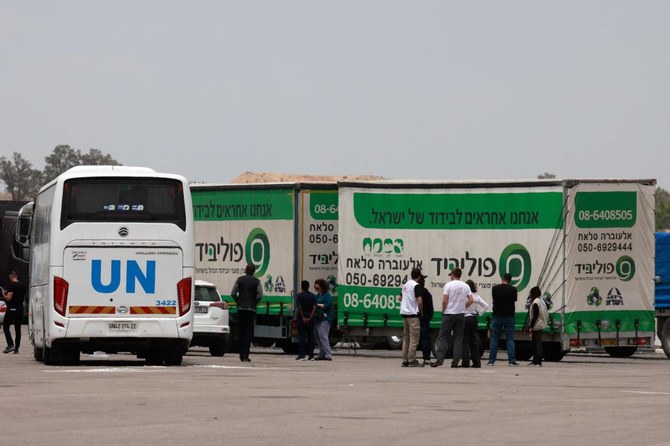
Trucks carrying humanitarian aid wait at the Israeli side of the Kerem Shalom border crossing with the Gaza Strip in southern Israel on May 28, 2024. (AFP)
Short Url
Updated 31 May 2024
Follow

Gaza aid not reaching the population: UN

  • “The aid that is getting in is not getting to the people, and that’s a major problem,” Jens Laerke, spokesman for OCHA said
  • “We continue to insist that Israeli authorities’ obligation under the law to facilitate delivery of aid does not stop at the border“

GENEVA: The humanitarian aid allowed into the Gaza Strip is not getting to civilians in need, the United Nations said Friday, urging Israel to fulfil its legal obligations.
“The aid that is getting in is not getting to the people, and that’s a major problem,” Jens Laerke, spokesman for the UN humanitarian agency OCHA, told a media briefing in Geneva.
He highlighted the role of the Israeli authorities at their Kerem Shalom crossing, the main entry point for aid into the besieged Palestinian territory since the Rafah crossing between Egypt and Gaza was closed by the Israeli military on May 7.
“We continue to insist that Israeli authorities’ obligation under the law to facilitate delivery of aid does not stop at the border,” said Laerke.
“It does not stop when you drop off just a few meters across the border and then drive away, and then leave it to humanitarians to drive through active combat zones — which they cannot do — to pick it up,” he said.
“We need that safe and unimpeded access to get to the drop-off point so we can pick it up and get it to people.
“We want all parties to live up to their obligations under the law.”
The bloodiest-ever Gaza war was sparked by Hamas’s October 7 attack on southern Israel, which resulted in the deaths of 1,189 people, mostly civilians, according to an AFP tally based on Israeli official figures.
Militants also took 252 hostages, 121 of whom remain in Gaza, including 37 the army says are dead.
Israel’s retaliatory offensive has killed at least 36,224 people in Gaza, mostly civilians, according to the Hamas-run territory’s health ministry.


Iranian attacks wound 16 Qatari citizens: Interior Ministry

Updated 7 sec ago
Follow

Iranian attacks wound 16 Qatari citizens: Interior Ministry

The latest round of Iran’s retaliatory attacks had injured 16 Qatari citizens by early Sunday, as the country intercepted more than 60 missiles and over ten drones launched from Iran, according to official data.

From Saturday night to Sunday morning, multiple explosions were heard southwest of the capital city of Doha as Qatar’s air defense systems repeatedly activated to intercept incoming Iranian missiles.

According to data released by Qatar’s Ministry of Defense, since the attacks began on Saturday, Qatar has been targeted by 65 missiles and 12 drones.

Among these, 63 missiles and 11 drones were successfully intercepted before reaching their intended targets while two missiles struck the US military’s Al-Udeid Air Base in Qatar and one drone hit an early warning radar facility in the country.

Qatar’s Interior Ministry announced on Sunday that the attacks had wounded 16 of its citizens, all due to scattered missile debris, with limited property damage in some areas.

The ministry urged citizens to remain indoors whenever possible, avoid non-essential outings, and steer clear of any unidentified objects.

Despite Sunday being the first working day of the week in Qatar, a noticeable decrease in vehicles and pedestrians was observed on the streets.

Following the Saturday attack, Qatar closed its airspace and territorial waters, suspended all public events and gatherings, and shifted all schools to remote learning.

Except for military, security, and healthcare systems, most government agencies implemented remote work arrangements.

Qatar’s Ministry of Commerce and Industry also advised the private sector to adopt remote work practices where possible.

Meanwhile, the Qatari government continues to send signals of stability.

The Ministry of Defense said it possesses full capabilities to protect national security, with the current security situation remaining stable and under control.

The Interior Ministry announced that security and civil defense forces have entered a state of full emergency readiness, capable of responding to any emergency.

The Ministry of Commerce and Industry stressed that domestic supplies of daily necessities are enough to meet public demand.