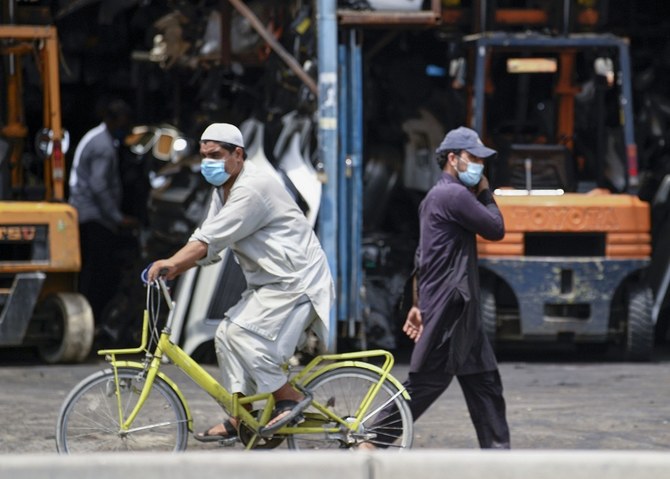
DUBAI: The UAE’s annual midday work ban comes into force on June 15 for all people whose jobs are outside, state news agency WAM reported.
The ban, which is enforced every summer in the country, requires all outside work to stop from 12:30 p.m. until 3 p.m., and for employees to be allowed to rest in a shaded place during the break.
The UAE has thousands of laborers who work outside on building sites, gardening and other lines of work and in the summer temperatures in the country regularly reach in excess of 40C.
The ban restricts working hours for outdoor workers to eight hours - any work over that should be compensated with overtime pay.
Violators will be fined up $13,600, according to the Ministry of Human Resources and Emiratisation.

UAE’s summer noon work ban to begin mid-June
https://arab.news/8w58q
UAE’s summer noon work ban to begin mid-June
- The ban, which is enforced every summer in the country, requires all outside work to stop from 12:30 p.m. until 3 p.m.
Syrian government, Kurds to extend truce: sources to AFP
- No official announcement has yet come from Damascus or SDF, but two sources said truce is to be extended by one month
DAMASCUS: The Syrian government and Kurdish forces have agreed to extend a ceasefire set to expire Saturday, as part of a broader deal on the future of Kurd-majority areas, several sources told AFP.
No official announcement has yet come from Damascus or the Kurdish-led Syrian Democratic Forces (SDF), but two sources said the truce is to be extended by one month.
On Tuesday, Damascus and the SDF agreed to a four-day ceasefire after Kurdish forces relinquished swathes of territory to government forces, which also sent reinforcements to a Kurdish stronghold in the northeast.
A diplomatic source in Damascus told AFP the ceasefire, due to expire on Saturday evening, will be extended “for a period of up to one month at most.”
A Kurdish source close to the negotiations confirmed “the ceasefire has been extended until a mutually acceptable political solution is reached.”
A Syrian official in Damascus said the “agreement is likely to be extended for one month,” adding that one reason is the need to complete the transfer of Daesh group militant detainees from Syria to Iraq.
All sources requested anonymity because they are not allowed to speak to the media.
After the SDF lost large areas to government forces, Washington said it would transfer 7,000 Daesh detainees to prisons in Iraq.
Europeans were among 150 senior IS detainees who were the first to be transferred on Wednesday, two Iraqi security officials told AFP.
The transfer is expected to last several days.
Daesh swept across Syria and Iraq in 2014, but backed by a US-led coalition, the SDF ultimately defeated the group and went on to jail thousands of suspected militants and detain tens of thousands of their relatives.
The truce between Damascus and the Kurds is part of a new understanding over Kurdish-majority areas in Hasakah province, and of a broader deal to integrate the Kurds’ de facto autonomous administration into the state.
Syrian President Ahmed Al-Sharaa’s Islamist forces toppled longtime ruler Bashar Assad in 2024.
The new authorities are seeking to extend state control across Syria, resetting international ties including with the United States, now a key ally.
The Kurdish source said the SDF submitted a proposal to Damascus through US envoy Tom Barrack that would have the government managing border crossings — a key Damascus demand.
It also proposes that Damascus would “allocate part of the economic resources — particularly revenue from border crossings and oil — to the Kurdish-majority areas,” the source added.
Earlier this month, the Syrian army recaptured oil fields, including the country’s largest, while advancing against Kurdish forces.