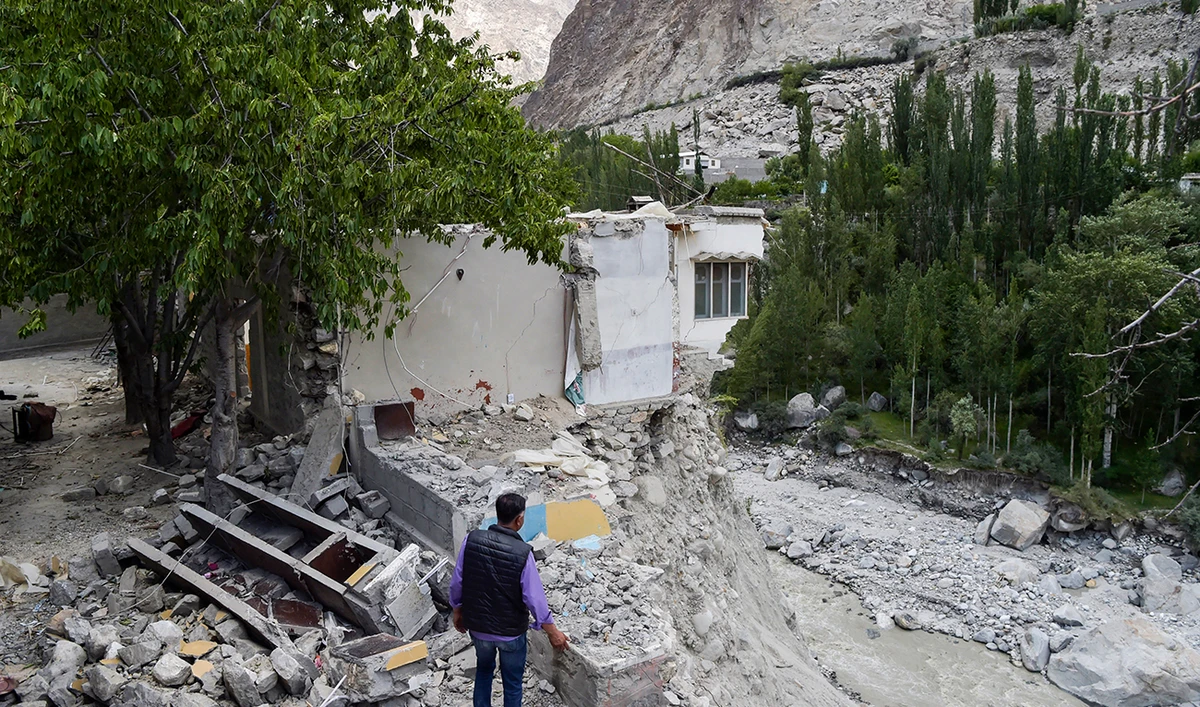
- Pakistan is home to more than 7,253 glaciers, containing more glacial ice than any other country on earth outside polar regions
- Officials, experts believe climate change is behind swift melting of glaciers that could affect regular water availability in Pakistan
ISLAMABAD: Unusually high temperatures in Pakistan’s northern areas have resulted in rapid melting of glaciers, officials and experts said on Friday, warning that the prolonged phenomenon could lead to water shortages and threaten lives in the longer run.
The South Asian country of 241 million is home to more than 7,253 known glaciers, and contains more glacial ice than any other country on earth outside the polar regions. Almost all these glaciers lie in the northern region of Gilgit-Baltistan and the Khyber Pakhtunkhwa province.
The glaciers are an essential source and provide around 70 percent of fresh water for Pakistan that flows into the rivers, supplying drinking water to humans, ecological habitats and for agricultural activity, and even powers electricity, according to the Green Network. But recent heatwaves and above normal temperatures are causing the snow to melt faster.
“The glaciers are our water bank and a lifeline for the whole country, but the high temperatures and climate change are resulting in their fast melting,” Dr. Zaheer Ahmed Babar, a director at the Pakistan Meteorological Department, told Arab News.
“The ratio of snow melting and subsequent water flow in the rivers are comparatively high as temperatures in the northern regions have recorded an increase of four to five degrees Celsius this month. In the longer run, if the phenomenon of high temperatures persists in the northern regions, our snow accumulation on the glaciers may lead to depletion and cause water shortages across Pakistan.”
Pakistan is currently witnessing a heatwave, with temperatures this week soaring above 52 degrees Celsius in the country’s southern regions, according to the PMD.
Babar said extreme weather patterns in Pakistan were getting prolonged with the passage of time, resulting in floods, heatwaves and a rise in seawater level, adding that the mercury was expected to drop after June 15 with the advent of the pre-monsoon rains.
Following an increased waterflow in rivers this month, the Indus River System Authority (IRSA) has increased the share of water for all provinces, bridging shortages for drinking and agriculture purposes.
“There are no water shortages now as we have been providing water to all the provinces as per their actual demand,” Khalid Idrees Rana, an operations director at IRSA, told Arab News.
“Our rivers are swelling at the moment due to the increased waterflow from the melting glaciers. The unusual high temperatures in the area are resulting in increased waterflow.”
Rana said the authority was providing 140,000 cusecs each to Punjab and Sindh provinces, 11,000 cusecs to Balochistan and 3,000 cusecs to Khyber Pakhtunkhwa.
“The increased waterflows in rivers are good for agriculture in the short term, but this could be dangerous in the longer term as we need a sustainable supply of water from our glaciers the whole year,” he said.
Experts have linked the increase in melting of glaciers to adverse impacts of climate change and called on people to adapt to sustainable use of water, especially in the agriculture sector, to conserve the precious resource.
“The fast glacier-melting is obviously the climate change phenomenon, and Pakistan needs to mobilize a global effort to mitigate its impacts through reduction in carbon emissions,” Dr. Qamar Zaman, a lead author of Pakistan’s national climate change policy, told Arab News.
“We need to ensure sustainable use of water by discouraging flood irrigation as the swift glaciers melting could affect regular water availability in the country.”