

Pakistan slashes petrol price by Rs4 amid confusion about bigger cut

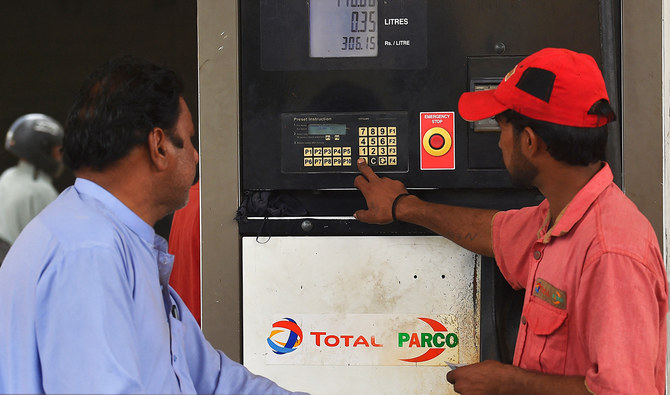
An employee prepares to fill petrol in a vehicle at a fuel station in Karachi on September 1, 2023. (AFP/File)
Short Url
Updated 01 June 2024
Follow

Pakistan slashes petrol price by Rs4 amid confusion about bigger cut

  • The confusion stemmed from a statement issued by PM Sharif's office saying he had directed authorities to reduce petrol price by Rs15.4
  • Finance Division says the Oil & Gas Regulatory Authority has worked out new prices, based on price variations in the international market

KARACHI: The Pakistani government on Saturday reduced the price of petrol by Rs4 per liter, the Finance Division announced, amid confusion about bigger cuts in petroleum prices.

The confusion stemmed from a statement issued by Prime Minister Shehbaz Sharif's office that said late Friday the premier had directed authorities to reduce petrol price by Rs15.4 and diesel by Rs7.9.

However, the price of petrol was slashed by only Rs4.74, while that of hi-speed diesel was reduced by Rs3.86, according to a notification issued by the Finance Division early Saturday.

"The prices of Petroleum products have seen a decreasing trend in the international market during the last fortnight," the notification read. "The Oil & Gas Regulatory Authority (OGRA) has worked out the consumer prices, based on the price variations in the international market."

A liter of petrol now costs Rs268.36, while that of high-speed diesel sells for Rs270.22.

Pakistan revises petroleum prices every fortnight. On May 15, the Pakistani government slashed the price of petrol by Rs15.39 per liter in view of declining global energy prices, bringing major relief to consumers reeling from record inflation over the past two years.

The South Asian country significantly increased fuel prices after securing a short-term, $3 billion loan from the International Monetary Fund (IMF) last year.

The rising rates also led to spiraling inflation in the country, though the government started offering relief to the people by gradually bringing down the petroleum prices.

Pakistan is already in talks with the IMF to secure another loan which is expected to be bigger in terms of size and duration.


EU, Pakistan sign €60 million loan agreement for clean drinking water in Karachi

Updated 17 December 2025
Follow

EU, Pakistan sign €60 million loan agreement for clean drinking water in Karachi

  • Project will finance rehabilitation, construction of water treatment facilities in Karachi city, says European Investment Bank
  • As per a report in 2023, 90 percent of water samples collected from various places in city was deemed unfit for drinking

ISLAMABAD: The European Investment Bank (EIB) and Pakistan’s government on Wednesday signed a €60 million loan agreement, the first between the two sides in a decade, to support the delivery of clean drinking water in Karachi, the EU said in a statement. 

The Karachi Water Infrastructure Framework, approved in August this year by the EIB, will finance the rehabilitation and construction of water treatment facilities in Pakistan’s most populous city of Karachi to increase safe water supply and improve water security. 

The agreement was signed between the two sides at the sidelines of the 15th Pak-EU Joint Commission in Brussels, state broadcaster Radio Pakistan reported. 

“Today, the @EIB signed its first loan agreement with Pakistan in a decade: a €60 million loan supporting the delivery of clean drinking water for #Karachi,” the EU said on social media platform X. 

Radio Pakistan said the agreement reflects Pakistan’s commitment to modernize essential urban services and promote climate-resilient infrastructure.

“The declaration demonstrates the continued momentum in Pakistan-EU cooperation and highlights shared priorities in sustainable development, public service delivery, and climate and environmental resilience,” it said. 

Karachi has a chronic clean drinking water problem. As per a Karachi Water and Sewerage Corporation (KWSC) study conducted in 2023, 90 percent of water from samples collected from various places in the city was deemed unsafe for drinking purposes, contaminated with E. coli, coliform bacteria, and other harmful pathogens. 

The problem has forced most residents of the city to get their water through drilled motor-operated wells (known as ‘bores’), even as groundwater in the coastal city tends to be salty and unfit for human consumption.

Other options for residents include either buying unfiltered water from private water tanker operators, who fill up at a network of legal and illegal water hydrants across the city, or buying it from reverse osmosis plants that they visit to fill up bottles or have delivered to their homes.

The EU provides Pakistan about €100 million annually in grants for development and cooperation. This includes efforts to achieve green inclusive growth, increase education and employment skills, promote good governance, human rights, rule of law and ensure sustainable management of natural resources.
