

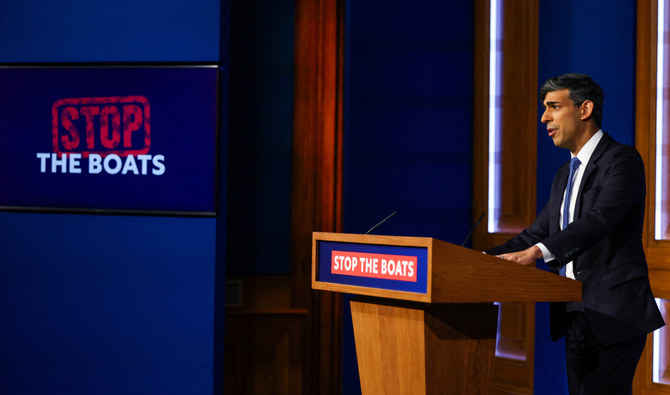

LONDON: British Prime Minister Rishi Sunak promised on Monday to start sending asylum seekers to Rwanda within 10 to 12 weeks as the upper house of parliament finally passed required legislation, delayed for weeks by attempts to alter the plan.
Sunak said the government had booked commercial charter planes and trained staff to take migrants to Rwanda, a policy he hopes will boost his Conservative Party’s flagging fortunes before an election later this year.
The House of Lords had long refused to back the divisive legislation without additional safeguards, but eventually relented after Sunak said the government would force parliament to sit as late into Monday night as necessary to get it passed.
“No ifs, no buts. These flights are going to Rwanda,” Sunak told a news conference earlier on Monday.
Tens of thousands of migrants — many fleeing wars and poverty in Africa, the Middle East and Asia — have reached Britain in recent years by crossing the English Channel in small boats on risky journeys organized by people-smuggling gangs.
Stopping the flow is a priority for the government, but critics say the plan to deport people to Rwanda rather than handle asylum seekers at home is inhumane. They cite concerns about the East African country’s own human rights record and the risk asylum seekers may be sent back to countries where they face danger.
Sunak’s new law states some existing UK human rights statutes will not apply to the scheme and Rwanda must be treated by British judges as a safe destination, in a bid to override a Supreme Court ruling which declared the scheme unlawful.
It also limits individuals’ options for an appeal to only exceptional cases.
Other European countries, including Austria and Germany, are also looking at agreements to process asylum seekers abroad.
The legislation returned on Monday to the House of Commons — the elected lower house — where lawmakers removed changes proposed by the Lords before the upper chamber considered it again.
Some Labour and unaffiliated peers wanted the legislation to include safeguards for Afghans who previously helped British troops and to establish a committee to monitor asylum seekers’ safety in Rwanda. But eventually the Lords let the legislation pass its final parliamentary step without any formal changes.
The legislation is expected to receive Royal Assent from King Charles later this week, and then will become law.
Speaking before the legislation was passed, Sunak said an airfield was on standby, slots were booked for flights and 500 staff were ready to escort migrants “all the way to Rwanda.”
Under the policy formulated two years ago, and agreed with Rwanda, any asylum seeker who arrives illegally in Britain will be sent to Rwanda under a scheme the government says will deter Channel crossings and smash the people smugglers’ business model.
Sunak’s team hope the pre-election pledge will help turn around his electoral fortunes, particularly among wavering Conservative voters who want to see less immigration.
He had previously said he hoped the policy would be operational by spring, without giving a precise date.
Polls suggest his Conservative Party will be badly beaten in this year’s election by Labour, which has said it will scrap the scheme if it wins power. Labour says it will pursue a deal with the European Union to return some arrivals to mainland Europe.
Even after successfully navigating parliamentary hurdles, Sunak may still face legal challenges to the law.
Charities and rights groups say they would try to stop individual deportations and the trade union which represents border force staff is promising to argue the new legislation is unlawful “within days” of the first asylum seekers being informed they will be sent to Rwanda.
“We urgently need the UK government to start treating refugees with decency and stop trying to send them away to an unsafe future in Rwanda,” Lucy Gregg, acting head of Advocacy at Freedom from Torture, said in a statement.


