UN seeks emergency funding to support cyclone-hit Sri Lanka

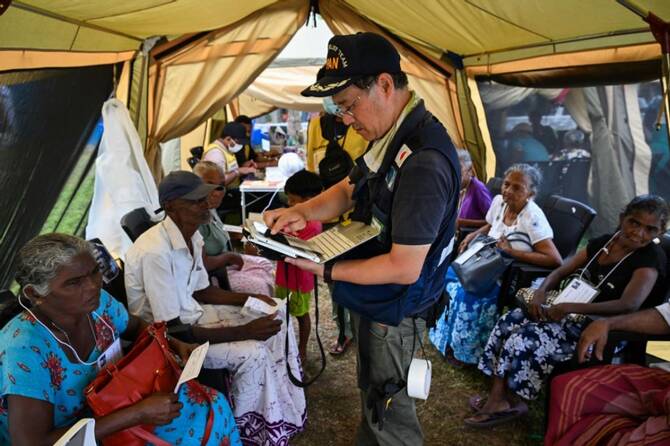
Japan Disaster Relief (JDR) medical officer tends to a flood victim at a camp in Chilaw, Sri Lanka. (AFP)
Short Url
Updated 11 December 2025
Follow

UN seeks emergency funding to support cyclone-hit Sri Lanka

  • The UN urged member states and other donors to help raise the remaining $25.8 million for the daunting recovery and reconstruction effort

COLOMBO: The United Nations called on international donors on Thursday to help provide crucial assistance to Sri Lanka, grappling with the aftermath of deadly Cyclone Ditwah.
The devastating storm, which hit the island nation late last month, killed at least 639 people and affected more than 2 million others — about 10 percent of the population — causing extensive damage to homes, roads, bridges, industries and agriculture.
Some 200 people are still missing.
The UN’s top envoy to the country, Marc-Andre Franche, announced plans for a $35.3-million emergency fund which he said was needed to feed and cater to the basic needs of 658,000 people who have been worst affected.
The fund excludes reconstruction of damaged infrastructure or personal property and focuses solely on immediate basic needs.
Franche said $9.5 million had already been secured, with the European Union, Switzerland, Britain and the United States among the donors pledging funds.
The United Nations urged member states and other donors to help raise the remaining $25.8 million for the daunting recovery and reconstruction effort.
The natural disaster, which President Anura Kumara Dissanayake has described as the most challenging for his country, struck as Sri Lanka was emerging from its worst economic crisis.
It defaulted on its $46-billion external debt in April 2022, and secured a $2.9-billion bailout from the International Monetary Fund in early 2023, having only stabilized the economy earlier this year.
“The disaster is hitting the country at a moment when around 25 percent of Sri Lankans still live in poverty,” Franche told reporters in Colombo.
Ongoing monsoon rains continue to pose a hazard with continued landslide warnings, the UN said.


China says Philippines distorted facts about incident near disputed atoll

Updated 17 December 2025
Follow

China says Philippines distorted facts about incident near disputed atoll

  • The Chinese ministry defended its coast guard’s actions as “reasonable, lawful, professional and restrained”

BEIJING: China’s defense ministry accused the Philippines on Wednesday of distorting the facts about an incident involving the Chinese coast guard and Filipino fishermen near a South China Sea shoal, a charge Manila strongly rejected.
The Philippine coast guard said over the weekend that three Filipino fishermen were injured and two fishing vessels damaged when Chinese coast guard ships cut their anchor lines and fired water cannon near the Sabina Shoal on Friday, actions the Philippine defense secretary denounced as “dangerous” and “inhumane.”
The Chinese ministry defended its coast guard’s actions as “reasonable, lawful, professional and restrained,” and vowed to “take strong and effective measures” in response to “all acts of infringement and provocation,” according to a statement released on its social media account.
“The Philippine side amassed a large number of ships in an organized and premeditated manner to illegally intrude” into the atoll’s lagoon, the ministry said. “Philippine personnel even threatened Chinese coast guard on site with a knife,” it added.
Philippine defense ministry spokesperson Arsenio Andolong maintained that Manila has evidence to counter China’s assertions.
“The facts are not distorted. They are documented, timestamped, and corroborated by video recordings, vessel logs, and on-site reporting by the Philippine Coast Guard,” Andolong said in a statement.
“The Philippines is not hyping the issue, the facts speak for themselves. These are aggressive and excessive actions of an encroaching state,” he added.
Sabina Shoal, which China refers to as Xianbin Reef and the Philippines as the Escoda Shoal, lies in the Philippines’ exclusive economic zone 150 km (95 miles) west of Palawan province.
China claims almost the entire South China Sea, a waterway supporting more than $3 trillion of annual commerce. The areas Beijing claims cut into the exclusive economic zones of Brunei, Indonesia, Malaysia, the Philippines and Vietnam.
An international arbitral tribunal ruled in 2016 that Beijing’s sweeping claims had no basis under international law, a decision China rejects.