

UK’s Rwanda plan rejected by Lords after vote to exempt Afghan soldiers

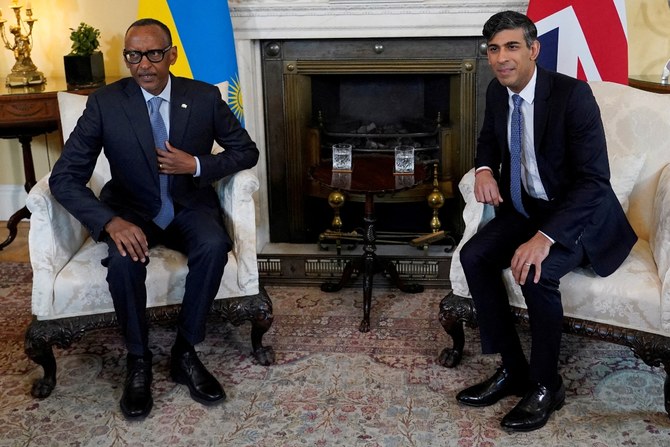
The Lords amendment on protections from deportation for former Afghan military personnel was proposed by a former UK defense secretary, Lord Browne of Ladyton, and supported by two former chiefs of the UK’s defense staff. (REUTERS)
Short Url
Updated 18 April 2024
Follow

UK’s Rwanda plan rejected by Lords after vote to exempt Afghan soldiers

  • Peers approve amendment to bill to protect ex-servicemen, families from being deported
  • Bill to return to Commons after Lords also vote to set up committee to monitor safety in Rwanda

LONDON: The UK’s House of Lords rejected the government’s plan to send migrants to Rwanda for asylum processing in a vote on Wednesday after it approved two amendments to the legislation.

The upper chamber of Parliament voted in favor of a proposal to exempt Afghans who worked with UK military personnel from being deported to the East African country, and of another that would see a committee established to monitor safety in Rwanda.

The bill will return to the House of Commons early next week, where MPs have previously refused to back amendments made to it by the Lords. 

The government of Prime Minister Rishi Sunak, who has made the Rwanda scheme a core part of his pledge to lower illegal migration across the English Channel before the next general election, says the bill in its current form is “the right way forward.”

However, a previous version of the scheme was rejected by the UK Supreme Court in 2023 as unlawful. 

The plan has also drawn cross-party criticism for its expense, worries about its effectiveness, the government’s inability to implement it and for the way it treats people in need of asylum, including former Afghan soldiers, translators and their families, many of whom risked their lives to assist the UK during operations in Afghanistan.

Numerous Afghans have been identified as having been threatened with deportation to Rwanda for entering the UK illegally, with many claiming safe legal routes either don’t work in practice or don’t exist.

The Independent highlighted the cases of a former Afghan Air Force pilot hailed as a “patriot” by former colleagues, who crossed the Channel in a small boat, and of two former Afghan special forces soldiers belonging to units known as “Triples” run by the British Army, who were wrongly denied assistance by the UK Ministry of Defence.

Along with reporting by Lighthouse Reports and Sky News, hundreds of other former Triples soldiers have also been identified hiding in Pakistan, awaiting an MoD review after many were refused entry to the UK.

The Lords amendment on protections from deportation for former Afghan military personnel was proposed by a former UK defense secretary, Lord Browne of Ladyton, and supported by two former chiefs of the UK’s defense staff.

Earlier on Wednesday Home Office minister Michael Tomlinson said peers should reject the amendments to “send a clear signal that if you come to the UK illegally, you will not be able to stay.”

But Lord Browne told the Lords: “Now is the time to give these people the sanctuary their bravery has earned.”

He added the government needed to be reminded of “the political consequences of their failure not to give either an assurance that is bankable or to accept this amendment. Because there is little, if any, support in your lordships’ House for their failure to do this and there (is) certainly no majority support in the country to treat these brave people this way.”

Lord Coaker, shadow home affairs spokesperson in the Lords, added: “Why on earth would the government oppose that particular amendment? It’s one of those things that is completely unbelievable.”

On Wednesday, Conservative MP Sir Robert Buckland told the Commons: “There is still a class of people who have served this country, who have been brave and have exposed themselves to danger, who have not yet been dealt with.

“Many of them are in Pakistan, and I think that it would have been helpful to have perhaps seen an amendment in lieu to deal with that point.”


Iceland joins Eurovision boycott over Israel’s participation

Updated 5 sec ago
Follow

Iceland joins Eurovision boycott over Israel’s participation

  • Decision follows similar moves by Spain, the Netherlands, Ireland and Slovenia over the Gaza war
  • Iceland’s national broadcaster says it pulled out 'given the public debate' in the country
LONDON: Iceland’s national broadcaster said Wednesday it will boycott next year’s Eurovision Song Contest because of discord over Israel’s participation, joining four other countries in a walkout of the pan-continental music competition.
Broadcasters in Spain, the Netherlands, Ireland and Slovenia told contest organizer the European Broadcasting Union last week that they will not take part in the contest in Vienna in May after organizers declined to expel Israel over its conduct of the war against Hamas in Gaza.
The board of Iceland’s RÚV met Wednesday to make a decision.
At its conclusion the broadcaster said in a statement that “given the public debate in this country ... it is clear that neither joy nor peace will prevail regarding the participation of RÚV in Eurovision. It is therefore the conclusion of RÚV to notify the EBU today that RÚV will not take part in Eurovision next year.”
“The Song Contest and Eurovision have always had the aim of uniting the Icelandic nation but it is now clear that this aim cannot be achieved and it is on these program-related grounds that this decision is taken,” the broadcaster said.
Last week the general assembly of the EBU — a group of public broadcasters from 56 countries that runs Eurovision — met to discuss concerns about Israel’s participation. Members voted to adopt tougher contest voting rules in response to allegations that Israel manipulated the vote in favor of its competitor, but took no action to exclude any broadcaster from the competition.
The pullouts include some big names in the Eurovision world. Spain is one of the “Big Five” large-market countries that contribute the most to the contest. Ireland has won seven times, a record it shares with Sweden.
Iceland, a volcanic North Atlantic island nation with a population of 360,000, has never won but has the highest per capita viewing audience of any country.
The walkouts cast a cloud over the future of what’s meant to be a feel-good cultural party marked by friendly rivalry and disco beats, dealing a blow to fans, broadcasters and the contest’s finances.
The contest, which turns 70 in 2026, strives to put pop before politics, but has repeatedly been embroiled in world events. Russia was expelled in 2022 after its full-scale invasion of Ukraine.
It has been roiled by the war in Gaza for the past two years, stirring protests outside the venues and forcing organizers to clamp down on political flag-waving.
Opponents of Israel’s participation cite the war in Gaza, where more than 70,000 Palestinians have been killed, according to the territory’s Health Ministry, which operates under the Hamas-run government and whose detailed records are viewed as generally reliable by the international community.
Israel’s government has repeatedly defended its campaign as a response to the attack by Hamas-led militants on Oct. 7, 2023. The militants killed around 1,200 people — mostly civilians — in the attack and took 251 hostage.
A number of experts, including those commissioned by a UN body, have said that Israel’s offensive in Gaza amounts to genocide, a claim Israel has vigorously denied.
Wednesday marked the final day for national broadcasters to announce whether they planned to participate. More than two dozen countries have confirmed they will attend the contest in Vienna, and the EBU says a final list of competing nations will be published before Christmas.