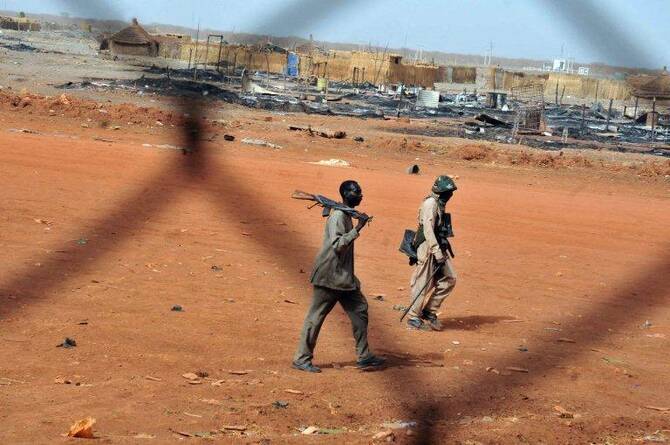
NAIROBI: South Sudan has sent its troops to neighboring Sudan to guard the strategic Heglig oil field near the border, its military head said on Thursday, days after the paramilitary Rapid Support Forces (RSF) took control of it.
Heglig houses the main processing facility for South Sudanese oil, which makes up the bulk of South Sudan’s public revenues. Some oil has continued to flow through Heglig, though at much reduced volumes.
Sudanese government forces and workers at the Heglig oil field withdrew from the area on Sunday to avoid fighting that could have damaged facilities there, government sources told Reuters on Monday.
General Paul Nang, South Sudan chief of defense forces, said the troop deployment was agreed between South Sudan’s President Salva Kiir, Sudan Army Chief General Abdel Fattah Al-Burhan and RSF head Mohamed Hamdan Dagalo.
“The three agreed that the area of Heglig should be protected because (it) is a very important strategic area for the two countries,” Nang said in comments on state-owned South Sudan Broadcasting Radio.
“Now it is the forces of South Sudan that are in Heglig.”
Oil is transported through the Greater Nile pipeline system to Port Sudan on the Red Sea for export, making the Heglig site critical both for Sudan’s foreign exchange earnings and for South Sudan, which is landlocked and relies almost entirely on pipelines through Sudan.
Another pipeline, Petrodar, runs from South Sudan’s Upper Nile State to Port Sudan.
The war that started in April 2023 between the Sudanese army and the RSF has repeatedly disrupted South Sudan’s oil flows, which before the conflict averaged between 100,000 and 150,000 barrels per day for export via Sudan.

South Sudan says its troops are guarding strategic Heglig oil field in Sudan
https://arab.news/c37k5
South Sudan says its troops are guarding strategic Heglig oil field in Sudan
- Sudanese government forces and workers at the Heglig oil field withdrew from the area on Sunday to avoid fighting that could have damaged facilities there
US lawmakers press Israel to probe strike on reporters in Lebanon
- “The IDF has made no effort, none, to seriously investigate this incident,” Welch said
- Collins called for Washington to publicly acknowledge the attack in which an American citizen was injured
WASHINGTON: Several Democratic lawmakers called Thursday for the Israeli and US governments to fully investigate a deadly 2023 attack by the Israeli military on journalists in southern Lebanon.
The October 13, 2023 airstrike killed Reuters videographer Issam Abdallah and wounded six other reporters, including two from AFP — video journalist Dylan Collins and photographer Christina Assi, who lost her leg.
“We expect the Israeli government to conduct an investigation that meets the international standards and to hold accountable those people who did this,” Senator Peter Welch told a news conference, with Collins by his side.
The lawmaker from Collins’s home state of Vermont said he had been pushing for answers for two years, first from the administration of Democratic president Joe Biden and now from the Republican White House of Donald Trump.
The Israeli government has “stonewalled at every single turn,” Welch added.
“With the Israeli government, we have been extremely patient, and we have done everything we reasonably can to obtain answers and accountability,” he said.
“The IDF has made no effort, none, to seriously investigate this incident,” Welch said, referring to the Israeli military, adding that it has told his office its investigation into the incident is closed.
Collins called for Washington to publicly acknowledge the attack in which an American citizen was injured.
“But I’d also like them to put pressure on their greatest ally in the Middle East, the Israeli government, to bring the perpetrators to account,” he said, echoing the lawmakers who called the attack a “war crime.”
“We’re not letting it go,” Vermont congresswoman Becca Balint said. “It doesn’t matter how long they stonewall us.”
AFP conducted an independent investigation which concluded that two Israeli 120mm tank shells were fired from the Jordeikh area in Israel.
The findings were corroborated by other international probes, including investigations conducted by Reuters, the Committee to Protect Journalists, Human Rights Watch, Amnesty International and Reporters Without Borders.
Unlike Welch’s assertion Thursday that the Israeli probe was over, the IDF told AFP in October that “findings regarding the event have not yet been concluded.”


