

Rwandan expelled from US given life genocide term

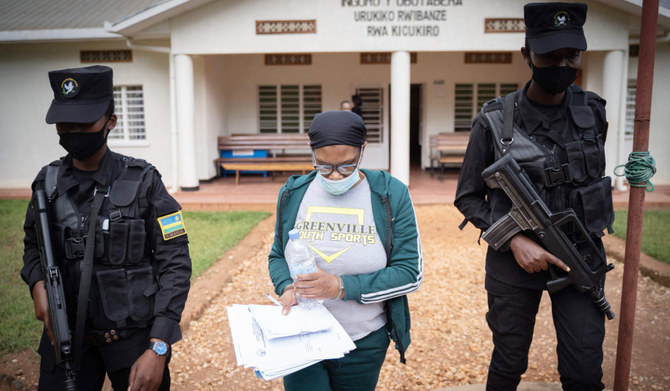
Beatrice Munyenyezi is escorted by police officers at a court in Kigali, Rwanda. (AFP file photo)
Short Url
Updated 13 April 2024
Follow

Rwandan expelled from US given life genocide term

  • The sentencing came days after Rwanda marked 30 years since the genocide carried out by the extremist Hutu regime between April and July 1994, which left more than 800,000 people dead, mostly Tutsi but also moderate Hutus, according to a UN tally

KIGALI: A Rwandan woman expelled to her homeland three years ago from the US has been given a life sentence for her role in the country’s 1994 genocide, The New Times newspaper reported on Saturday.
A court in the southern town of Huye found Beatrice Munyenyezi guilty of the charges of murder as a genocide crime, complicity in genocide, incitement to commit genocide, and complicity in rape.
However, she was acquitted on a charge of planning genocide, the Rwandan-based national paper said.
The sentencing came days after Rwanda marked 30 years since the genocide carried out by the extremist Hutu regime between April and July 1994, which left more than 800,000 people dead, mostly Tutsi but also moderate Hutus, according to a UN tally.

FASTFACT

Beatrice Munyenyezi was deported in April 2021 from the US after serving a 10-year prison sentence there for lying about her involvement in the genocide as she set about obtaining American citizenship.

Munyenyezi, 54, denied all the charges against her.
But the court concluded she was guilty of ordering and committing murders and attacks herself, including that of a nun who was raped on her orders.
Nicknamed the “commander,” the investigation and several witness accounts said that Munyenyezi was supervising a roadblock in Huye — then called Butare — where she identified Tutsis and had them killed, and also encouraged Hutu extremists to rape women.
She was deported in April 2021 from the US after serving a 10-year prison sentence there for lying about her involvement in the genocide as she set about obtaining American citizenship, saying she faced persecution in her own country.
The case attracted US attention as her mother-in-law Pauline Nyiramasuhuko, a former minister in the genocidal regime, and her husband Arsene Shalom Ntahobali, a former local militia leader, were also on trial for genocide crimes at the International Criminal Tribunal for Rwanda in Arusha, Tanzania.
They were also sentenced to life in prison, in 2011, before their terms were reduced to 47 years on appeal.


Sri Lankan lawmakers to meet to fast-track cyclone aid

Updated 10 sec ago
Follow

Sri Lankan lawmakers to meet to fast-track cyclone aid

  • Sri Lanka’s parliament will interrupt its recess to fast-track financial aid needed for rebuilding after Cyclone Ditwah, which killed nearly 650 people, officials said Sunday
COLOMBO: Sri Lanka’s parliament will interrupt its recess to fast-track financial aid needed for rebuilding after Cyclone Ditwah, which killed nearly 650 people, officials said Sunday.
President Anura Kumara Dissanayake had said last week that the island nation would need at least $1.66 billion in 2026 — in addition to the $166 million he said the government would spend this year — to rebuild and recover from what he described as the “most challenging natural disaster” to hit the country.
Parliament Speaker Jagath Wickramaratne on Sunday issued a notice for an urgent meeting of the legislature, which had gone into recess after approving the 2026 budget earlier this month and was not scheduled to meet again until January 6.
“I have summoned the parliament to meet on Thursday (18th)... having been requested so to do by the Hon. Prime Minister (Harini Amarasuriya),” the Speaker said in a gazette notification.
Officials at the country’s finance ministry told AFP that the meeting was being held to approve next year’s expenditure for cyclone recovery.
Official figures show that 643 people were killed, with another 184 still missing, following landslides and floods triggered by the cyclone.
At least 2.3 million people — just over 10 percent of the country’s population — were affected by the devastating calamity. Nearly 75,000 people remain housed in state-run camps.
An official leading the recovery effort has estimated that overall damage could cost up to $7 billion.
The United Nations last week set up a $35.3 million fund to provide food and temporary shelter to 658,000 of the worst-affected people.
The fund excludes reconstruction of damaged infrastructure or private property and focuses solely on immediate basic needs.
The United Nations’ top envoy to the country, Marc-Andre Franche, said last week $9.5 million had already been secured, with the European Union, Switzerland, Britain and the United States among donors pledging funds.
The United Nations urged member states and other donors to help raise the remaining $25.8 million.
A quarter of Sri Lanka’s population was living in poverty when the cyclone struck, Franche said, urging the international community to assist the devastated nation.
Sri Lanka is also recovering from its worst-ever financial crisis.
It defaulted on $46 billion of external debt in April 2022 and secured a $2.9 billion bailout from the International Monetary Fund in early 2023.