UN seeks emergency funding to support cyclone-hit Sri Lanka

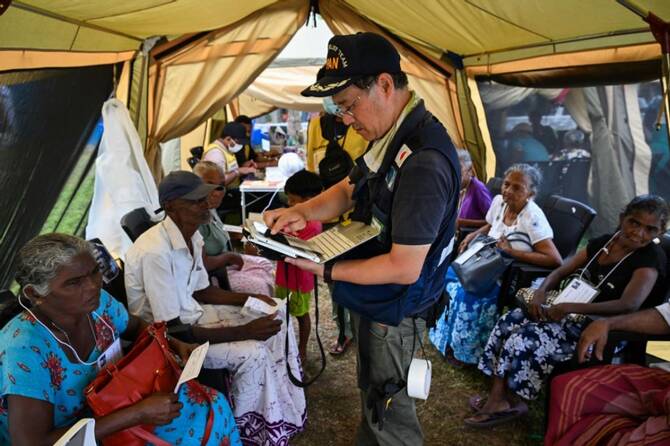
Japan Disaster Relief (JDR) medical officer tends to a flood victim at a camp in Chilaw, Sri Lanka. (AFP)
Short Url
Updated 11 December 2025
Follow

UN seeks emergency funding to support cyclone-hit Sri Lanka

  • The UN urged member states and other donors to help raise the remaining $25.8 million for the daunting recovery and reconstruction effort

COLOMBO: The United Nations called on international donors on Thursday to help provide crucial assistance to Sri Lanka, grappling with the aftermath of deadly Cyclone Ditwah.
The devastating storm, which hit the island nation late last month, killed at least 639 people and affected more than 2 million others — about 10 percent of the population — causing extensive damage to homes, roads, bridges, industries and agriculture.
Some 200 people are still missing.
The UN’s top envoy to the country, Marc-Andre Franche, announced plans for a $35.3-million emergency fund which he said was needed to feed and cater to the basic needs of 658,000 people who have been worst affected.
The fund excludes reconstruction of damaged infrastructure or personal property and focuses solely on immediate basic needs.
Franche said $9.5 million had already been secured, with the European Union, Switzerland, Britain and the United States among the donors pledging funds.
The United Nations urged member states and other donors to help raise the remaining $25.8 million for the daunting recovery and reconstruction effort.
The natural disaster, which President Anura Kumara Dissanayake has described as the most challenging for his country, struck as Sri Lanka was emerging from its worst economic crisis.
It defaulted on its $46-billion external debt in April 2022, and secured a $2.9-billion bailout from the International Monetary Fund in early 2023, having only stabilized the economy earlier this year.
“The disaster is hitting the country at a moment when around 25 percent of Sri Lankans still live in poverty,” Franche told reporters in Colombo.
Ongoing monsoon rains continue to pose a hazard with continued landslide warnings, the UN said.


Delhi ‘plant cafe’ offers residents respite from toxic smog

Updated 4 sec ago
Follow

Delhi ‘plant cafe’ offers residents respite from toxic smog

  • Air Quality Index in the capital regularly hovers above 300, which is considered dangerous
  • Residents are increasingly considering air pollution levels before venturing outside

NEW DELHI: As air pollution hovers around dangerous levels across New Delhi, a small cafe is becoming increasingly popular among residents of the Indian capital, offering respite from the constant toxic smog that threatens public health.

At Planterie, described by its owner as plant studio, rows of plants line both the floor and shelves as dozens of pots with spilling foliage hang by the window, resembling a lush greenhouse.

The cafe has gained traction online over the past month, after visitors posted clips of monitors showing comparatively better air quality inside.

On Wednesday, the Air Quality Index, or AQI, inside the cafe stood at about 30, a stark contrast to the levels outdoors, which hit above 300 across the capital.

On the AQI scale from 0 to 500, good air quality is represented by levels below 50, while levels above 300 are dangerous.

“This is one of a kind in Delhi … I’m sure you can feel the difference once you come in … (plants) make such a difference,” Sureika Narain, a walking tour guide and a regular at the cafe, told Arab News.

“I’ve grown up in Delhi. I’ve seen the pollution become worse and worse, but somehow I’m able to cope with it through the yogas, pranayama (breathing technique), whatever we do in life, and we find places like this that we carry on in life … this kind of place in Delhi is very important.”

Delhi has not recorded a single “clean air” day in 2025, with Air Quality Index readings hitting high above the 50 score throughout the year.

Its residents have staged at least four protests since October, demanding more government action to address air pollution.

The pollution levels also get worse as winter descends, when Delhi’s air further thickens into an opaque, toxic smog, triggering headaches, itchy eyes and burning throats among the public.

“During the winter season, pollution goes very high and people become more and more conscious. And people do find it, like if you come in here, immediately you feel a little bit of calmness, because all the plants and the air is very clean inside,” Farial Sabrina, co-owner of Planterie, told Arab News.

Since opening in 2021, she said some of her customers would commute at least 45 minutes just to visit the cafe, which offers a limited menu and can only accommodate about 20 people at a time.

“I feel grateful and sometimes overwhelmed with the response that people have given. People do come up to us and really thank us for existing,” Sabrina said.

“If you’re living in a big city, we want everything best, but air is a basic right.”

To limit exposure to toxic air, Delhi residents are increasingly choosing to stay at home, where air purifiers are at least keeping them safe.

As many start to consider AQI levels before going outside, places like Planterie are becoming a chosen alternative.

“I try to avoid going outside and the high AQI at the moment, so I mostly stay indoors with the air filter on,” Mona, a Planterie customer, told Arab News.

“The motivation to come here was basically to leave the house in the high AQI and, you know, find a place where the air quality is a little better.”

The same was true for Laura Supprin, a German living in the city.

“This is like a nice combination: good coffee, cute interior, some nice coffees or teas, and also lower AQI. So, it was a win-win,” she said.

“If you’re outside for too long, you, like, get a headache and don’t feel really great. So, having a place like this is good.”