

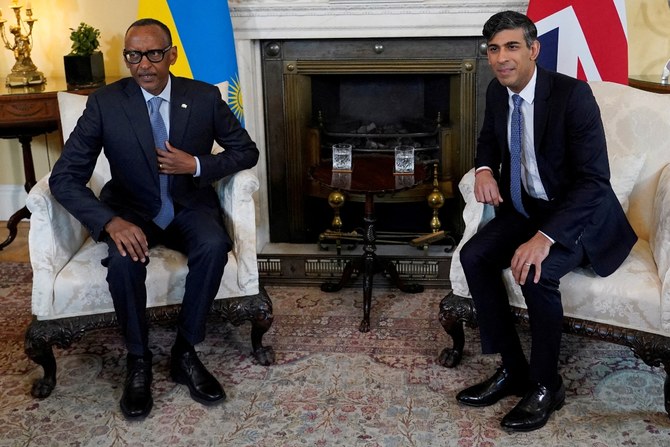
UK’s Rwanda plan rejected by Lords after vote to exempt Afghan soldiers

The Lords amendment on protections from deportation for former Afghan military personnel was proposed by a former UK defense secretary, Lord Browne of Ladyton, and supported by two former chiefs of the UK’s defense staff. (REUTERS)
Short Url
Updated 18 April 2024
Follow

UK’s Rwanda plan rejected by Lords after vote to exempt Afghan soldiers

  • Peers approve amendment to bill to protect ex-servicemen, families from being deported
  • Bill to return to Commons after Lords also vote to set up committee to monitor safety in Rwanda

LONDON: The UK’s House of Lords rejected the government’s plan to send migrants to Rwanda for asylum processing in a vote on Wednesday after it approved two amendments to the legislation.

The upper chamber of Parliament voted in favor of a proposal to exempt Afghans who worked with UK military personnel from being deported to the East African country, and of another that would see a committee established to monitor safety in Rwanda.

The bill will return to the House of Commons early next week, where MPs have previously refused to back amendments made to it by the Lords. 

The government of Prime Minister Rishi Sunak, who has made the Rwanda scheme a core part of his pledge to lower illegal migration across the English Channel before the next general election, says the bill in its current form is “the right way forward.”

However, a previous version of the scheme was rejected by the UK Supreme Court in 2023 as unlawful. 

The plan has also drawn cross-party criticism for its expense, worries about its effectiveness, the government’s inability to implement it and for the way it treats people in need of asylum, including former Afghan soldiers, translators and their families, many of whom risked their lives to assist the UK during operations in Afghanistan.

Numerous Afghans have been identified as having been threatened with deportation to Rwanda for entering the UK illegally, with many claiming safe legal routes either don’t work in practice or don’t exist.

The Independent highlighted the cases of a former Afghan Air Force pilot hailed as a “patriot” by former colleagues, who crossed the Channel in a small boat, and of two former Afghan special forces soldiers belonging to units known as “Triples” run by the British Army, who were wrongly denied assistance by the UK Ministry of Defence.

Along with reporting by Lighthouse Reports and Sky News, hundreds of other former Triples soldiers have also been identified hiding in Pakistan, awaiting an MoD review after many were refused entry to the UK.

The Lords amendment on protections from deportation for former Afghan military personnel was proposed by a former UK defense secretary, Lord Browne of Ladyton, and supported by two former chiefs of the UK’s defense staff.

Earlier on Wednesday Home Office minister Michael Tomlinson said peers should reject the amendments to “send a clear signal that if you come to the UK illegally, you will not be able to stay.”

But Lord Browne told the Lords: “Now is the time to give these people the sanctuary their bravery has earned.”

He added the government needed to be reminded of “the political consequences of their failure not to give either an assurance that is bankable or to accept this amendment. Because there is little, if any, support in your lordships’ House for their failure to do this and there (is) certainly no majority support in the country to treat these brave people this way.”

Lord Coaker, shadow home affairs spokesperson in the Lords, added: “Why on earth would the government oppose that particular amendment? It’s one of those things that is completely unbelievable.”

On Wednesday, Conservative MP Sir Robert Buckland told the Commons: “There is still a class of people who have served this country, who have been brave and have exposed themselves to danger, who have not yet been dealt with.

“Many of them are in Pakistan, and I think that it would have been helpful to have perhaps seen an amendment in lieu to deal with that point.”


Reference to Trump’s impeachments is removed from the display of his Smithsonian photo portrait

Updated 12 January 2026
Follow

Reference to Trump’s impeachments is removed from the display of his Smithsonian photo portrait

  • For now, references to Presidents Andrew Johnson and Bill Clinton being impeached in 1868 and 1998, respectively, remain as part of their portrait labels, as does President Richard Nixon’s 1974 resignation as a result of the Watergate scandal

WASHINGTON: President Donald Trump’s photo portrait display at the Smithsonian’s National Portrait Gallery has had references to his two impeachments removed, the latest apparent change at the collection of museums he has accused of bias as he asserts his influence over how official presentations document US history.
The wall text, which summarized Trump’s first presidency and noted his 2024 comeback victory, was part of the museum’s “American Presidents” exhibition. The description had been placed alongside a photograph of Trump taken during his first term. Now, a different photo appears without any accompanying text block, though the text was available online. Trump was the only president whose display in the gallery, as seen Sunday, did not include any extended text.
The White House did not say whether it sought any changes. Nor did a Smithsonian statement in response to Associated Press questions. But Trump ordered in August that Smithsonian officials review all exhibits before the nation celebrates the 250th anniversary of the Declaration of Independence on July 4. The Republican administration said the effort would “ensure alignment with the president’s directive to celebrate American exceptionalism, remove divisive or partisan narratives, and restore confidence in our shared cultural institutions.”
Trump’s original “portrait label,” as the Smithsonian calls it, notes Trump’s Supreme Court nominations and his administration’s development of COVID-19 vaccines. That section concludes: “Impeached twice, on charges of abuse of power and incitement of insurrection after supporters attacked the US Capitol on January 6, 2021, he was acquitted by the Senate in both trials.”
Then the text continues: “After losing to Joe Biden in 2020, Trump mounted a historic comeback in the 2024 election. He is the only president aside from Grover Cleveland (1837– 1908) to have won a nonconsecutive second term.”
Asked about the display, White House spokesman Davis Ingle celebrated the new photograph, which shows Trump, brow furrowed, leaning over his Oval Office desk. Ingle said it ensures Trump’s “unmatched aura ... will be felt throughout the halls of the National Portrait Gallery.”
The portrait was taken by White House photographer Daniel Torok, who is credited in the display that includes medallions noting Trump is the 45th and 47th president. Similar numerical medallions appear alongside other presidents’ painted portraits that also include the more extended biographical summaries such as what had been part of Trump’s display.
Sitting presidents are represented by photographs until their official paintings are commissioned and completed.
Ingle did not answer questions about whether Trump or a White House aide, on his behalf, asked for anything related to the portrait label.
The gallery said in a statement that it had previously rotated two photographs of Trump from its collection before putting up Torok’s work.
“The museum is beginning its planned update of the America’s Presidents gallery which will undergo a larger refresh this Spring,” the gallery statement said. “For some new exhibitions and displays, the museum has been exploring quotes or tombstone labels, which provide only general information, such as the artist’s name.”
For now, references to Presidents Andrew Johnson and Bill Clinton being impeached in 1868 and 1998, respectively, remain as part of their portrait labels, as does President Richard Nixon’s 1974 resignation as a result of the Watergate scandal.
And, the gallery statement noted, “The history of Presidential impeachments continues to be represented in our museums, including the National Museum of American History.”
Trump has made clear his intentions to shape how the federal government documents US history and culture. He has offered an especially harsh assessment of how the Smithsonian and other museums have featured chattel slavery as a seminal variable in the nation’s development but also taken steps to reshape how he and his contemporary rivals are depicted.
In the months before his order for a Smithsonian review, he fired the head archivist of the National Archives and said he was firing the National Portrait Gallery’s director, Kim Sajet, as part of his overhaul. Sajet maintained the backing of the Smithsonian’s governing board, but she ultimately resigned.
At the White House, Trump has designed a notably partisan and subjective “Presidential Walk of Fame” featuring gilded photographs of himself and his predecessors — with the exception of Biden, who is represented by an autopen — along with plaques describing their presidencies.
The White House said at the time that Trump himself was a primary author of the plaques. Notably, Trump’s two plaques praise the 45th and 47th president as a historically successful figure while those under Biden’s autopen stand-in describe the 46th executive as “by far, the worst President in American History” who “brought our Nation to the brink of destruction.”