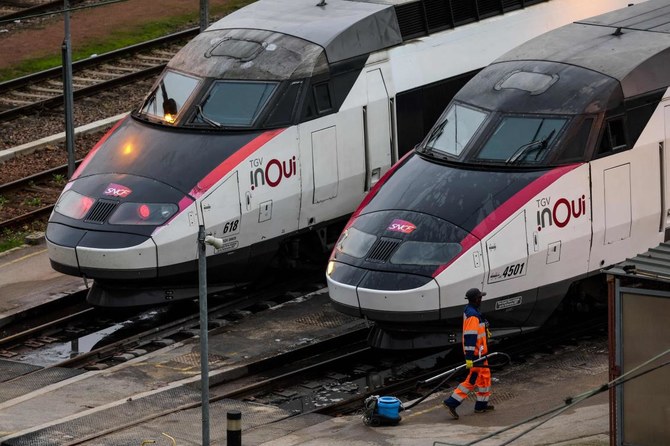
PARIS: France’s high-speed rail network was hit Friday with widespread and “criminal” acts of vandalism including arson attacks, paralyzing travel to Paris from across the rest of France and Europe, and thwarting Olympic athletes from travel, only hours before the grand opening ceremony of the Games.
French officials condemned the attacks as “criminal actions,” though they said there was no sign of a direct link to the Games. Prosecutors in Paris opened a national investigation saying the crimes could carry sentences of 10 to 20 years.
“It’s a hell of a way to start the Olympics,” said Sarah Moseley, a 42-year-old traveler waiting at the Gare du Nord station in Paris as she learned that her train to London was delayed by the rail chaos.
As Paris authorities geared up for a spectacular parade on and along the Seine River, three fires were reported near the tracks on the high-speed lines of Atlantique, Nord and Est, causing disruptions that affected hundreds of thousands of travelers.
Among them were Olympic athletes themselves.
Two out of four trains carrying Olympic athletes to Paris on the western Atlantique high-speed line were stopped hours before the opening ceremony, affected by the coordinated sabotage on the tracks, an official from the French railway operator SNCF said Friday.
Also, two German athletes in showjumping who were on a train to Paris to take part in the opening ceremony but had to turn back in Belgium because of the closures, and will now miss the ceremony, German news agency dpa reported.
“There was no longer a chance of making it on time,” rider Philipp Weishaupt, who was traveling with teammate Christian Kukuk, told dpa.
There were no known reports of injuries from the attacks.
French Prime Minister Gabriel Attal said France’s intelligence services have been mobilized to find the perpetrators of the “acts of sabotage” which he described as “prepared and coordinated.”
Attal said that the actions on the eve of the Olympics had “a clear objective: blocking the high-speed train network.”
He said the vandals strategically targeted the axes from the north, east and west toward Paris hours before the Olympics opening ceremony.
It was “a premeditated, calculated, coordinated attack” that indicates “a desire to seriously harm” the French people, the CEO of the national railway company SNCF, Jean-Pierre Farandou, said.
“The places were especially chosen to have the most serious impact, since each fire cut off two lines,” Farandou said.
Farandou said railway maintenance workers managed to thwart a suspected sabotage attempt along tracks heading south-east of Paris.
Workers on the night shift spotted intruders and alerted police, Farandou said.
“These people left, of course, very quickly when they realized they were spotted. So, thank you to the railway workers,” Farandou said. “Unfortunately, we couldn’t do it everywhere.”
Farandou said repairs were being made as police conducted forensic examinations and searched for the perpetrators.
France’s Transport Minister Patrice Vergriete said train traffic was beginning to resume in the afternoon, especially on the Atlantique line, which had been completely halted. “At Montparnasse station and Bordeaux station, which were the most affected, we should find one in three trains running this afternoon. Things are already improving,” he said.
The attack occurred against a backdrop of global tensions and heightened security measures as the city prepared for the 2024 Olympic Games. Many travelers were planning to converge on the capital for the opening ceremony, and many vacationers were also in transit.
Earlier this week, France’s interior minister said about 1,000 people suspected of possibly meddling for a foreign power have been blocked from attending the games.
Although he has repeatedly pointed to suspicions of Russia-backed interference, Gerald Darmanin added that such threats have also come from other countries that he did not name. Among those blocked were people suspected of Islamic radicalization or left- or right-wing political extremism, or who had significant criminal records, Darmanin said.
The coordinated train line attacks targeted remote locations far from the capital as 35,000 police officers are being deployed in Paris each day for the Olympics, with a peak of 45,000 for the opening ceremony.
French authorities have foiled several plots to disrupt the Olympics, including arresting a Russian man on suspicion of planning to destabilize the games.
Paris has been the target of deadly terror attacks in the past decade, and some French officials saw hosting the Olympic Games as a chance for the nation to heal from years of trauma.
The Paris police prefecture “concentrated its personnel in Parisian train stations” after the “massive attack” that paralyzed the TGV high-speed network, Laurent Nuñez, the Paris police chief, told France Info television.
Also Friday, the French airport of Basel-Mulhouse on the border with Germany and Switzerland was evacuated in the morning and shut down briefly “for safety reasons,” the airport said. It wasn’t clear whether there was a connection to the rail attacks.
The disruptions hit Paris’ Montparnasse station particularly hard.
In the station’s crowded hall, Maiwenn Labbé-Sorin said she spent hours stranded on a train before it doubled back to Paris.
“We stayed two hours without water, without toilets, without electricity,” she said. “Then we could go out on the track for a bit and then the train returned. Now I’m not sure what’s going to happen.”
Many passengers at the Gare du Nord, one of Europe’s busiest train stations, were looking for answers and solutions on Friday morning. All eyes were on the central message boards as most services to northern France, Belgium and the United Kingdom were delayed.
Germany’s national railway operator, Deutsche Bahn, said there also were short-notice cancelations and delays of trains between France and Germany.
“They should have more information for tourists, especially if it’s a malicious attack,” said Corey Grainger, a 37-year-old Australian sales manager on his way to London, as he rested on his two suitcases in the middle of the station.
Sports Minister Amélie Oudéa-Castera said authorities were working to “evaluate the impact on travelers, athletes, and ensure the transport of all delegations to the competition sites” for the Olympics. Speaking on BFM television, she added, “Playing against the Games is playing against France, against your own camp, against your country.”
The troubles came ahead of an opening ceremony planned for later Friday, in which 7,000 Olympic athletes are due to sail down the Seine past iconic Parisian monuments such as Notre-Dame Cathedral, the Louvre Museum, and the Musee d’Orsay.


![]()

Arson attacks paralyze French high-speed rail network hours before start of Olympics
Short Url
https://arab.news/8mj7a
Arson attacks paralyze French high-speed rail network hours before start of Olympics
- French officials condemned the attacks as “criminal actions”
- Two out of four trains carrying Olympic athletes to Paris on the western Atlantique high-speed line were stopped hours before the opening ceremony


Latest updates




© 2026 SAUDI RESEARCH & PUBLISHING COMPANY, All Rights Reserved And subject to Terms of Use Agreement.