Indonesia denies reports of recognizing Israel, vows to stay at forefront defending Palestine

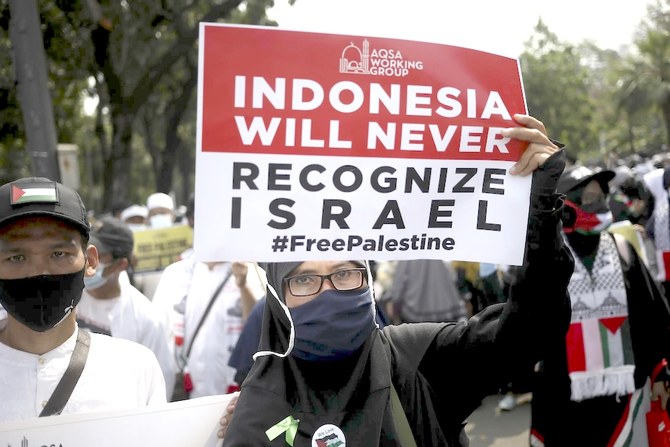
An Indonesian woman holds up a poster during a rally against Israel’s attacks on Gaza, outside the US embassy in Jakarta on May 21, 2021. (AP)
Short Url
Updated 12 April 2024
Follow

Indonesia denies reports of recognizing Israel, vows to stay at forefront defending Palestine

  • Establishing ties with Israel would be ‘political suicide’ for Indonesian leadership, analyst says
  • Israeli media reports claim Jakarta has begun OECD-brokered talks with Tel Aviv

JAKARTA: Jakarta has denied plans to establish diplomatic ties with Tel Aviv, following viral Israeli media reports claiming it was part of a deal to smooth Indonesia’s entry into the Organization for Economic Cooperation and Development.

Indonesia is the first Southeast Asian nation to apply for the membership of the 38-nation forum. Accession talks began in February, but according to local Israeli media were objected to by Tel Aviv over the lack of diplomatic ties with Jakarta.

Countries need unanimous approval from all OECD members, including Israel, to join the bloc.

Citing anonymous sources, the Israeli media reports claimed that Indonesia had started OECD-brokered talks with Israel, which in exchange for recognition would agree to the world’s most populous Muslim-majority nation joining the group.

However, the Indonesian Ministry of Foreign Affairs rejected the claims.

“There are no plans to open diplomatic ties with Israel, especially in the wake of Israel’s atrocities in Gaza. Indonesia’s stance has not changed, and we remain consistent in supporting Palestine’s independence within the framework of the two-state solution,” Lalu Muhamad Iqbal, the ministry’s spokesperson, told reporters late on Thursday.

“Indonesia will always be consistent and at the forefront of defending the rights of the Palestinian people.”

One of the staunchest supporters of Palestine, the Indonesian government has repeatedly called for an end to Israeli occupation of Palestinian territories and for a two-state solution based on pre-1967 borders.

Since the beginning of Israel’s deadly invasion of Gaza in October, Jakarta has also been vocal on the international stage, demanding an end to military support and weapons sales to Tel Aviv.

In January, Indonesian Foreign Minister Retno Marsudi called on the UN Security Council to make no exceptions in upholding international law, and to bring Israel to account over mass killing and atrocities.

Israeli ground and air attacks have in the past six months have killed at least 33,400 Palestinian citizens, almost half of them children. Over 70,000 have been injured, mutilated or disabled by the strikes, while thousands remain missing under the rubble.

The Israeli military has also levelled large parts of Gaza, destroyed most of its civilian and medical infrastructure, and blocked water, food and aid supplies to the territory, bringing its more than 2 million inhabitants to the brink of famine.

Since the beginning of the onslaught, mass public protests in support of Palestine have taken place frequently in Indonesia, where people see Palestinian independence as mandated by their own constitution, which calls for the abolition of colonialism.

“If the government takes the opposite step by recognizing the state of Israel and tolerating colonialism and oppression, that will cause political suicide, given that such a thing would lead to political delegitimization and loss of public trust,” Airlangga Pribadi Kusman, a political science lecturer at Airlangga University in Surabaya, told Arab News.

“The current and future Indonesian government should continue its policy of supporting Palestinian independence as has been the commitment of previous governments.”



EU eyes migration clampdown with push on deportations, visas

Updated 5 sec ago
Follow

EU eyes migration clampdown with push on deportations, visas

  • Irregular arrivals in the 27-nation bloc were down by more than a quarter in 2025
  • “The priority is clear: bringing illegal arrival numbers down and keeping them down,” Brunner said

BRUSSELS: The European Union on Thursday laid out plans to overhaul its visa system and step up deportations as part of a five-year migration strategy that cements a hardening line on the hot-button issue.
Irregular arrivals in the 27-nation bloc were down by more than a quarter in 2025, according to the EU’s border agency — but political pressure to act remains high.
“The priority is clear: bringing illegal arrival numbers down and keeping them down,” Magnus Brunner, the EU’s commissioner for migration, said.
The strategy unveiled Thursday stressed the need to boost deportations of failed asylum-seekers among the bloc’s priorities.
“Abuse gives migration a bad name — it undermines public trust and ultimately takes away from our ability to provide protection and undercuts our drive to attract talent,” said Brunner.
The European Parliament is currently examining a legal text put forward by the European Commission allowing for so-called “return hubs” to be set up outside the EU’s borders.
Criticized by rights groups, the proposal also envisages harsher penalties for migrants who refuse to leave European territory, including longer periods of detention.
European governments are under pressure to take a tougher stance amid a souring of public opinion on migration that has fueled a rightward shift across the bloc.

- ‘Flawed’ approach -

The strategy also mentioned reinforcing an “assertive migration diplomacy” to persuade third countries to help stop migrants from reaching Europe and take back their nationals with no right to stay.
Brussels recently struck or is negotiating deals with Northern African countries including Tunisia, Mauritania, Egypt and Morocco, whereby it gets help controlling migration flows in return for aid and investments.
Amnesty International criticized the EU’s approach as “flawed.”
It “only heightens its dependence on third countries to manage migration, while making it complicit in any rights violations that may result,” said Olivia Sundberg Diez, a policy analyst with the human rights group.
Brussels also put forward a brand-new visa strategy, with the stated objective of using the granting of access to EU territory to certain nationals as a diplomatic means to foster its policy goals.
It’s “one of the strongest tools in our hands,” said a commission source.
In particular, the EU wants to sanction countries that refuse to take back their nationals by restricting the issuance of visas, while easing procedures to attract skilled workers.
The commission is expected to present a plan for reform by the end of the year.