

Bangladesh resists pressure to accept more Rohingya from Myanmar

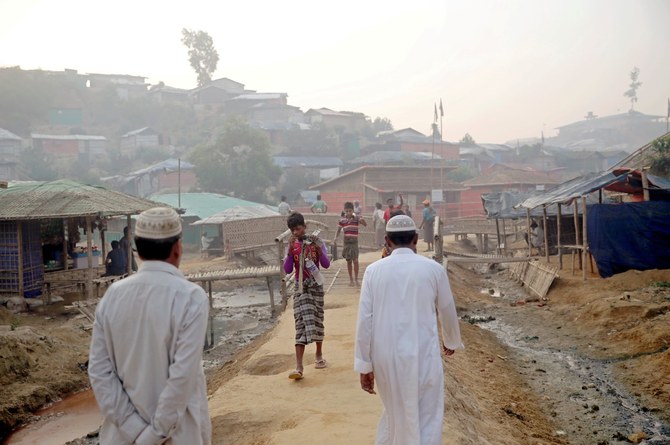
Rohingya refugees walk on a road at the Balukhali camp in Cox's Bazar, Bangladesh. (File/Reuters)
Short Url
Updated 21 February 2024
Follow

Bangladesh resists pressure to accept more Rohingya from Myanmar

  • Dhaka spends about $1.2 billion annually to support refugees
  • Myanmar fighting in early February spilled across the border into Bangladesh

DHAKA: Bangladesh is refusing to accept more Rohingya fleeing Myanmar, with authorities saying on Wednesday that the country is already overburdened in supporting more than 1.2 million refugees.

The Rohingya have sought refuge in Bangladesh over decades after escaping death and persecution in Myanmar, especially during a military crackdown in 2017.

The developing country spends an estimated $1.2 billion annually to support the refugees, as international aid for the oppressed stateless minority has fallen since 2020.

Most of the Rohingya refugees live in squalid camps in Cox’s Bazar district, a coastal region in eastern Bangladesh.

“We are already overburdened with more than 1 million Rohingya,” Mizanur Rahman, Bangladesh’s refugee relief and repatriation commissioner in Cox’s Bazar, told Arab News.

“The people of Bangladesh certainly will not welcome any more Rohingya here. Hospitality in the host community has turned into hostility. In this context, there is nothing much we can do for the newly displaced (Rohingya from Myanmar).”

Rahman’s statement follows comments from other Bangladeshi officials, including Road Transport and Bridges Minister Obaidul Quader, who told reporters earlier this month that Bangladesh “will not allow any more Rohingya to enter the country.”

Hundreds of people from Myanmar, including some Rohingya, have gathered at various points along Bangladesh’s border in recent weeks to seek shelter as the junta battles a strong resistance offensive.

Hundreds of Myanmarese border troops and police, some with bullet wounds, also sought refuge in Bangladesh during intense periods of fighting in early February.

“It can’t be said that the overall law and order situation is very good at the moment as almost every day there are incidents of murders … moreover, there have been new added tensions due to the unrest in the border areas,” Rahman said.

The Rohingya, which the UN has described as “one of the world’s most persecuted minorities,” have faced decades of discrimination and repression in Myanmar, where they are not recognized as an indigenous ethnic group and are denied the right to claim citizenship.

Thousands of Rohingya refugees embarked on deadly sea journeys from Bangladesh — and to a lesser extent from Myanmar — in 2023. Last year also saw the highest figure in nine years — 569 — of the number of Rohingya refugees who died or went missing during dangerous crossings.


‘New progress’ on North Korea possible in coming days, Seoul official says

Updated 3 sec ago
Follow

‘New progress’ on North Korea possible in coming days, Seoul official says

  • Senior official says Seoul has made considerable efforts to bring North Korea to dialogue
  • Trump administration has decided to lift sanctions for humanitarian aid projects to North Korea
SEOUL: A senior South Korean official said Friday “new progress” on North Korea could come within days, with a local report saying the Trump administration has decided to approve humanitarian sanctions exemptions for Pyongyang.
In a meeting with reporters in the United States, the senior official said Seoul has made considerable efforts to bring North Korea to dialogue.
“There could be some new progress in the coming days” on North Korea, the government official said on condition of anonymity.
Washington has long demanded that Pyongyang give up its banned nuclear weapons program, with the country under successive rounds of UN sanctions over it.
The South Korean senior official’s comments came while addressing US President Donald Trump’s scheduled trip to China in April.
Trump last year made repeated overtures to Pyongyang’s leader Kim Jong Un during his barnstorming tour of Asia, saying he was “100 percent” open to a meeting and even bucking decades of US policy by conceding that North Korea was “sort of a nuclear power.”
North Korea did not respond to Trump’s offer, and has repeatedly said it will never give up its nuclear weapons.
South Korea’s daily Dong-A Ilbo reported on Friday, citing Seoul’s unnamed government sources, that the Trump administration has decided to lift sanctions for humanitarian aid projects to North Korea, at the UN Security Council’s 1718 Committee.
Analysts say the move would allow South Korea’s NGOs to provide humanitarian assistance — such as nutritional supplements, medical equipment and water purification systems — to North Korea, an improverished state that has struggled to provide for its people.
Trump met North Korea’s Kim three times. The US leader once famously declared they were “in love” during his first term, in efforts to reach a denuclearization deal.
But since a summit in Hanoi in 2019 fell through over differences about what Pyongyang would get in return for giving up its nuclear weapons, no progress has been made between the two countries.
Seoul and Washington earlier this week reaffirmed their commitment to North Korea’s “complete denuclearization” and cooperation on Seoul’s nuclear-powered submarine plan, a move that has previously drawn an angry response from Pyongyang.
North Korea is set to hold a landmark congress of its ruling party soon, its first in five years.
Ahead of that conclave, Kim ordered the “expansion” and modernization of the country’s missile production.