


Dhaka: Billal Hossain was 8 months old when his mother Nurjahan Begum agreed to send him to day care at a charity-run orphanage near their home in a poor neighborhood of Dhaka. A few days later, he was gone forever.
Thousands of Bangladeshi babies were adopted abroad in the 1970s. Most of them were children born to survivors of a campaign of genocidal rape committed by the Pakistani military and associated paramilitary forces during Bangladesh’s liberation war in 1971.
Between 200,000 and 400,000 Bengali women and girls are believed to have been raped at the time, prompting the government of the newly independent Bangladesh to introduce emergency legislation in 1972 to allow foreigners to adopt the “war babies” left at orphanages across the country.
But Begum never gave up her son for adoption. It was 1976, and being a single mother of two living in the impoverished industrial area of Tongi, she hoped that at least her youngest child would be well fed by the charity that offered help.
She was not the only mother in the neighborhood who was approached by the orphanage, which they believed was run by a Dutch organization.

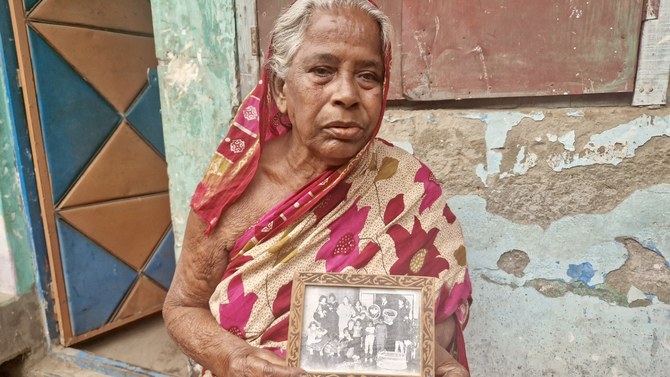
Nurjahan Begum sits in front of her home in Tongi area, Dhaka, Feb. 1, 2024, holding a photo believed to be showing Bangladeshi kids at a charity running a children’s home, where her son Billal Hossain disappeared in 1976. (AN Photo)
“They gained our trust by giving the children proper care. They would look after the children from 8 a.m. to 5 p.m., but after a few days, most of the children disappeared,” Begum told Arab News at her home in Tongi.
“I begged the orphanage over and over again to return my child, but to no avail.”
She appealed to the local authorities and the military, who at that time ruled the country, and some suspects were reportedly arrested in the case, but Begum did not learn anything about her son’s whereabouts.
After some time she was told her son would be returned to her after completing secondary school. That, too, never happened.
Now, at the age of 75, she looks back at a life spent waiting to see him again.
“The only thing I want is to get back my son,” she said. “If I could just see him ... I have been left with a feeling of emptiness in my heart.”
An investigation into the abduction of children in Tongi was launched by Bangladeshi authorities in December last year, after the British newspaper The Guardian reported on Bangladeshi children “wrongly adopted” to the Netherlands in the late 1970s.
Special Superintendent Mashroof Hossain of the Special Branch — the prime intelligence agency of Bangladesh Police — said that most of the parents likely did not know how to look for official help and their children only recently began to investigate their origins.
“These parents were lured with the offer that their children would be brought up in better conditions and that they would stay in Bangladesh. We have heard that in some cases the parents were asked to sign blank papers,” Hossain told Arab News.
“It’s a very complex and time-consuming probe as we need to find the details of incidents that happened 50 years ago. It’s not very easy. Many records from those days are missing, many people have already died.”
His team is in touch with 25 adoptees and four of them have already been reunited with their families in Bangladesh — a drop in the ocean so far, as Hossain is sure that the actual number of cases is “much higher,” as in the Netherlands alone an association of people adopted from Bangladesh has 500 members.
“During those days, not only war babies were adopted from Bangladesh, but also other babies were there, disguised as war babies. The cases we are dealing with now are of the children of Tongi, who were not war babies,” he said.
“It’s our responsibility to resolve this. A heinous crime was committed. Even after 50 years, if we can resolve a few cases, Bangladesh would at least get some relief from this historic burden.”
Rahman Khaa, 70, was working as a rickshaw driver when the Tongi children’s home approached his wife Razia who agreed to give their 1-year-old daughter Nasima Begum to the charity’s care.
The girl stayed there and they were allowed to regularly visit. But one month later, she went missing.
“I asked the orphanage’s authorities about her whereabouts. I was told that they had no clear idea where she had been transferred,” Khaa said.
His wife passed away last year, grieving until her last day over her decision to admit the child into the charity’s care.
“I know that from another world her mother’s blessings are always with our daughter,” Khaa said.
“She is for sure a grown-up woman now. If she returns, it will make me the happiest man on Earth.”


