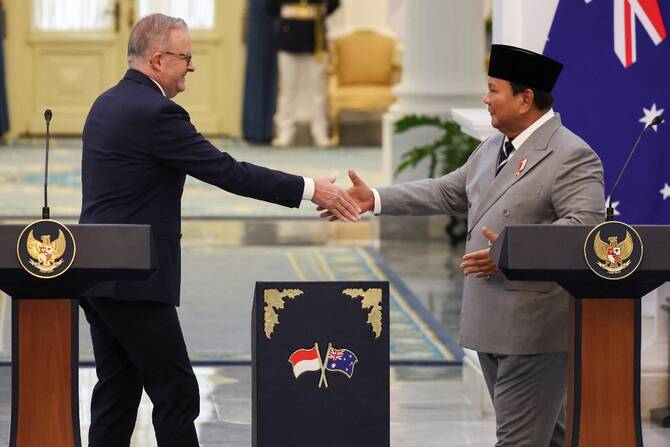
JAKARTA: Indonesian and Australian leaders signed a new bilateral security treaty Friday that both governments say will deepen ties between the often-testy neighbors.
The treaty was signed in Indonesia’s capital, Jakarta, three months after Australian Prime Minister Anthony Albanese and Indonesian President Prabowo Subianto announced in Sydney that negotiations on the pact had been substantively concluded, highlighting their ambition to better utilize the two country’s past security agreements inked in 1995 and 2006.
Albanese has cast the agreement as a “watershed moment” in relations with its major closest neighbor, saying in a statement ahead of his arrival in Jakarta late Thursday, that it marks a major extension of existing security and defense cooperation and reflects a relationship “as strong as it has ever been.” He is traveling with Foreign Minister Penny Wong, who called it the most important step in the partnership in three decades.
Analysts said the treaty is becoming increasingly important to Australia in face of growing tensions with China in the region. However, it is expected to echo elements of a 1995 security agreement inked between then-Prime Minister Paul Keating and Indonesia’s former authoritarian President Suharto — Prabowo ‘s former father-in-law.
That agreement committed both nations to consult on security issues and respond to adverse challenges, but was terminated by Indonesia four years later following Australia’s decision to lead a peacekeeping mission into East Timor. The two countries improved their security relationship over the next decade by signing a new treaty in 2006, known as the Lombok Treaty, which they expanded on in 2014.
Susannah Patton from the Lowy Institute, a Sydney-based international policy think tank, said the agreement, whose text has not been published, is largely about the political commitment to consult. She described it as a “symbolic agreement,” noting the 2024 defense cooperation accord was more focused on practical military collaboration.
Patton said the new treaty sits below Australia’s alliance with the United States and the security agreement signed with Papua New Guinea in terms of obligations. She did not expect to find clarity in the agreement on whether Indonesia would come to Australia’s defense in the event of a security threat in the region.
“So it’s very much not a mutual defense treaty because I think that would not be politically acceptable to Indonesia as a non-aligned country,” Patton said.
Despite that, she praised the agreement as a huge success for Albanese, because not many people would have predicted this kind of agreement would be possible with Indonesia as a non-aligned country with “a very big difference between the way that Australia and Indonesia see the world.”
She said that Australia has very much taken advantage of the fact that the Southeast Asia country is now under Prabowo, a president who is really much more willing to break with Indonesian foreign policy tradition and to strike leader-led agreements.
Albanese’s office framed the visit as his fifth official trip to Indonesia and part of a broader push to expand cooperation beyond security into trade, investment, education and development.
Albanese is scheduled to meet Prabowo and Indonesian officials through Sunday before returning to Australia.
Although Indonesia, a vast archipelago nation of more than 280 million people, is often presented as one of Australia’s most important neighbors and strategic allies, the relationship has undergone various ups and downs. Recent disagreements include allegations of wiretapping by the Australian Signals Directorate to monitor the private phone calls of Indonesia’s former President Susilo Bambang Yudhoyono, his wife and other senior officials, as well as Indonesia’s execution of Australian drug smugglers, and cases of people smuggling.


![]()


Leaders of Indonesia and Australia sign a new security treaty to affirm deeper ties
Short Url
https://arab.news/49wan
Leaders of Indonesia and Australia sign a new security treaty to affirm deeper ties
- Analysts said the treaty is becoming increasingly important to Australia in face of growing tensions with China in the region


Congress taking first votes on Iran war as debate rages about US goals
- The US Senate is headed toward a vote on President Donald Trump’s decision to embark on a war against Iran
- It’s an extraordinary test in Congress for a conflict that has rapidly spread across the Middle East with no clear US exit strategy
WASHINGTON: The US Senate is headed toward a vote Wednesday on President Donald Trump’s decision to embark on a war against Iran, an extraordinary test in Congress for a conflict that has rapidly spread across the Middle East with no clear US exit strategy.
The legislation, known as a war powers resolution, gives lawmakers an opportunity to demand congressional approval before any further attacks are carried out. The Senate resolution and a similar bill being voted on in the House later this week face unlikely paths through the Republican-controlled Congress and would almost certainly be vetoed by Trump even if they were to pass.
Nonetheless, the votes marked a weighty moment for lawmakers. Their decisions on the five-day-old war — which Trump entered without congressional approval — could determine the fates of US military members, countless other lives and the future of the region.
“Wars without clear objectives do not remain small. They get bigger, bloodier, longer and more expensive,” said Senate Democratic leader Chuck Schumer at a news conference Tuesday. “This is not a necessary war. It’s a war of choice.”
Trump administration scrambles for congressional support
After launching a surprise attack against Iran on Saturday, Trump has scrambled to win support for a conflict that Americans of all political persuasions were already wary of entering. Trump administration officials have been a frequent presence on Capitol Hill this week as they try to reassure lawmakers that they have the situation under control.
“We are not going to put American troops in harm’s way,” Secretary of State Marco Rubio told reporters in a raucous news conference at the Capitol Tuesday.
But six US military members were killed over the weekend in a drone strike in Kuwait.
Trump has also not ruled out deploying US ground troops. He has said he is hoping to end the bombing campaign within a few weeks, but his goals for the war have shifted from regime change to stopping Iran from developing nuclear capabilities to crippling its navy and missile programs.
“I think they are achieving great success with what they’ve done so far,” Senate Majority Leader John Thune said Tuesday, adding that what happens next in the country will be “largely up to the Iranian people.”
Almost all Republican senators were readying to vote Wednesday against the war powers resolution to halt military action, but a number still expressed hesitation at the idea of deploying troops on the ground in Iran.
“I don’t think the American people want to see troops on the ground,” said Sen. Bill Cassidy, R-Louisiana, as he exited a classified briefing Tuesday. He added that Trump administration officials “left open that possibility,” but it wasn’t an option they were emphasizing.
Lawmakers to go on record
The votes in Congress this week represented potentially consequential markers of just where lawmakers stand on the war as they look ahead to midterm elections and the consequences of the conflict.
“Nobody gets to hide and give the president an easy pass or an end-run around the Constitution,” said Sen. Tim Kaine, the Virginia Democrat leading the war powers resolution. “Everybody’s got to declare whether they’re for this war or against it.”
Republican leaders have successfully, though narrowly, defeated a series of war powers resolutions pertaining to several other conflicts that Trump has entered or threatened to enter. This one, however, is different.
Unlike Trump’s military campaigns against alleged drug boats or even Venezuelan leader Nicolás Maduro, the attack on Iran represents an open-ended conflict that is already ricocheting across the region. For Republicans who are used to operating in a political party dominated by Trump and his promises of keeping the US out of foreign entanglements, the moment represented a bit of whiplash.
“War is ugly, it always has been ugly, but we’re taking out a regime that has been trying to attack us for quite some time,” said Sen. Markwayne Mullin, an Oklahoma Republican.
Meanwhile, Sen. Lindsey Graham, a South Carolina Republican who has long pushed Trump to engage overseas, argued that the widening conflict represented an opportunity for Arab and European countries to join in the fight against Iran and the militant groups it supports.
“I don’t mind people being on record as to whether or not they think this is a good idea,” he told reporters, but also argued that too much power over the military was ceded to Congress in the War Powers Act, which mandates that presidents must withdraw troops from a conflict within 90 days if there is no congressional authorization.
House vote looms
On the other side of the Capitol, House leaders were also readying for an intense debate over the war followed by a vote Thursday.
“I do believe we have the votes to defeat it, I certainly hope we do,” House Speaker Mike Johnson said after an all-member briefing on Tuesday night.
Meanwhile, House Democratic leader Hakeem Jeffries said he expected a strong showing from Democrats in favor of the war powers resolution.
As lawmakers emerged from a closed-door briefing Tuesday night, Rep. Gregory Meeks, the top Democrat on the House Foreign Affairs Committee, implored the Trump administration to “come to Congress” and speak directly to the American people about the rationale for the war.
His voice filled with emotion as he said, “Our young men and women’s lives are on the line.”
The legislation, known as a war powers resolution, gives lawmakers an opportunity to demand congressional approval before any further attacks are carried out. The Senate resolution and a similar bill being voted on in the House later this week face unlikely paths through the Republican-controlled Congress and would almost certainly be vetoed by Trump even if they were to pass.
Nonetheless, the votes marked a weighty moment for lawmakers. Their decisions on the five-day-old war — which Trump entered without congressional approval — could determine the fates of US military members, countless other lives and the future of the region.
“Wars without clear objectives do not remain small. They get bigger, bloodier, longer and more expensive,” said Senate Democratic leader Chuck Schumer at a news conference Tuesday. “This is not a necessary war. It’s a war of choice.”
Trump administration scrambles for congressional support
After launching a surprise attack against Iran on Saturday, Trump has scrambled to win support for a conflict that Americans of all political persuasions were already wary of entering. Trump administration officials have been a frequent presence on Capitol Hill this week as they try to reassure lawmakers that they have the situation under control.
“We are not going to put American troops in harm’s way,” Secretary of State Marco Rubio told reporters in a raucous news conference at the Capitol Tuesday.
But six US military members were killed over the weekend in a drone strike in Kuwait.
Trump has also not ruled out deploying US ground troops. He has said he is hoping to end the bombing campaign within a few weeks, but his goals for the war have shifted from regime change to stopping Iran from developing nuclear capabilities to crippling its navy and missile programs.
“I think they are achieving great success with what they’ve done so far,” Senate Majority Leader John Thune said Tuesday, adding that what happens next in the country will be “largely up to the Iranian people.”
Almost all Republican senators were readying to vote Wednesday against the war powers resolution to halt military action, but a number still expressed hesitation at the idea of deploying troops on the ground in Iran.
“I don’t think the American people want to see troops on the ground,” said Sen. Bill Cassidy, R-Louisiana, as he exited a classified briefing Tuesday. He added that Trump administration officials “left open that possibility,” but it wasn’t an option they were emphasizing.
Lawmakers to go on record
The votes in Congress this week represented potentially consequential markers of just where lawmakers stand on the war as they look ahead to midterm elections and the consequences of the conflict.
“Nobody gets to hide and give the president an easy pass or an end-run around the Constitution,” said Sen. Tim Kaine, the Virginia Democrat leading the war powers resolution. “Everybody’s got to declare whether they’re for this war or against it.”
Republican leaders have successfully, though narrowly, defeated a series of war powers resolutions pertaining to several other conflicts that Trump has entered or threatened to enter. This one, however, is different.
Unlike Trump’s military campaigns against alleged drug boats or even Venezuelan leader Nicolás Maduro, the attack on Iran represents an open-ended conflict that is already ricocheting across the region. For Republicans who are used to operating in a political party dominated by Trump and his promises of keeping the US out of foreign entanglements, the moment represented a bit of whiplash.
“War is ugly, it always has been ugly, but we’re taking out a regime that has been trying to attack us for quite some time,” said Sen. Markwayne Mullin, an Oklahoma Republican.
Meanwhile, Sen. Lindsey Graham, a South Carolina Republican who has long pushed Trump to engage overseas, argued that the widening conflict represented an opportunity for Arab and European countries to join in the fight against Iran and the militant groups it supports.
“I don’t mind people being on record as to whether or not they think this is a good idea,” he told reporters, but also argued that too much power over the military was ceded to Congress in the War Powers Act, which mandates that presidents must withdraw troops from a conflict within 90 days if there is no congressional authorization.
House vote looms
On the other side of the Capitol, House leaders were also readying for an intense debate over the war followed by a vote Thursday.
“I do believe we have the votes to defeat it, I certainly hope we do,” House Speaker Mike Johnson said after an all-member briefing on Tuesday night.
Meanwhile, House Democratic leader Hakeem Jeffries said he expected a strong showing from Democrats in favor of the war powers resolution.
As lawmakers emerged from a closed-door briefing Tuesday night, Rep. Gregory Meeks, the top Democrat on the House Foreign Affairs Committee, implored the Trump administration to “come to Congress” and speak directly to the American people about the rationale for the war.
His voice filled with emotion as he said, “Our young men and women’s lives are on the line.”
Latest updates


© 2026 SAUDI RESEARCH & PUBLISHING COMPANY, All Rights Reserved And subject to Terms of Use Agreement.