


CAIRO: On a recent press trip arranged by Art Cairo, which ran Jan. 23-26, the organizers treated visitors to a tour of the Egyptian capital’s cultural hotspots — including some unmissable tourist favorites and sites that sit off the beaten path. For those planning a trip to the bustling city, it’s a valuable guide to how best to appreciate Cairo’s rich cultural history.
Our first stop was Aisha Fahmy Palace, an elegant, reddish-brown residence built in 1907 on the banks of the Nile in the Zamalek district, and named after the daughter of Egyptian aristocrat and King Fuad I’s army chief, Ali Fahmy.

Aisha Fahmy Palace, Cairo. (Shutterstock)
Architecturally, the palace reflects a European neoclassical style (it was designed by Italian architect Antonio Lasciac) blended with local influences, with ornate façades, marble staircases, intricate woodwork and richly decorated interiors. For decades, it served as a private residence before being transferred to the Egyptian Ministry of Culture. Today, it functions as a bridge between Cairo’s aristocratic history and its contemporary cultural life, regularlyhosting exhibitions, performances and interdisciplinary artistic projects. During Art Cairo, it was the location for an exhibition of Egyptian art — depicting key moments in its history — titled “Soura min Masr” (A Picture from Egypt).
Next up was Amir Taz Palace — a rare surviving example of Mamluk architecture in Cairo. According to the Ministry of Tourism and Antiquities, it was commissioned in 1352 and “pays testament to the city’s medieval urban past”through its monumental entrance, central courtyard and finely carved stone façades. The ceilings of the palace are decorated with geometric and plant motifs typical of Islamic adornment, while the maq’ad is a significant example of Mamluk domestic architecture. The traditional raised loggia or reception hall would have served as a grand sitting area overlooking the inner courtyard. Today, the palace operates as a cultural center, hosting exhibitions, concerts, lectures and artistic events.

Amir Taz Palace, Cairo. (Shutterstock)
We moved on to the clutch of buildings in medieval Cairo known as the Khayer-Bek Complex, named for the governor of Aleppo under Sultan Al-Ghouri who defected to the Ottoman side in 1516 — effectively ending Mamluk rule — and was rewarded with a high-ranking official role when the Ottomans conquered Egypt.
The complex is home to the 13th-century Alin Aq Palace, as well as several later Ottoman houses that are all interconnected. It also boasts a mausoleum, and a mosque featuring a brick minaret whose threshold is made from a block of stone from a pharaonic building, summing up this historical hodgepodge of a site in an architectural nutshell.

Inside the Mahmoud Khalil Museum. (Shutterstock)
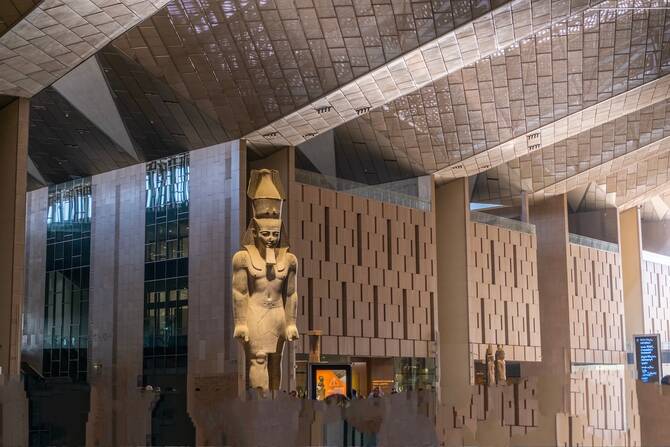
We then returned to Art Cairo’s staging ground, the newly inaugurated Grand Egyptian Museum — the largest archaeological museum in the world dedicated to a single civilization. It houses more than 57,000 artifacts across itsTutankhamun Galleries, Main Galleries, Grand Hall, Grand Staircase and Khufu’s Boat Museum. The 4,600-year-old solar boat of King Khufu, the pharaoh who is credited with building the Great Pyramid of Giza, is a particular draw, along with a showstopping exhibition of the complete collection of King Tutankhamun — more than 5,000 artifacts showcased together for the first time. Both draw hoards of visitors, but are well worth the visit.
Finally, although the Mahmoud Khalil Museum was not featured on the Art Cairo program, it is one of Egypt’s most significant fine art institutions and a rare example of a private collection transformed into a public museum. Housed in a Nile-side palace in Giza, the museum was once the residence of the eponymous prominent Egyptian politician and art collector and his French wife, Emilienne Luce. Built in the early 20th century, the mansion reflects European architectural influences popular among Cairo’s elite at the time.

The mosque in the Khayer Bek Complex, Cairo. (Shutterstock)
Its collection is internationally renowned, featuring works by major European artists including Vincent van Gogh, Claude Monet, Pierre-Auguste Renoir and Paul Gauguin, alongside seminal examples of Egyptian modern art.
Since opening to the public in 1962, the museum has played a key role in Egypt’s cultural landscape, hosting exhibitions and serving as a hub for art education and appreciation. It has also been the subject of crime-related headlines, having been the site of more than one art heist. It was closed for a decade following the 2010 theft of a Van Gogh painting known as “Poppy Flowers,” which was cut from its frame and stolen in August of that year.


