

Pakistan’s Lahore marks Basant festival after government lifts decades-old ban on kite flying

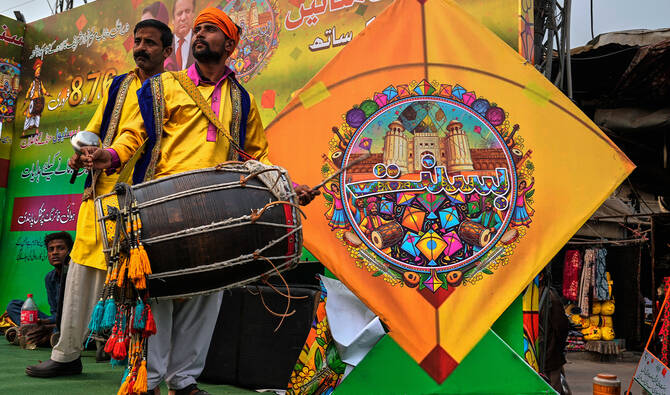
Traditional drummers perform on a truck decorated with colourful kites ahead of the three-day kite flying Basant festival celebrations, in Lahore, Pakistan, on Feb. 3, 2026. (AP)
Short Url
Updated 06 February 2026
Follow

Pakistan’s Lahore marks Basant festival after government lifts decades-old ban on kite flying

  • Pakistan’s Punjab province outlawed Basant in 2000s after authorities linked metal-coated kite strings and celebratory gunfire to multiple deaths and injuries
  • The three-day festivities began after midnight on Thursday as residents gathered on brightly lit rooftops to fly colorful kites to welcome the cultural festival

ISLAMABAD: The eastern Pakistani city of Lahore on Friday welcomed the return of Basant spring festival after the government this year lifted a more than two-decade-old ban on kite flying for a period three days, with Punjab Chief Minister Maryam Nawaz urging masses to follow precautions.

Basant, once a vibrant tradition signaling the arrival of spring with colorful kites and rooftop festivities, was outlawed in Pakistan’s Punjab province in the 2000s after authorities linked metal-coated kite strings and celebratory gunfire to multiple deaths and injuries.

The government of CM Nawaz this year allowed Basant festivities in the provincial capital of Lahore, Pakistan’s cultural heart, on Feb. 6-8, but issued an extensive safety plan regarding kite materials and motorcyclists and pedestrians to avoid any untoward incident.
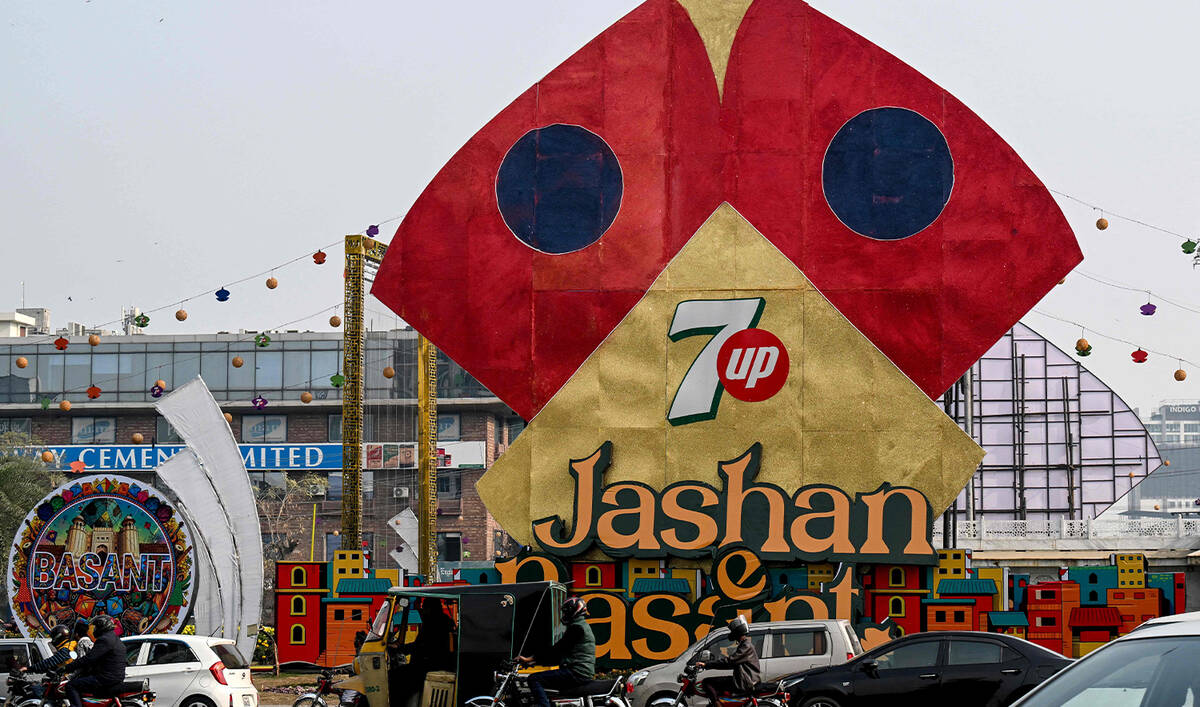


Commuters ride past a large model of a kite celebrating the Basant festival in Lahore on February 3, 2026. (AFP)

The three-day festivities began after midnight on Thursday as residents of Lahore gathered on their brightly lit rooftops along with family, friends and guests visiting from other cities and abroad to fly colorful kites to welcome the return of Basant.

“Kites return to the skies of Lahore as Basant comes alive again after 25 years,” CM Nawaz said on X. “A celebration of culture, color, and community! Let’s enjoy the festivities together responsibly, follow all safety SOPs (standard operating procedures), and make this Basant safe for everyone.”

Provincial officials, including Punjab Information Minister Azma Bokhari, were seen flying kites in videos widely shared online. Meanwhile, the prices of air tickets from various Pakistani cities to Lahore have skyrocketed during the three days of the festival as more and more people try to join the celebrations after over a 20-year-hiatus.

The Pakistan Meteorological Department (PMD) this week forecast favorable weather conditions for kite flying in Lahore on Feb. 6-8, marked by light westerly winds blowing at speeds of 10–15 kilometers an hour.

Authorities have distributed 1 million safety rods among motorcyclists through designated safety points across Lahore, with spending on the initiative crossing Rs110 million ($392,000), according to local media reports. To enforce regulations and manage traffic flow, around 100 road safety camps have been set up in the city, staffed by teams from the district administration, traffic police and rescue services.

In addition, the Punjab government has launched a free shuttle service to reduce traffic congestion and promote safer travel via 695 buses deployed across Lahore.


Pakistan to maintain hard line on Afghanistan after strikes as Taliban vows military response

Updated 26 February 2026
Follow

Pakistan to maintain hard line on Afghanistan after strikes as Taliban vows military response

  • Islamabad blames Afghanistan’s ‘guerrilla mindset’ for escalating tensions between the two countries
  • Afghan Taliban spokesperson denies militant presence in his country, accuses Pakistan of hitting civilians

ISLAMABAD: Pakistan vowed on Wednesday to continue its current policy toward Afghanistan unless the Taliban leadership abandons its “guerrilla mindset,” days after Islamabad carried out airstrikes inside Afghan territory, sharply escalating tensions between the two neighbors once again.

Pakistan conducted intelligence-based strikes overnight into Sunday in Afghanistan’s eastern Nangarhar and southeastern Paktika provinces, saying it had targeted camps of the banned Tehreek-e-Taliban Pakistan (TTP), its affiliates and Daesh-linked fighters.

Islamabad has long accused Kabul of allowing militant groups to use Afghan soil to launch attacks on Pakistani civilians and security forces, a charge the Taliban deny. The two sides also clashed in October last year, leading Pakistan to close key border crossings for bilateral and transit trade.

State Minister for Interior Talal Chaudhry told Geo News that Pakistan had attempted dialogue but would now persist with practical measures if the Taliban failed to change course.

“They call themselves a state, but they have not yet emerged from their guerrilla mindset,” he said.

“Now, with the practical steps we are taking, we want to change their behavior and see them in the form of a state,” he added.

Pakistan blamed a string of recent suicide bombings in Islamabad, Bajaur and Bannu on militants operating from Afghan territory before launching the latest strikes.

Chaudhry said Afghanistan had been acting like “an irresponsible neighbor,” warning that his country’s current approach would continue if attacks inside Pakistan persisted.

“This war will be won, and all this will end,” he said. “If it is not resolved the straight way, then it will be completely ended by a hard-line approach.”

Meanwhile, Kabul has condemned the airstrikes as violations of its sovereignty and said civilians were killed.

In an interview with Al Arabiya, Taliban government spokesman Zabihullah Mujahid also pledged to respond militarily.

“It would be a military response, but its details are confidential and I cannot explain further,” he said.

Mujahid rejected Pakistan’s allegations that TTP or Daesh militants operate from Afghan soil, saying security problems inside Pakistan were domestic in nature.

“Afghan soil is not allowed to be used against anyone,” he said, adding that Kabul had carried out extensive operations against Daesh and eliminated its presence in Afghanistan.

The 2,600-kilometer border between the two countries remains a vital trade and transit route, but crossings have faced repeated closures amid rising tensions, disrupting commerce and humanitarian movement.

Several regional countries, including Saudi Arabia, Türkiye and Qatar, have sought to mediate between the two countries, though their military exchanges risk further destabilizing their ties.