

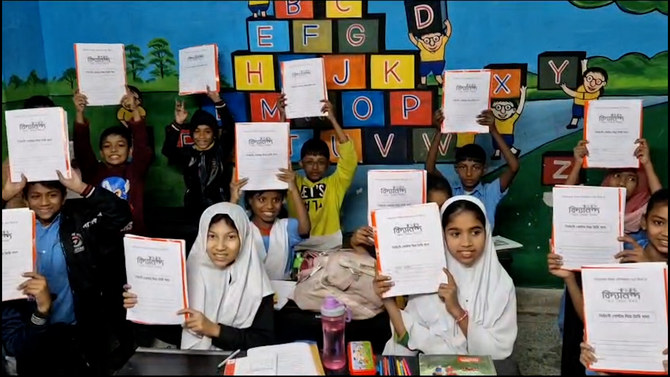
Bangladeshi election posters get new life as stationery for kids

Bangladeshi children hold school notebooks made from election posters recycled by Bidyanondo Foundation, in Dhaka. (AN Photo)
Short Url
Updated 08 February 2024
Follow

Bangladeshi election posters get new life as stationery for kids

  • 27,000 tonnes of campaign posters used in Bangladesh’s recent election
  • Bidyanondo Foundation workers gathered 100,000 posters from streets of 2 cities alone

DHAKA: Taped to the walls, fastened to fences, campaign posters were everywhere, littering the streets of Bangladesh before and after general polls.

They might have well remained there or headed to the landfill, but soon social workers stepped in to give them a new lease of life.

Some 27,000 tonnes of posters were used for last month’s election. When they were still hanging, with the photos of politicians smiling to voters, officials at one of the country’s biggest social welfare organizations, the Bidyanondo Foundation, were thinking of ways to prevent them from going to waste.

“Our main objective was to turn the waste into valuables ... Why should these posters remain as litter on the streets?” Abdullah Al-Mamun, the foundation’s spokesperson, told Arab News.

“People know our Bidyanondo as a differently thinking organization. Our ideas are always a bit out of the box.”

Days after the Jan. 7 polls ended, the organization’s volunteers started collecting the campaign litter from the streets of the capital, Dhaka, and the southeastern city of Chattogram.

By last week they had gathered 100,000 posters, some of which have already become notebooks for marginalized children under the organization’s care.

On the market, a notebook that would be enough for one month of classes, costs 100 Bangladeshi taka (around $1) — a price most children from marginalized groups would not be able to pay.

“If we calculate for 12 months of the year, this way it would save 1,000 taka per student. For a poor family of a rickshaw puller, 1,000 taka is a significant amount,” Al-Mamun said.

“We run seven orphanages and two schools, where there are more than 500 students ... Every year, we have to spend thousands of taka to buy writing notebooks, so we thought we could distribute these among our children.”

It takes 20 posters to make one notebook. So far, around 1,000 have been produced and are already in use.

Sumaya Akhter, a nine-year-old daughter of a rickshaw driver from a Bidyanondo-run school in Dhaka’s Mirpur, has already been writing in her notebook.

“I write Bengali, English, mathematics, and other subjects. I will also do drawings here,” she told Arab News.

She liked drawing village landscapes most, similar to her classmate Zahid Chowkider, who proudly showed the two drawings that he had already made.

“Another one, I just started. There is a home, tree, boat, cloud, sun, bird,” he said. “The paper of this notebook is good as it’s a little thicker, which is good for drawings.”


North Korea accuses South of another drone incursion

Updated 12 sec ago
Follow

North Korea accuses South of another drone incursion

  • The North Korean military tracked a drone “moving northwards” over the South Korean border county of Ganghwa
  • South Korea said it had no record of the flight

SEOUL: North Korea accused the South on Saturday of flying another spy drone over its territory this month, a claim that Seoul denied.
The North Korean military tracked a drone “moving northwards” over the South Korean border county of Ganghwa in early January before shooting it down near the North Korean city of Kaesong, a spokesperson said in a statement carried by the state-run Korean Central News Agency (KCNA).
“Surveillance equipment was installed” on the drone and analysis of the wreckage showed it had stored footage of the North’s “important targets” including border areas, the spokesperson said.
Photos of the alleged drone released by KCNA showed the wreckage of a winged craft lying on the ground next to a collection of grey and blue components it said included cameras.
South Korea said it had no record of the flight, and Defense Minister Ahn Gyu-back said the drone in the photos was “not a model operated by our military.”
The office of South Korean President Lee Jae Myung said a national security meeting would be held on Saturday to discuss the matter.
Lee had ordered a “swift and rigorous investigation” by a joint military-police investigative team, his office said in a later statement.
On the possibility that civilians operated the drone, Lee said: “if true, it is a serious crime that threatens peace on the Korean Peninsula and national security.”
Located northwest of Seoul, Ganghwa County is one of the closest South Korean territories to North Korea.
KCNA also released aerial images of Kaesong that it said were taken by the drone.
They were “clear evidence” that the aircraft had “intruded into (our) airspace for the purpose of surveillance and reconnaissance,” Pyongyang’s military spokesperson said.
They added that the incursion was similar to one in September when the South flew drones near its border city of Paju.
Seoul would be forced to “pay a dear price for their unpardonable hysteria” if such flights continued, the spokesperson said.
South Korea is already investigating alleged drone flights over the North in late 2024 ordered by then-President Yoon Suk Yeol. Seoul’s military has not confirmed those flights.
Prosecutors have indicted Yoon on charges that he acted illegally in ordering them, hoping to provoke a response from Pyongyang and use it as a pretext for his short-lived bid to impose martial law.

- Cheap, commercial drone -

Flight-path data showed the latest drone was flying in square patterns over Kaesong before it was shot down, KCNA said.
But experts said the cheap, commercially available model was unlikely to have come from Seoul’s armed forces.
“The South Korean military already has drones capable of transmitting high-resolution live feeds,” said Hong Min, an analyst at the Korea Institute for National Unification.
“Using an outdated drone that requires physical retrieval of a memory card, simply to film factory rooftops clearly visible on satellite imagery, does not hold up from a military planning perspective.”