

India’s top court upholds abrogation of Kashmir’s special status

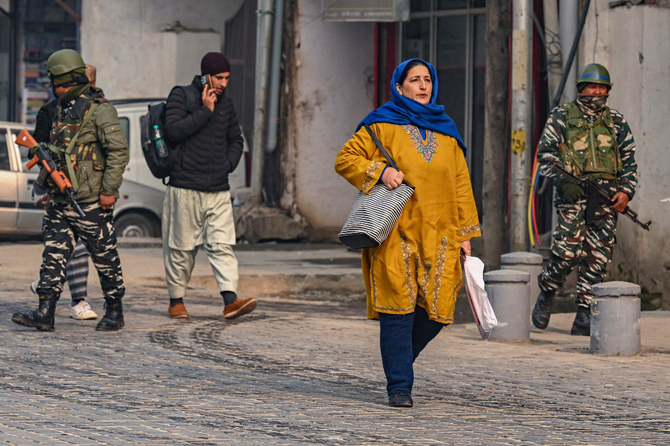
People walk along a street as Indian paramilitary personnel patrol in Srinagar on Dec. 11, 2023, ahead of Supreme Court's verdict on Article 370. (AFP)
Short Url
Updated 11 December 2023
Follow

India’s top court upholds abrogation of Kashmir’s special status

  • Five-judge bench also ordered statehood to be restored, polls to be held by next September
  • For many people in Kashmir, the Supreme Court ruling came as a disappointment

NEW DELHI: India’s top court upheld on Monday a 2019 government decision that stripped Kashmir of its special autonomous status in a unanimous ruling that sets the stage for local polls to be held by September next year.

The semi-autonomy of Jammu and Kashmir was granted by India’s constitution until Aug. 5, 2019, when the Indian government unilaterally revoked the relevant provisions under Article 370 and scrapped the region’s flag, legislature, protections on land ownership, and fundamental rights.  

The Indian Supreme Court began in August hearings of petitions that were filed over the past four years to challenge the government’s contentious move.  

“We don’t find that the president’s exercise to abrogate Article 370 was malafide,” Chief Justice DY Chandrachud said while reading out the judgment.  

“Article 370 is a temporary provision. J&K’s Constitution was subordinate to the Constitution of India. Article 370 was introduced to serve a transitional purpose, to serve as an interim process … and the president can abrogate Article 370.”  

Indian-controlled Jammu and Kashmir is part of the larger Kashmiri territory, which has been the subject of international dispute since the 1947 partition of the Indian subcontinent into Hindu-majority India and Muslim-majority Pakistan. 

Both countries claim Kashmir in full, and rule in part. 

Indian-controlled Kashmir has for decades witnessed outbreaks of separatist insurgency to resist control from the government in New Delhi. 

With the constitutional change, Jammu and Kashmir was split into two federally governed union territories in a move that was followed by a total communications blackout, severe restrictions on freedom of movement, and detention of local leaders — some of whom remain in jail. 

Administrative measures introduced after the abrogation of the special status and statehood have allowed non-locals to settle and vote in the region, raising fears of attempts to engineer demographic change. 

The five-judge bench of the Supreme Court also ordered the government to hold elections in the region by Sept. 30, 2024 and to restore its statehood “at the earliest.” 

The Supreme Court decision was welcomed by Prime Minister Narendra Modi, who described it as “historic.”  

“The verdict today is not just a legal judgment; it is a beacon of hope, a promise of a brighter future and a testament to our collective resolve to build a stronger, more united India,” Modi said.  

But for the people of Kashmir, Monday’s verdict came as a disappointment.  

“I am very much disappointed. Today’s verdict is totally against our emotions and gives pain to the majority of the people of Jammu and Kashmir,” Aijaz Ahmad, a business professional based in Srinagar, told Arab News.  

Yashwant Sinha group, comprising civil society members who have monitored the situation in Kashmir over the last six years, has reported anger, hatred, a sense of political betrayal and alienation among residents of the valley.  

“People of the valley with whom I have been talking for weeks are not at all surprised and as a petitioner, I am not surprised either,” said Air Vice Marshal Kapil Kak, a retired officer of the Indian Air Force and one of the petitioners who appealed to India’s apex court.  

Kak, who is also a member of Yashwant Sinha group, told Arab News the Supreme Court ruling will “take it further away” from resolving the problem of Jammu and Kashmir and exacerbate the concerns and deep alienation felt by youths of the valley.  

Kashmiris were “dejected, humiliated, discredited and disenfranchised” by the Supreme Court ruling, said Nasir Khuehami, president of Kashmir Students Union.  

Subhash Chander Gupta, a senior advocate based in Jammu, believes the verdict was a “politically bad judgment” that will create a trust deficit in the region while also further deepening the “distrust between the Kashmiri people and the rest of India.”  

The apex court’s decision was “nothing less than a death sentence not only for Jammu and Kashmir but for the idea of India,” said Mehbooba Mufti, former chief minister of Jammu and Kashmir. 

“This is the defeat of the imagination of India, the Gandhian India with which Muslims of Jammu and Kashmir, rejecting Pakistan, joined hands with the Hindus, Buddhists, Sikhs and Christians … Today marks the defeat of that idea of India," she said.   

Kashmir “continues to be a bleeding humanitarian and political issue” that is “begging redressal,” said Mirwaiz Umar Farooq, a top cleric and pro-freedom leader.  

“Those people who at the time of the partition of the subcontinent, facilitated the accession of J&K and reposed their faith in the promises and assurances given to them by the Indian leadership must feel deeply betrayed.”


Tens of thousands protest in Minneapolis over fatal ICE shooting

Updated 11 January 2026
Follow

Tens of thousands protest in Minneapolis over fatal ICE shooting

  • Federal-state tensions escalated further on Thursday when a US Border Patrol agent in Portland, Oregon, shot and wounded a man and woman in their car after an attempted vehicle stop

MINNEAPOLIS: Tens of thousands of people marched through Minneapolis on Saturday to decry the fatal shooting of a woman by a US immigration agent, part of more than 1,000 rallies planned nationwide this weekend against the ​federal government’s deportation drive. The massive turnout in Minneapolis despite a whipping, cold wind underscores how the fatal shooting of 37-year-old Renee Good by an Immigration and Customs Enforcement officer on Wednesday has struck a chord, fueling protests in major cities and some towns. Minnesota’s Democratic leaders and the administration of President Donald Trump, a Republican, have offered starkly different accounts of the incident.

HIGHLIGHTS

• Minneapolis police estimate tens of thousands present at protests on Saturday

• Mayor urges protesters to remain peaceful and not ‘take the bait’ from Trump

• Over 1,000 ‘ICE Out’ rallies planned across US

• Minnesota Democrats denied access to ICE facility outside Minneapolis

Led by a team of Indigenous Mexican dancers, demonstrators in Minneapolis, which has a metropolitan population of 3.8 million, marched toward the residential street where Good was shot in her car.

’HEARTBROKEN AND DEVASTATED’
The boisterous crowd, which the Minneapolis Police Department estimated in the tens of thousands, chanted Good’s name and slogans such as “Abolish ICE” and “No justice, no peace — get ICE off our streets.”
“I’m insanely angry, completely heartbroken and devastated, and then just like longing and hoping that things get better,” Ellison Montgomery, a 30-year-old protester, told Reuters.
Minnesota officials have called the shooting unjustified, pointing to bystander video they say showed Good’s vehicle turning away from the agent as he fired. The Department of Homeland Security, ‌which oversees ICE, ‌has maintained that the agent acted in self-defense because Good, a volunteer in a community network that monitors and ‌records ⁠ICE operations ​in Minneapolis, drove ‌forward in the direction of the agent who then shot her, after another agent had approached the driver’s side and told her to get out of the car.
The shooting on Wednesday came soon after some 2,000 federal officers were dispatched to the Minneapolis-St. Paul area in what DHS has called its largest operation ever, deepening a rift between the administration and Democratic leaders in the state. Federal-state tensions escalated further on Thursday when a US Border Patrol agent in Portland, Oregon, shot and wounded a man and woman in their car after an attempted vehicle stop. Using language similar to its description of the Minneapolis incident, DHS said the driver had tried to “weaponize” his vehicle and run over agents.
The two DHS-related shootings prompted a coalition of progressive and civil rights groups, including Indivisible and the American Civil Liberties Union, to plan more than 1,000 events under the banner “ICE Out For Good” on Saturday and Sunday. The rallies have ⁠been scheduled to end before nightfall to minimize the potential for violence.
In Philadelphia, protesters chanted “ICE has got to go” and “No fascist USA,” as they marched from City Hall to a rally outside a federal detention facility, according to ‌the local ABC affiliate. In Manhattan, several hundred people carried anti-ICE signs as they walked past an immigration ‍court where agents have arrested migrants following their hearings.
“We demand justice for Renee, ICE ‍out of our communities, and action from our elected leaders. Enough is enough,” said Leah Greenberg, co-executive director of Indivisible.

DEMONSTRATIONS MOSTLY PEACEFUL

Minnesota became a major flashpoint in ‍the administration’s efforts to deport millions of immigrants months before the Good shooting, with Trump criticizing its Democratic leaders amid a massive welfare fraud scandal involving some members of the large Somali-American community there.
Minneapolis Mayor Jacob Frey, a Democrat who has been critical of immigration agents and the shooting, told a press conference earlier on Saturday that the demonstrations have remained mostly peaceful and that anyone damaging property or engaging in unlawful activity would be arrested by police.
“We will not counter Donald Trump’s chaos with our own brand of chaos,” Frey said. “He wants us to take the bait.”
More ​than 200 law enforcement officers were deployed Friday night to control protests that led to $6,000 in damage at the Depot Renaissance Hotel and failed attempts by some demonstrators to enter the Hilton Canopy Hotel, believed to house ICE agents, the City of Minneapolis said in a statement.
Police ⁠Chief Brian O’Hara said some in the crowd scrawled graffiti and damaged windows at the Depot Renaissance Hotel. He said the gathering at the Hilton Canopy Hotel began as a “noise protest” but escalated as more than 1,000 demonstrators converged on the site, leading to 29 arrests.
“We initiated a plan and took our time to de-escalate the situation, issued multiple warnings, declaring an unlawful assembly, and ultimately then began to move in and disperse the crowd,” O’Hara said.

HOUSE REPRESENTATIVES TURNED AWAY FROM ICE FACILITY
Three Minnesota congressional Democrats showed up at a regional ICE headquarters near Minneapolis on Saturday morning, where protesters have clashed with federal agents this week, but were denied access. Legislators called the denial illegal.
“We made it clear to ICE and DHS that they were violating federal law,” US Representative Angie Craig told reporters as she stood outside the Whipple Federal Building in St. Paul with Representatives Kelly Morrison and Ilhan Omar.
Federal law prohibits DHS from blocking members of Congress from entering ICE detention sites, but DHS has increasingly restricted such oversight visits, prompting confrontations with Democratic lawmakers.
“It is our job as members of Congress to make sure those detained are treated with humanity, because we are the damn United States of America,” Craig said.
Referencing the damage and protests at Minneapolis hotels overnight, DHS spokesperson Tricia McLaughlin said the congressional Democrats were denied entry to ensure “the safety of detainees and staff, and in compliance with the agency’s mandate.” She said DHS policies require members of Congress to notify ICE ‌at least seven days in advance of facility visits.