


SRINAGAR: Terrified to step out from his home in Srinagar, Sanjay Tickoo says he has not felt for decades as unsafe as he is now, three years after the Indian government stripped the Kashmir region of its limited autonomy, promising security and reform.
A leader of the minority Hindu community known as Pandits, he remained in Kashmir Valley when most Hindus fled after an armed anti-India rebellion broke out in 1989 and gripped the region until the early 1990s.
Now, three decades later, he is feeling the same sense of fear and uncertainty, which for both Hindus and Muslims alike has become a reality after the Indian government revoked the constitutional autonomy of Jammu and Kashmir and split the state into two federally governed territories on Aug. 5, 2019.
“During the last 32 years it’s the first time I feel under threat,” Tickoo, who heads the Kashmiri Pandit Sangharsh Samiti, the largest Kashmiri Pandit group in the region, told Arab News.
Located in the northern part of the Indian subcontinent, the territory is part of the larger region of Kashmir, which has been the subject of dispute since 1947 partition of the Indian subcontinent into Hindu-majority India and Muslim-majority Pakistan. Both countries claim Kashmir in full and rule in part.
Indian-controlled Kashmir has for decades witnessed outbreaks of separatist insurgency to resist control from the government in New Delhi.
When New Delhi abrogated Articles 370 and 35A of the Indian Constitution, which granted Indian-administered Kashmir its autonomy, Indian Prime Minister Narendra Modi said a “new era” of development was beginning in the region where the scrapped provisions “had only given terrorism, separatism, nepotism and massive corruption.”
The move was accompanied by a total communications blackout, severe restrictions on freedom of movement, and detention of hundreds of local political leaders.
Many of the detainees have been released since then but some still remain in prison. The Internet has been restored, but in turn authorities have intensified a crackdown on media and civil society groups, often resorting to counterterrorism laws.
In a report released earlier this week, Human Rights Watch (HRW) estimated that at least 35 journalists in Kashmir have faced “police interrogation, raids, threats, physical assault, restrictions on freedom of movement, or fabricated criminal cases for their reporting” since August 2019.
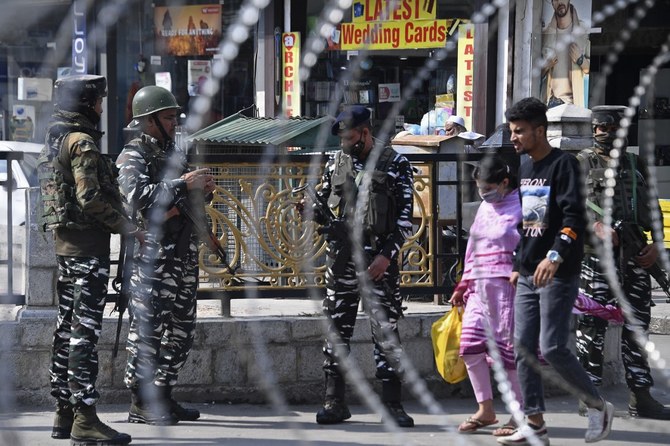
Thousands of government troops have also been sent to the region, the world’s most militarized zone, where already over 500,000 soldiers were stationed before 2019. They have been implicated in numerous abuses, among which HRW has listed routine harassment, ill-treatment at checkpoints, arbitrary detention and extrajudicial killings.
“If everything is fine, why such an unprecedented presence of security forces in the valley,” Tickoo said.
His own community has been shaken by an unprecedented spate of targeted killings and for months has been on strike, demanding that the government relocate them.
At least 20 Kashmiri Pandits have been shot dead by gunmen in Kashmir Valley since August 2019, after a series of administrative measures allowing more outsiders to settle in the region raised fears of an attempt to engineer demographic change in the Muslim-majority area.
“A volcano is growing,” Tickoo said. “We don’t know when it will burst and what would be the impact in Kashmir and India.”
For HRW, both the targeted attacks by militants and raids by security forces in Kashmir are “grim reminders of the unending cycle of violence linked to repressive Indian government policies and the failure to bring abusive forces to account.”
Not only has security worsened in Kashmir since the suspension of its statehood — any political activity in the region has ceased to exist.
“People in Kashmir don’t have the same democratic rights as people in other parts of India,” Raja Muzaffar Bhat, a Srinagar-based civil rights activist, told Arab News.
The last state elections in Kashmir were held in 2015, when a regional pro-India party, the People’s Democratic Party and Modi’s Bharatiya Janata Party agreed to form the government.
But local assemblies have been empty since 2019 and no legislative elections have been announced so far.
“We want our own legislators,” said Bhat. “Why can’t we have our own democratically elected government? Today officers are ruling the region.”
Tension in the region is also growing along another line that never existed before.
When Hindu-dominated Jammu and Muslim-majority Kashmir formed one state, they could be shown as an “example of democracy and secularism in the country,” Subhash Gupta, political analyst and lawyer from Jammu, told Arab News.
But the situation has changed since their division into two union territories under direct administration from New Delhi.
“We are torn apart and the distance and difference between Jammu and Kashmir has widened, economically, socially and religiously,” Gupta said.
“People like me feel that the scrapping of the Article 370 was not called for, it was not needed. This article was a gateway between India and Jammu and Kashmir, and New Delhi demolished that gateway.”


