

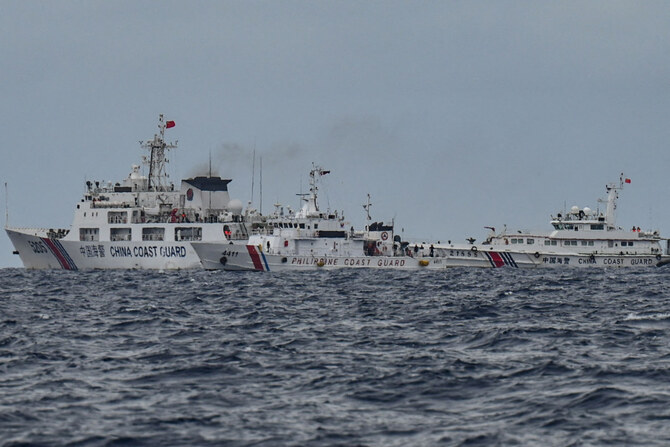


BEIJING: China’s campaign of confrontation, from remote reefs in Southeast Asia to Taiwan and far-flung Japanese islands, is designed to wear down regional rivals competing with it for contested territories, analysts say.
Beijing in recent years has asserted its claims in the long-running disputes far more boldly as its military strength has grown.
The escalating actions — over islands in the East China Sea claimed by Japan, the self-ruled territory of Taiwan and the South China Sea — have also come as Beijing’s rivals have drawn closer to the United States.
“(China) believes its strong-arm tactics are paying dividends,” Duan Dang, a Vietnam-based maritime security analyst, told AFP.
China has in recent months deployed military and coast guard vessels in a bid to eject the Philippines from a trio of strategically important reefs and islands in the South China Sea.
“The number of fronts where an accident could spiral suddenly is very real,” Dylan Loh, an assistant professor at Singapore’s Nanyang Technological University, told AFP.
The latest flashpoint is Sabina Shoal, just 140 kilometers (86 miles) west of the Philippine island of Palawan and roughly 1,200 kilometers from China’s nearest major landmass, the island of Hainan.
On Monday, Beijing said it took “control measures” against two Philippine Coast Guard ships that “illegally” entered the waters near Sabina Shoal.
Manila countered that Chinese vessels had stopped Philippine ships from resupplying their own coast guard vessels in the area — slamming Beijing as the “biggest disruptor” to regional peace.
China has for years sought to expand its power in the South China Sea, brushing aside an international ruling that its claim to most of the waterway has no legal basis.
It has built artificial islands armed with missile systems and runways for fighter jets, and deployed vessels that the Philippines says harass its ships and block its fishers.
In 2012, Beijing seized control of Scarborough Shoal, another contested area close to the Philippines.
And in June, Chinese coast guard personnel brandishing weapons boarded Philippine vessels near the disputed Second Thomas Shoal, a confrontation in which Manila said one of its sailors lost a thumb.
The recent incidents have come as the Philippines has strengthened ties with traditional ally the United States, with which it has a mutual defense treaty.
Duan said the pact might “deter outright war,” but Beijing still saw a chance to tighten the screws on Manila while Washington was distracted by the ongoing Middle East conflict and the uncertainties around its own presidential election in November.
However the Philippines on Thursday flagged the possibility of US escorts for its resupply missions.
Chong Ja Ian, an associate professor of political science at the National University of Singapore (NUS), told AFP China was trying to “wear down” Filipino resolve.
Beijing is posing a “direct challenge to the Philippines’ ability to administer and make use of its exclusive economic zone,” he said.
They are “trying to push the envelope (but stay) below the threshold of aggression,” he explained.
“They don’t want to lose control of the escalation.”
China’s recent assertiveness has extended far beyond the South China Sea.
Around Taiwan, it has sent increasing numbers of fighter jets, drones and naval vessels as part of a strategy that analysts say is designed to keep the democratic island exhaustingly vigilant against a possible invasion.
Beijing says Taiwan is part of its territory and has refused to rule out using force to unify with it.
China has also in recent years ratcheted up pressure over a disputed island group controlled by Japan in the East China Sea.
Tokyo in June protested after four Chinese vessels that were believed to be armed approached the islands, known as the Diaoyu in China and the Senkaku in Japan.
And this week Japan said a Chinese military plane flew into its airspace for the first time, a “serious violation” of its sovereignty.
Beijing has not admitted the incursion near the uninhabited Danjo Islands — uncontestedly Japanese territory — but has said it would have been unintentional.
However, analysts said it may have deliberately aimed to probe Japan’s air defense network and collect electronic intelligence.
“People sometimes look at the South China Sea and the Taiwan Strait and the East China Sea... as isolated,” said Chong, of NUS.
“They are not. These are all areas where (China) hopes to be able to establish more control,” he said.
“They’re trying to see how far they can push.”


