


VATICAN CITY: If any evidence were needed to underscore that Pope Francis’ upcoming trip to Asia and Oceania is the longest, farthest and most challenging of his pontificate, it’s that he’s bringing along his secretaries to help him navigate the four-country program while keeping up with work back home.
Francis will clock 32,814 kilometers (20,390 miles) by air during his Sept. 2-13 visit to Indonesia, Papua New Guinea, East Timor and Singapore, far surpassing any of his previous 44 foreign trips and notching one of the longest papal trips ever, both in terms of days on the road and distances traveled.
That’s no small feat for a pope who turns 88 in December, uses a wheelchair, lost part of a lung to a respiratory infection as a young man and had to cancel his last foreign trip at the last minute (to Dubai in November to participate in the UN climate conference) on doctors’ orders.
But Francis is pushing ahead with this trip, originally planned for 2020 but postponed because of COVID-19. He’s bringing along his medical team of a doctor and two nurses and taking the usual health precautions on the ground. But in a novelty, he’s adding his personal secretaries into the traditional Vatican delegation of cardinals, bishops and security.
The long trip recalls the globetrotting travels of St. John Paul II, who visited all four destinations during his quarter-century pontificate, though East Timor was an occupied part of Indonesia at the time of his landmark 1989 trip.
By retracing John Paul’s steps, Francis is reinforcing the importance that Asia has for the Catholic Church, since it’s one of the few places where the church is growing in terms of baptized faithful and religious vocations. And he is highlighting that the complex region also embodies some of his core priorities as pope – an emphasis on interreligious and intercultural dialogue, care for the environment and insistence on the spiritual component of economic development.
Here is a look at the trip and some of the issues that are likely to come up, with the Vatican’s relations with China ever-present in the background in a region where Beijing wields enormous influence.
Indonesia
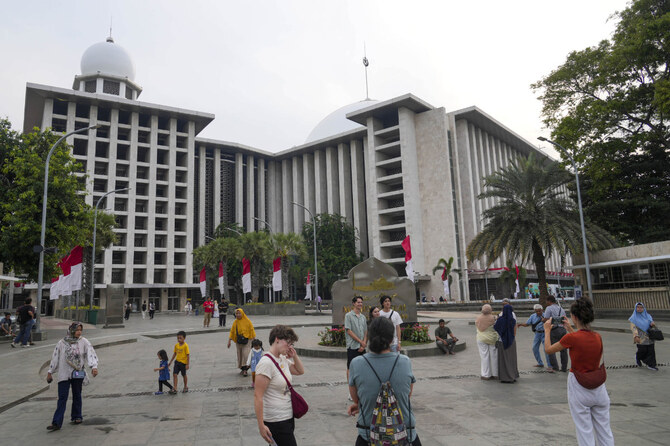
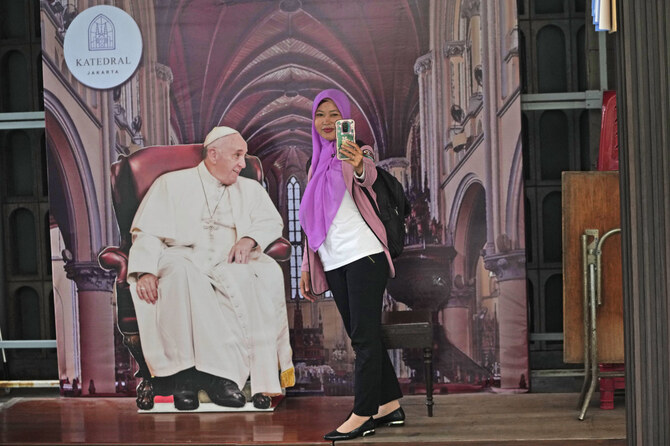
Francis loves gestures of interfaith fraternity and harmony, and there could be no better symbol of religious tolerance at the start of his trip than the underground “Tunnel of Friendship” linking Indonesia’s main Istiqlal mosque to the country’s Catholic cathedral.

Inside Istiqlal Mosque in Jakarta, Indonesia. (AP Photo)
Francis will visit the underpass in central Jakarta with the grand imam, Nasaruddin Umar, before both partake in an interfaith gathering and sign a joint declaration.
Francis has made improving Christian-Muslim relations a priority, and has often used his foreign travels to promote his agenda of committing religious leaders to work for peace and tolerance, and renounce violence in God’s name.
Indonesia is home to the world’s largest Muslim population and has enshrined religious freedom in its constitution, officially recognizing six religions — Islam, Buddhism, Confucianism, Hinduism, Protestantism and Catholicism. Francis is likely to highlight this tradition of religious tolerance and celebrate it as a message for the broader world.
“If we are able to create a kind of collaboration between each other, that could be a great strength of the Indonesian nation,” the imam said in an interview.
Papua New Guinea
Francis was elected pope in 2013 largely on the strength of an extemporaneous speech he delivered to his fellow cardinals in which he said the Catholic Church needed to go to the “peripheries” to reach those who need God’s comfort the most. When Francis travels deep into the jungles of Papua New Guinea, he will be fulfilling one of the marching orders he set out for the future pope on the eve of his own election.
Few places are as remote, peripheral and poverty-wracked as Vanimo, a northern coastal town on the main island of New Guinea. There Francis will meet with missionaries from his native Argentina who are working to bring Christianity to a largely tribal people who still practice pagan traditions alongside the Catholic faith.

Parishioners leave after a Sunday mass at St. Joseph Cathedral Church in Maumere, East Nusa Tenggara province, Indonesia, on Aug. 25, 2024. (AP)
“If we suspend our preconceptions, even in tribal cultures we can find human values close to Christian ideals,” Cardinal Luis Antonio Tagle, who heads the Vatican’s missionary evangelization office and is part of the Vatican delegation, told the Fides missionary news agency.
Francis will likely reflect on the environmental threats to vulnerable and poor places like Papua New Guinea, such as deep sea mining and climate change, while also pointing to the diversity of its estimated 10 million people who speak some 800 languages but are prone to tribal conflicts.
East Timor
When John Paul visited East Timor in 1989, he sought to console its overwhelmingly Catholic population who had suffered under Indonesia’s brutal and bloody occupation for 15 years already.
“For many years now, you have experienced destruction and death as a result of conflict; You have known what it means to be the victims of hatred and struggle,” John Paul told the faithful during a seaside Mass in Tasi-Toli, near Dili.
“I pray that those who have responsibility for life in East Timor will act with wisdom and good will toward all, as they search for a just and peaceful resolution of present difficulties,” he said then in a direct challenge to Indonesia.
It would take another decade for the United Nations to organize a referendum on Timor’s independence, after which Indonesia responded with a scorched-earth campaign that left the former Portuguese colony devastated. East Timor emerged as an independent country in 2002, but still bears the trauma and scars of an occupation that left as many as 200,000 people dead — nearly a quarter of the population.
Francis will literally walk in John Paul’s footsteps when he celebrates Mass on the same seaside esplanade as that 1989 liturgy, which some see as a key date in the Timorese independence movement.
“That Mass with the pope was a very strong, very important moment for Timor’s identity,” said Giorgio Bernardelli, editor of AsiaNews, the missionary news agency. “It also in many ways put the spotlight on the drama that Timor was living for the international community.”
Another legacy that will confront Francis is that of the clergy sexual abuse scandal: Revered independence hero and Nobel Peace Prize winner Bishop Carlos Felipe Ximenes Belo was secretly sanctioned by the Vatican in 2020 for sexually abusing young boys.
There is no word on whether Francis will refer to Belo, who is still revered in East Timor but has been barred by the Vatican from ever returning.
Singapore
Francis has used several of his foreign trips to send messages to China, be they direct telegrams of greetings when he flies through Chinese airspace or more indirect gestures of esteem, friendship and fraternity to the Chinese people when nearby.
Francis’ visit to Singapore, where three-quarters of the population is ethnically Chinese and Mandarin is an official language, will give him yet another opportunity to reach out to Beijing as the Vatican seeks improved ties for the sake of China’s estimated 12 million Catholics.
“It’s a faithful people, who lived through a lot and remained faithful,” Francis told the Chinese province of his Jesuit order in a recent interview.
The trip comes a month before the Vatican is set to renew a landmark 2018 agreement governing bishop nominations.
Just last week, the Vatican reported its “satisfaction” that China had officially recognized Tianjin Bishop Melchior Shi Hongzhen, who as far as the Vatican is concerned had actually taken over as bishop in 2019. The Holy See said China’s official recognition of him under civil law now was “a positive fruit of the dialogue established over the years between the Holy See and the Chinese government.”
But by arriving in Singapore, a regional economic powerhouse which maintains good relations with both China and the United States, Francis is also stepping into a protracted maritime dispute as China has grown increasingly assertive with its presence in the South China Sea.


