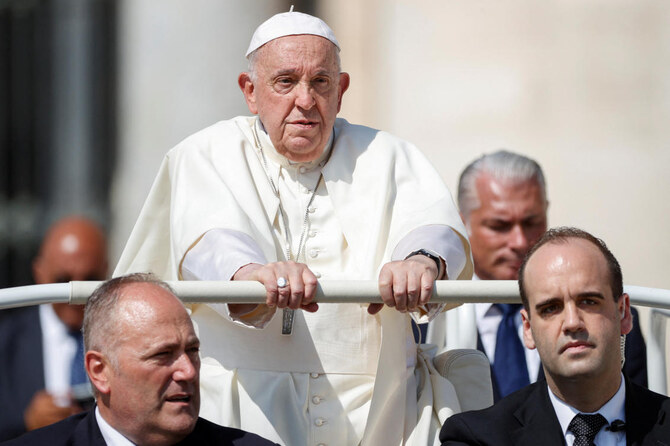
VATICAN CITY: Pope Francis leaves on Monday for a visit to four island nations across southeast Asia, an ambitious trip to urge global action on climate change that may test the strength of the 87-year-old head of the global Catholic Church. Over 12 days from Sept. 2-13, Francis will travel nearly 33,000 km (20,500 miles) to visit Indonesia, Papua New Guinea, East Timor and Singapore. It is the longest trip yet by the pontiff, who now regularly uses a wheelchair due to knee and back pain. Francis pushed hard for the 2015 Paris climate agreement and aides say he wants to continue his appeals to confront the dangers of a rapidly warming world, and especially to support the most vulnerable. In the countries on his tour, these dangers include rising sea levels and increasingly severe and unpredictable heat waves and typhoons. Jakarta, the Indonesian capital where the trip begins, has experienced disastrous flooding in recent years and is slowly sinking, prompting the government to build a new $32-billion capital on Borneo. Francis is scheduled to headline more than 40 events during the voyage and some observers say that, beyond his specific itinerary, he wants to show he is still capable of leading the 1.4-billion-member Church, despite his age and bouts of ill health.
“It is a show of strength for Pope Francis,” said Massimo Faggioli, an Italian academic who has followed the papacy closely.
What does the pope hope to achieve?
Faggioli, a professor at Villanova University in Philadelphia, noted that no pope had toured abroad at such an age. Benedict XVI, Francis’ immediate predecessor, resigned at 85. John Paul II, suffering from Parkinson’s disease, made his last visit abroad at 84. The tour will be Francis’ 45th foreign trip since his election in March 2013. He speaks often about reaching out to people or groups on the margins of society, and has prioritized trips to places never before visited by a pope, or where Catholics are a small minority.
“Francis has almost drawn a new map of the Church,” said Faggioli. “It’s global Catholicism now, a Church that it is not just more globally extensive, but truly globalized.” Also on the agenda is a renewed push for Catholic-Muslim dialogue, long a priority for Francis who, in 2019, became the first pope to visit the Arabian peninsula.
Indonesia, the world’s most populous Muslim-majority nation, has about 280 million inhabitants, only about 3 percent of them Catholic. Francis will take part in an interfaith meeting at Jakarta’s Istiqlal Mosque, the largest in Southeast Asia.
Jeremy Menchik, a political scientist professor at Boston University who has written extensively on Indonesia’s politics, said it was in a “golden age” of interfaith dialogue, noting that the mosque sits opposite Jakarta’s Catholic cathedral.
“This is a moment where you have pluralism rather than polemics,” he said. Francis lands in Jakarta at about midday on Tuesday, and departs for Papua New Guinea three days later. To allow him to rest after a night-flight of more than 13 hours, he will have no public activities on Tuesday, apart from a brief official welcome at the airport.
Why has the Pope chosen Asia?
In each of the four countries, the pope will hold official meetings with political authorities, diplomats, and local Catholics. He will also lead outdoor celebrations of the Catholic Mass in all four countries.
Catholic officials broadly see Asia as fertile ground to expand the faith, which has experienced decline in Western countries.
Shihoko Goto, director of the Indo-Pacific Program at the Wilson Center, a Washington think-tank, said Francis’ visit, despite his health concerns, “speaks volumes about the strategic importance of Asia for the Church.”
Papua New Guinea, with an official population of about 9 million, has some 2.5 million Catholics, the Vatican says. East Timor, with a population of 1.3 million, is nearly 96 percent Catholic, while Singapore counts about 210,000 Catholics among its 5.92 million people, according to the Vatican.


![]()

Pope Francis takes climate message to Southeast Asia on 12-day trip
Short Url
https://arab.news/jn2u2
Pope Francis takes climate message to Southeast Asia on 12-day trip
- Pope Francis sets off on Monday for four-country Asia visit
- Climate change and Catholic-Muslim dialogue high on agenda


Latest updates


© 2026 SAUDI RESEARCH & PUBLISHING COMPANY, All Rights Reserved And subject to Terms of Use Agreement.