

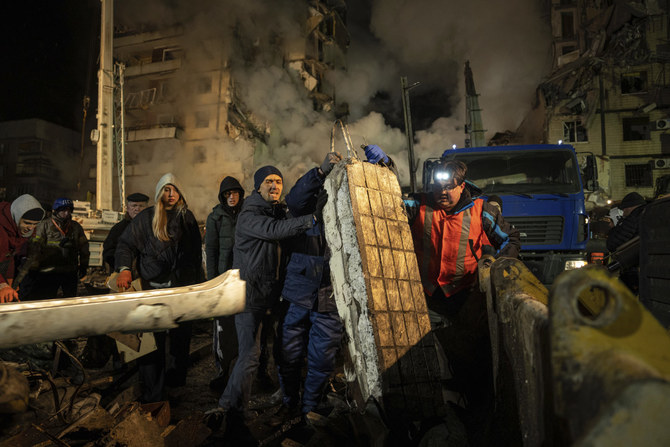
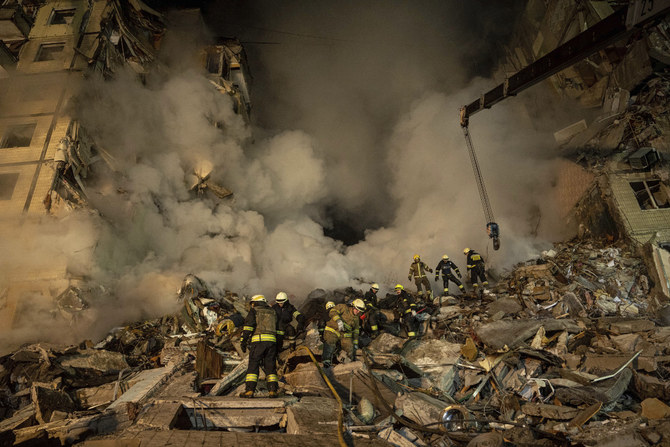

KYIV: Ukraine said Sunday that the death toll had risen to 21 after a Russian missile slammed into a tower block in the city of Dnipro during a massive wave of strikes causing power outages and blackouts across the war-torn country.
Officials said more than 40 people were still missing after the Dnipro strike Saturday, which came as Ukraine celebrated the Old New Year holiday and as Britain became the first Western country to offer Kyiv the heavy tanks it has long sought.
At least 21 people were killed and 73 others wounded in the attack on the Dnipro tower block, Ukraine’s regional council head Mykola Lukashuk said.
A 15-year-old girl was among the dead, officials said, after dozens of people were pulled from the rubble, including a woman brought out by rescuers on Sunday.
“Rescue operations continue. The fate of more than 40 people remain unknown,” regional governor Valentyn Reznichenko said.
The strike destroyed dozens of flats in the apartment block leaving hundreds of people homeless, said Kyrylo Tymoshenko, a senior official at the presidency.
The Ukrainian army said the block was hit by an X-22 Russian missile that it lacked the capacity to shoot down.
“Only anti-aircraft missile systems, which in the future may be provided to Ukraine by Western partners... are capable of intercepting these air targets,” it said.
Ukrainian President Volodymyr Zelensky on Saturday pleaded for more Western military weapons, saying that Russian “terror” could be stopped only on the battlefield.
“What is needed for this? Those weapons that are in the warehouses of our partners,” Zelensky said.
UK sending tanks to Ukraine
Earlier Saturday, British Prime Minister Rishi Sunak pledged to provide Challenger 2 tanks to Ukraine, the first Western country to supply the heavy tanks Kyiv has been crying out for.
Russia’s embassy in the UK swiftly issued a warning that “bringing tanks to the conflict zone, far from drawing the hostilities to a close, will only serve to intensify combat operations, generating more casualties, including among the civilian population.”
But in his evening address on Saturday, Zelensky argued that Russian “terror” could only be stopped on the battlefield.
“This can and must be done on our land, in our sky, in our sea,” he said.
Moldova, Ukraine’s southwestern neighbor, said Saturday it had found missile debris on its territory after the latest Russian strikes.
“Russia’s brutal war against Ukraine directly impacts Moldova again,” President Maia Sandu tweeted, posting photos of the wreckage.
“We strongly condemn today’s intensified attacks.”
Infrastructure targetted
Ukraine’s energy facilities operator Ukrenergo said it was working on “eliminating the consequences” of the latest Russian strikes.
In Kyiv, AFP journalists heard several explosions, while Ukrainian officials reported strikes on a power facility.
“There is a hit to an infrastructure facility, without critical destruction or fire,” the Kyiv city administration said.
In the northeastern Kharkiv region, “the enemy launched another missile attack on critical infrastructure and industrial facilities,” governor Oleg Synegubov said.
Emergency blackouts were applied in “most regions” of Ukraine due to the fresh barrage of attacks, energy minister German Galushchenko said Saturday.
Attacks were also reported in the southern Zaporizhzhia region.
Zelensky said Ukraine had managed to shoot down 20 of the more than 30 Russian missiles fired.
“Unfortunately, energy infrastructure facilities have been also hit,” he added, with the Kharkiv and Kyiv regions suffering the most.
Soledar defenders holding out
There was still uncertainty about the fate of Soledar, a salt mining outpost that Russia claimed to have captured, against denials from Ukraine.
Both sides have conceded heavy losses in the battle for the town.
Ukraine’s military governor in the embattled eastern region of Donetsk insisted Saturday that “Soledar is controlled by Ukrainian authorities, our military controls it.”
The “battles continue in and outside of the city,” he added.
He was responding to claims by Russia’s defense ministry on Friday that it had “completed the liberation” of Soledar the previous day.
The industrial town with a pre-war population of about 10,000 has now been reduced to rubble through intense fighting.
Capturing Soledar could improve the position of Russian forces as they push toward what has been their main target since October — the nearby transport crossroads of Bakhmut.
Turkiye said Saturday it was ready to push for local cease-fires in Ukraine and warned that neither Moscow nor Kyiv had the military means to “win the war.”
President Recep Tayyip Erdogan’s foreign policy adviser Ibrahim Kalin conceded that it seemed unlikely that the warring sides were ready to strike an “overarching peace deal” in the coming months.


