



ISLAMABAD: Prime Minister Shehbaz Sharif on Wednesday promised that the state of Pakistan would not bow before any militant group, after a deadly, days-long standoff killed three soldiers and 25 militants in the country’s northwest.
Pakistani Taliban militants being held at a counterterrorism facility in the northwestern city of Bannu took control of the compound on Sunday after overpowering their interrogators and taking their weapons, leading to a two-day siege.
Pakistani army commandos ultimately stormed the compound on Tuesday and killed 25 militants holed up in the facility, while three soldiers were killed in the operation to retake the compound, the army said.
Sharif condemned recent militant attacks in Bannu and other parts of the country, promising to crush the “wicked effort” to create chaos in the country through “terrorism.”
“The state will not bow before any terrorist group and terrorists will be dealt with according to the constitution and the law,” the prime minister said in a statement.
“Terrorism is a sensitive national security issue, which requires collective mindset and strategy.”
He said the federation would work together with provinces to fight the menace of “terrorism.”
“The federation will assist provinces in capacity-building of counterterrorism force and department,” PM Sharif said.
“[We] will work on restructuring of Khyber Pakhtunkhwa counterterrorism department and will fulfill all requirements of our forces.”
The Pakistan Taliban, or the Tehreek-e-Taliban Pakistan (TTP), associate themselves with the Afghan Taliban and have been fighting to overthrow the government in Islamabad since late 2000s.
The TTP has ramped up attacks in recent weeks since announcing the end of an Afghan Taliban-brokered cease-fire with Islamabad in November.
Providing details of the Bannu standoff late Tuesday, Pakistani military spokesman Maj-Gen Ahmed Sharif said a “terrorist” detained in the CTD complex overpowered a constable on duty on December 18, snatched his weapon and freed 34 other detainees.
Immediately after surrounding the CTD complex on December 18, he said, security forces killed two militants and arrested three. Ten soldiers, including three officers, were injured in the action.
The Bannu counterterrorism center siege came on the same day four Pakistani police officers were killed and another four critically wounded in a militant attack on a police station in the northwestern Pakistani district of Lakki Marwat.
On Monday, a suicide bombing killed at least two passersby and a soldier in the northwestern region of North Waziristan, while the TTP said on Tuesday it had attacked a police station in Wana city in the South Waziristan district and killed two policemen, but police said only one officer had been wounded.
Foreign Minister Bilawal Bhutto-Zardari said the recent attacks by the Pakistani Taliban had crossed a “red line” for Pakistan and it would not tolerate such incursions.
“Within our government, I am particularly hawkish on the issue of TTP or the issue of terrorism in general. I believe that the recent events in the region.. are alarming, not only the border incidents but the recent Bannu incident, which our security commanders have very bravely managed to overcome that specific threat,” he said at the Washington-based Atlantic Council think-tank on Tuesday.
“But as far as the TTP are concerned, it’s absolutely our red line. It is something that we will not tolerate. And without going further diplomatically, on record, I would say that absolutely, we would be willing to consider each and every single option to ensure the safety and security of our people.”
To a question, Bhutto-Zardari said the overall security situation in Pakistan had improved since 2007 and the country was far more stable and secure despite these latest attacks and skirmishes on the border.
“Owing to the improved security in the region as compared to the past, there is more confidence today for people do [conduct] business in Pakistan, but those things can be put at risk if this [situation] goes unchecked,” he said.
“And, obviously, that would undermine any hope for us, whether it is CPEC (China-Pakistan Economic Corridor) or any other form of economic activity.”
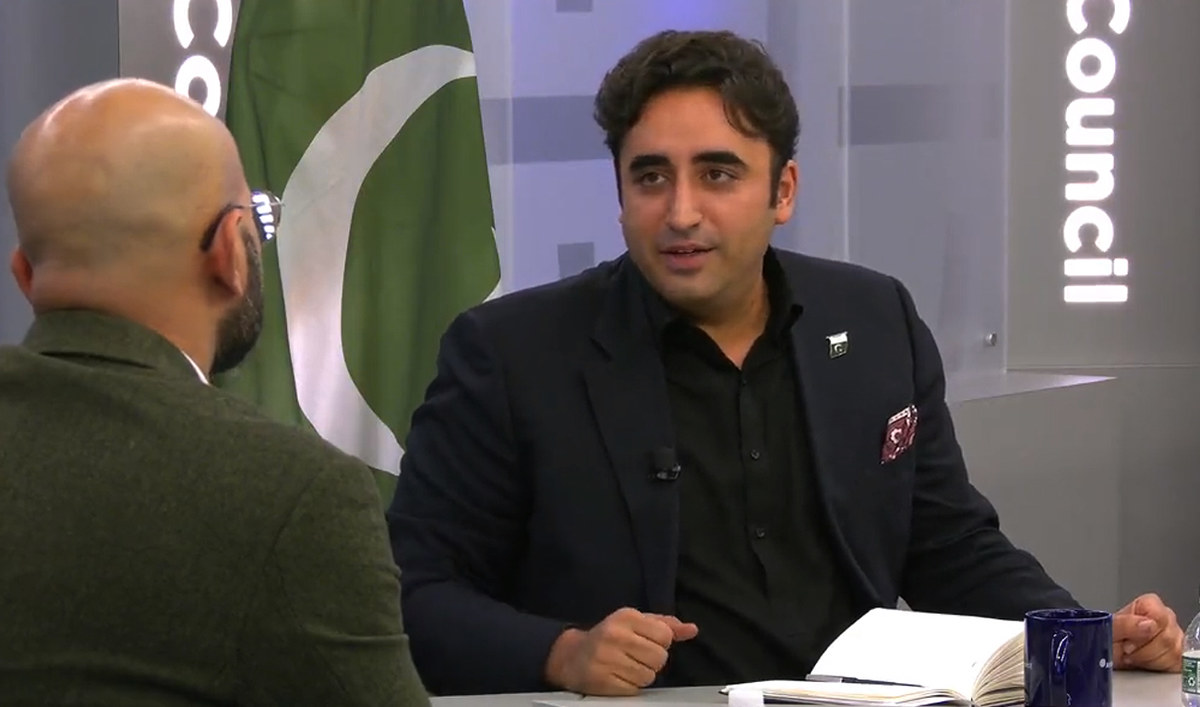
Pakistan Foreign Minister Bilawal Bhutto-Zardari speaks during a talk at the Atlantic Council's Front Page event in Washington, US on December 20, 2022. (Photo courtesy: Twitter/AtlanticCouncil)
A major segment of Beijing’s Belt and Road infrastructure initiative, CPEC is a $65 billion network of roads, railways, pipelines and ports in Pakistan that will connect China to the Arabian Sea and help Islamabad expand and modernize its economy.
Bhutto-Zardari said he believed Pakistan would have to press Afghanistan to take on the TTP or other militant groups operating in the neighboring country.
“As far as the Afghan Taliban are concerned, I think it’s important for us to get to a position where we can work with them to deal with this issue because I can conduct as many operations as I want from our side of the border, but if they keep jumping on to the other side, and there is no hammer and anvil effect, then no counterterrorism policy will be effective,” he said.
“So, the [priority] is to get the interim or de facto Afghan government to demonstrate their will and capacity to deal with this issue and I think there is space to explore on that front.”


