Husband of Daesh bride Shamima Begum disputes ‘grooming’ claims

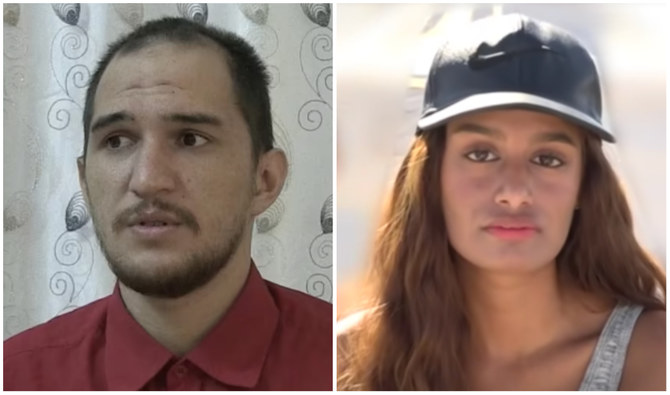
Yago Riedijk (L), who was 23 when he married Shamima Begum (R), then 15, said the couple enjoyed a good marriage. (Screenshots)
Short Url
Updated 02 December 2022
Follow

Husband of Daesh bride Shamima Begum disputes ‘grooming’ claims

  • Yago Riedijk says he and then schoolgirl ‘agreed on the conditions of marriage’
  • Begum is appealing a British government decision to strip her of her citizenship

LONDON: The husband of Daesh bride Shamima Begum has insisted his marriage to the British schoolgirl was a happy one, the Daily Mail reported.

Yago Riedijk, who was 23 when he married Begum, then 15, said the couple enjoyed a good marriage in Syria, despite claims from Begum she was groomed and trafficked.

Begum left her east London home in February 2015 and married Dutch convert and Daesh soldier Riedijk days after arriving in Syria.

The couple had three children, all of whom died of disease or malnutrition.

Lawyers for Begum, who is appealing a British government decision to strip her of her citizenship, told the special immigration court there was “overwhelming” evidence she was groomed and trafficked by Daesh for the purpose of “sexual exploitation and marriage to an adult male.”

Nick Squires KC, a member of Begum’s legal team, told the Special Immigration Appeals Commission: “In doing so, she was following a well-known pattern by which ISIS (another term for the terror group) cynically recruited and groomed female children as young as 14 so that they could be offered as wives to adult men.”

However, Riedijk, who was speaking in an interview from prison in northern Syria, said the marriage was consensual and, initially at least, a happy one.

“Basically, I was looking for marriage and a friend of mine came to me and said ‘there’s a sister looking for marriage, are you interested?’ I took him up on his offer.

“We had a talk, we agreed on the conditions of marriage,” he said.

It was “not really something big or anything important, it was small things like going out shopping, things like this,” he added.

“Basically she asked for some freedoms, which I agreed to give her — going shopping, seeing her friends, very, very basic stuff. We agreed on a dowry — all she asked for was an English translation of the Quran, which I agreed to.”

Following Daesh’s ousting from the last of the territory it had seized across Syria and Iraq in March 2019, the British government said Begum was a risk and rescinded her citizenship.

MI5, the UK’s security service, concluded that Begum’s travel to Syria was voluntary and she had “demonstrated determination and commitment” to joining the terror group.

Female recruits to Daesh were likely to have been radicalized and were probably given military training to fight in defense of the group, it said in a statement.

“They were exposed to routine acts of extreme violence, which would be likely to have had the effect of desensitizing individuals, and encouraging them to view violent terrorist activity as an acceptable and legitimate course of action.

“(Daesh) was committed to perpetuating violence against those who it viewed as enemies of Islam, including the UK.”


Ancient cures and AI: WHO seeks evidence for traditional medicine

Updated 2 sec ago
Follow

Ancient cures and AI: WHO seeks evidence for traditional medicine

  • The World Health Organization opens a major conference on traditional medicine on Wednesday, arguing that new technologies, including artificial intelligence
NEW DELHI: The World Health Organization opens a major conference on traditional medicine on Wednesday, arguing that new technologies, including artificial intelligence, can bring scientific scrutiny to centuries-old healing practices.
The meeting in New Delhi will examine how governments can regulate traditional medicine while using emerging scientific tools to validate safe and effective treatments.
The UN body hopes this push will help make ancestral practices more compatible with modern health care systems.
“Traditional medicine is not a thing of the past,” WHO chief Tedros Adhanom Ghebreyesus said in a video released ahead of the three-day conference.
“There is a growing demand for traditional medicine across countries, communities, and cultures.”
Indian Prime Minister Narendra Modi, in his own message, said the summit would “intensify efforts to harness” the potential of traditional medicine.
Modi is a longtime advocate of yoga and traditional health practices and has backed the WHO Global Center for Traditional Medicine, launched in 2022 in his home state of Gujarat.
Shyama Kurvilla, the head of the center, said reliance on traditional remedies was “a global reality,” noting that 40-90 percent of populations in 90 percent of WHO member states used them.
“With half the world’s population lacking access to essential health services, traditional medicine is often the closest — or only care — available for many people,” she told AFP in New Delhi.
’Evidence-informed’
The UN agency defines traditional medicines as the accumulated knowledge, skills and practices used over time to maintain health and prevent, diagnose and treat physical and mental illness.
But many lack proven scientific value, while conservationists warn that demand for certain products drives trafficking in endangered wildlife, including tigers, rhinos and pangolins.
“WHO’s role, therefore, is to help countries ensure that, as with any other medicine, traditional medicine is safe, evidence-informed, and equitably integrated in systems,” Kurvilla added.
Kurvilla, who studied at the London School of Hygiene and Tropical Medicine, and taught global health policy at Boston University, said that “40 percent or more of biomedical Western medicine, pharmaceuticals, derive from natural products.”
She cited aspirin drawing on formulations using willow tree bark, contraceptive pills developed from yam plant roots and child cancer treatments based on Madagascar’s rosy periwinkle flower.
The WHO also lists the development of the anti-malaria treatment artemisinin as drawing on ancient Chinese medicine texts.
’Frontier science’
“It’s a huge, huge opportunity — and industry has realized this,” Kurvilla.
Rapid technological advancements, including artificial intelligence, had pushed research to a “transformative moment,” to apply scientific rigour to traditional remedies.
The WHO will also launch what it calls the world’s largest digital repository of research on the subject — a library of 1.6 million scientific records intended to strengthen evidence and improve knowledge-sharing.
Dr. Sylvie Briand, WHO’s chief scientist, said AI can assist in analizing drug interactions.
“Artificial intelligence, for instance, can screen millions of compounds, helping us understand the complex structure of herbal products and extract relevant constituents to maximize benefit and minimize adverse effects,” she told reporters ahead of the conference.
Briand said advanced imaging technologies, including brain scans, were shedding light on how practices such as meditation and acupuncture affect the body.
Kurvilla said she was excited by the possibilities.
“It is the frontier science that’s allowing us to make this bridge... connecting the past and the future,” she said.