Pakistan PM invites Turkiye to join China-Pakistan Economic Corridor for regional progress

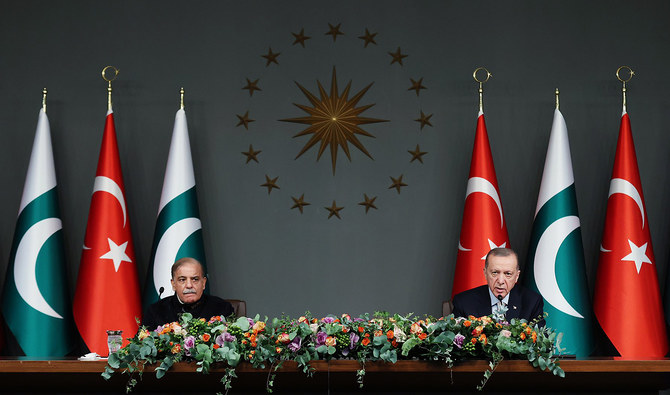
Turkiye President Recep Tayyip Erdogan (right) speaks during a joint press conference with Pakistan Prime Minister Shehbaz Sharif (left) in Istanbul on November 25, 2022. (Photo courtesy: Twitter/tcbestepe)
Short Url
Updated 26 November 2022
Follow

Pakistan PM invites Turkiye to join China-Pakistan Economic Corridor for regional progress

  • Shehbaz Sharif says he will discuss the matter with Chinese leadership, if Turkiye agrees to the idea
  • Pakistan prime minister vows to make all-out efforts to achieve the target of $5 billion bilateral trade

ISLAMABAD: Prime Minister Shehbaz Sharif on Friday invited Turkiye to join the China-Pakistan Economic Corridor (CPEC) to bring about regional prosperity, alleviate poverty and empower people through better education and health facilities, Pakistani state media reported.

Sharif arrived in Turkiye on Friday on a two-day visit that he said would unpack the “untapped potential” of bilateral ties between the two countries.

The prime minister vowed to boost Pakistan-Turkiye trade and defense cooperation to $5 billion, inviting Turkiye to join CPEC, a major segment of Beijing’s Belt and Road infrastructure initiative.

Under the $65 billion project, Beijing is building a network of roads, railways, pipelines and ports in Pakistan that will connect China to the Arabian Sea and help Islamabad expand and modernize its economy.

“I would suggest that let this be a cooperation between China, Pakistan and Turkiye. This would be a wonderful joint cooperation. This will bring prosperity and progress to this entire region,” Pakistan’s APP news agency quoted Sharif as saying at a joint press stakeout with Turkish President Recep Tayyip Erdogan.

“This will help alleviate poverty and unemployment. This will certainly empower our poor people. This will promote education and health. This is how we can meet the challenges of today.”

Sharif said he would be “happy” to discuss the matter with the Chinese leadership, if Turkiye moved ahead on the idea of joining the CPEC.

In their meeting, the two leaders underscored the effective implementation of a trade and goods agreement the two countries signed in August this year, according to the report.

Sharif said the $1 billion trade volume between Pakistan and Turkiye did not reflect the close brotherly relations and promised to make all-out efforts to achieve the target of $5 billion trade between the two countries.

Erdogan said both countries were hopeful of further increasing their relations in trade, defense and other sectors.

Expressing grief over the deaths and destruction caused by the recent floods in Pakistan, the Turkish president said, “Our solidarity has been shown to each other during challenging times… Pakistan’s joy is our joy and their grief is our grief.”

The deadly floods, blamed on climate change, killed more than 1,700 Pakistanis, affected 33 million others and caused the country more than $30 billion losses earlier this year.



Color and caution as banned kite-flying festival returns to Pakistan

Updated 6 sec ago
Follow

Color and caution as banned kite-flying festival returns to Pakistan

  • This year authorities allowed the festival for three days but with ramped up safety measures in a move welcomed by many
  • Families and groups of friends gathered on rooftops and in parks and streets to celebrate the three-day kite-flying festival

ISLAMABAD: Brightly colored kites soared through the skies over Pakistan’s eastern city of Lahore this weekend, marking the return of a festival after a 19-year ban that had been imposed over safety concerns.

Families and groups of friends gathered on rooftops and in parks and streets for the three-day kite-flying festival in Punjab province, known as ‘Basant’, the Urdu language word for the spring season it traditionally marks the arrival of.

“Everyone is excited — all of Punjab, all of Pakistan. It has become hard to find kites and strings because they sold out,” said Shahzaib, a kite flyer, with drums playing in the background.

Punjab authorities banned the festival in 2007 due to a series of fatal accidents caused by glass powdered-coated kite strings and celebratory aerial gunfire.

The exceptionally sharp strings, known as manjha, had badly injured and killed pedestrians and motorcyclists, prompting the crackdown.

But this year authorities relented, allowing the festival for three days but with ramped up safety measures in place in a move welcomed by many Lahoris and thousands who traveled to the city from across the country to take part.

“People had lost businesses when the ban happened. After the ban lifted I sold 20,000 to 25,000 kites,” said Tariq, a kite maker.

Rights groups and cultural activists have long criticized the ban, arguing that poor enforcement rather than the festival itself was to blame for past tragedies.

Some official events planned to take place during the festival were canceled after a suicide blast at a mosque in Pakistan’s capital Islamabad on Friday killed 31 people.

Police were deployed across the city to enforce safety rules, while hospitals were placed on alert to deal with potential injuries.

Authorities also monitored kite sales — including using QR codes to track kites — and confiscated banned materials, including glass-coated strings.

Motorcycle riders placed protective rods on their bikes to intercept kite strings before they could cut riders.

Kite fighting was the main attraction of the festival with participants manoeuvring their kites to sever the strings of their opponents’, often drawing cheers from neighboring rooftops.

Workshops that once lay dormant were operating again to meet demand.

“Buying and flying kites should not be a one-time thing,” said Chand Ustad, 51, string maker.

“Keep buying them, keep flying them, this helps our business as well.”