Pakistan PM invites Turkish investment in renewable energy to cut carbon emissions

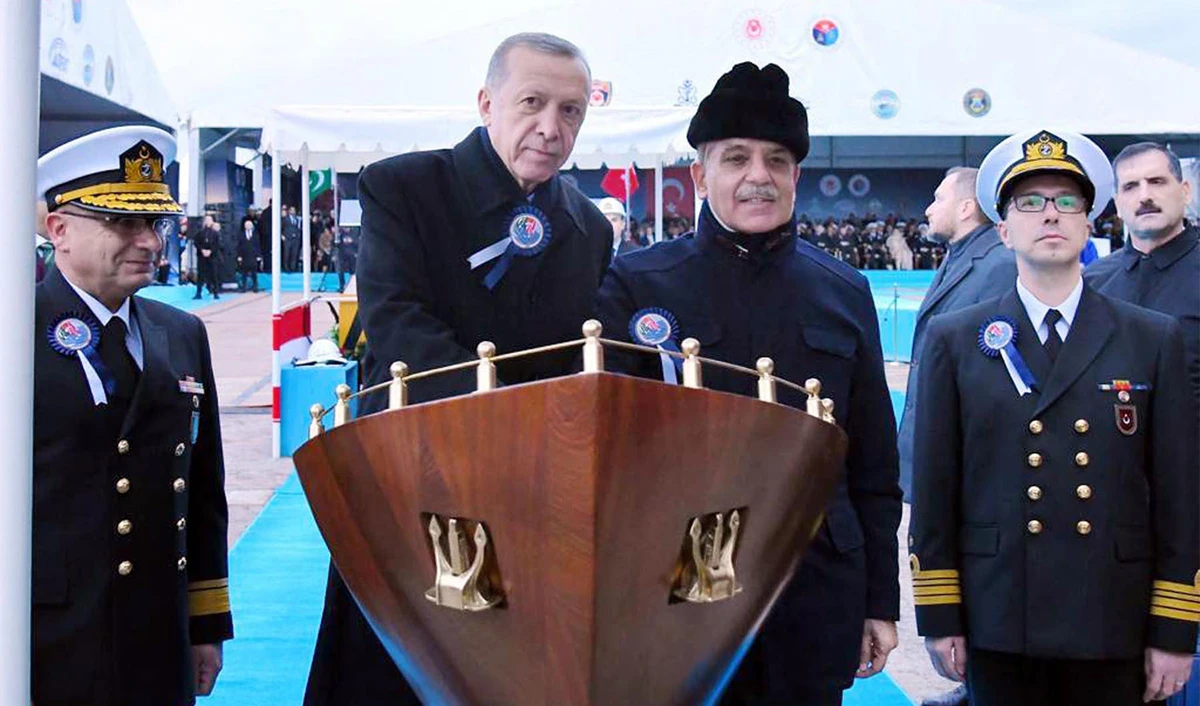
Pakistan Prime Minister Shehbaz Sharif, center right, and Turkish President Recep Tayyip Erdogan, center left, jointly launch PNS Khyber, third of the four MILGEM Corvette ships for Pakistan Navy, in Istanbul, Turkey, on November 25, 2022. (PID)
Short Url
Updated 25 November 2022
Follow

Pakistan PM invites Turkish investment in renewable energy to cut carbon emissions

  • Shehbaz Sharif inaugurates the third of the four MILGEM corvette ship for Pakistan Navy at the Istanbul shipyard
  • The prime minister says Pakistan and Turkey are deeply engaged in promoting defense capabilities for peace

ISLAMABAD: Prime Minister Shehbaz Sharif said on Friday Pakistan and Turkey had huge potential to collaborate in the field of alternative energy while addressing a ceremony in Istanbul to launch a warship for his country’s naval forces.

Sharif arrived in Turkey earlier in the day on a visit that he said would unpack the “untapped potential” of bilateral ties between the two countries.

Together with Turkish President Recep Tayyip Erdogan, he inaugurated one of the four MILGEM corvette ship for the Pakistan Navy at the Istanbul shipyard.

He applauded the defense cooperation between the two countries while urging to expand it further in other areas of strategic importance.

The prime minister specifically mentioned how a developing country like Pakistan had to pay high import bills for petroleum and energy products while emphasizing the significance of producing clean and renewable energy.

“We immediately want to shift to solar energy, towards wind power, towards hydel power generation,” Sharif told the participants of the ceremony. “Turkish investors have great potential to invest in these fields. I want to make use of this opportunity to propose to you that let’s join hands together and get rid of high carbon emissions, cut our import bills and let’s really promote investments in these fields.”


The prime minister praised the MILGEM project, which his country signed with a Turkish state-owned defense contractor in 2018, under which the Pakistan Navy would get four warships from Turkey.

“It is another great day in our historical relations and brotherhood to be here and witness the launching of second MILGEM corvette, Khyber, for Pakistan Navy,” he said.

Sharif noted the two countries had strong bilateral relations and had always helped each other.

“Pakistan and Turkey are deeply engaged in promoting our defense capabilities for peace and to ward off aggression,” he continued. “Let’s further enhance our production capacities. Let’s further cooperate in this field.”

Addressing the ceremony, President Erdogan also applauded the defense cooperation between the two countries while saying that four corvettes were produced under the MILGEM project: Two of them were developed in Turkey while two were built in Pakistan.

According to Pakistan’s APP news agency, he said that his government wanted Turkey to reach the top of the global defense industry, adding that his country would also launch homegrown drone and fighter jet in the coming year.
Pakistan accuses India of manipulating Chenab flows, seeks clarification under Indus Waters Treaty

Updated 1 min 25 sec ago
Follow

Pakistan accuses India of manipulating Chenab flows, seeks clarification under Indus Waters Treaty

  • Foreign office spokesperson says sudden variations in river flows threaten agriculture, food security and livelihoods downstream
  • He also condemns a niqab-removal incident in India, calling it part of a broader pattern of religious intolerance and Islamophobia

ISLAMABAD: Pakistan said on Thursday it had observed abrupt variations in the flow of the River Chenab during the ongoing month, accusing India of manipulating river flows at a critical point in the agricultural cycle and saying it had written to New Delhi seeking clarification.

Local media reported quoted Pakistani officials as saying India released about 58,000 cusecs of water at Head Marala on Dec. 7–8 before sharply reducing flows to roughly 870–1,000 cusecs through Dec. 17, far below the 10-year historical average of 4,000–10,000 cusecs for this period.

Pakistan’s Foreign Office spokesman Tahir Andrabi told a weekly media briefing in Islamabad India had failed to share prior information or operational data on the Chenab flows, a practice he said New Delhi had previously followed under the 1960 Indus Waters Treaty. New Delhi said earlier this year it had put the treaty “in abeyance” following a gun attack in Indian-administered Kashmir that it blamed on Pakistan, a charge Islamabad denied, calling instead for an impartial and transparent international investigation.

Pakistan also described India’s unilateral suspension of the treaty as a violation of international law and an “act of war.”

“Pakistan would like to reiterate that the Indus Waters Treaty is a binding international agreement, which has been an instrument of peace and security and stability in the region,” Andrabi said. “Its breach or violation, on one hand, threatens the inviolability of international treaties in compliance with international law, and on the other hand, it poses serious threats to regional peace, principles of good neighborliness, and norms governing interstate relations.”

Andrabi said Pakistan viewed the sudden variations in the Chenab’s flow with “extreme concern and seriousness,” saying the country’s Indus Waters Commissioner had written to his Indian counterpart seeking clarification in line with procedures outlined in the treaty.

“Any manipulation of river flow by India, especially at a critical time of our agricultural cycle, directly threatens the lives and livelihoods, as well as food and economic security of our citizens,” he continued. “We call upon India to respond to the queries raised by Pakistan.”

He said Pakistan had fulfilled its obligations under the Indus Waters Treaty and urged the international community to take note of India’s “continued disregard” of a bilateral treaty and to counsel New Delhi to act responsibly under international law.

Andrabi maintained Pakistan remained committed to peaceful resolution of disputes with India but would not compromise on its water rights.

In the same briefing, he also condemned an incident in which the chief minister of the Indian state of Bihar was seen in a video forcibly removing the niqab of a Muslim woman during a public interaction, followed by remarks by a minister in Uttar Pradesh who mocked the episode, saying it reflected a broader pattern of religious intolerance and Islamophobia and warranted strong condemnation.