

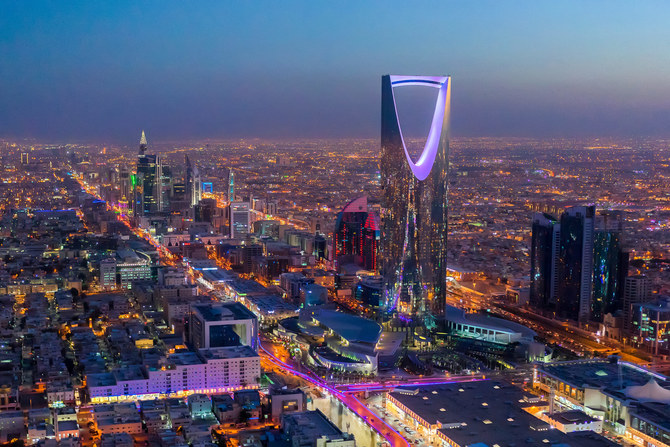
Saudi Arabia’s 2022 GDP to grow at highest rate in 10 years: S&P 

S&P also updated its outlook for Saudi Arabia to positive, and assessed the Kingdom’s short and long-term foreign and local currency sovereign credit ratings to A-/A-2, Saudi Press Agency reported. 
Short Url
Updated 18 September 2022
Follow

Saudi Arabia’s 2022 GDP to grow at highest rate in 10 years: S&P 

RIYADH: Saudi Arabia’s gross domestic product is expected to grow at the highest rate in 10 years , to 7.5 percent in 2022, as the country steadily recovers from the pandemic, according to credit rating agency S&P. 

S&P also updated its outlook for Saudi Arabia to positive, and assessed the Kingdom’s short and long-term foreign and local currency sovereign credit ratings to A-/A-2. 

S&P report noted that the surplus in the Kingdom’s state budget is expected to be about 6.3 percent in 2022. 

The credit rating agency further added that the positive outlook reflects its strength of GDP growth, healthy financial policies, and government reforms that aim to diversify the economy, which has been oil-dependent for several decades. 

S&P noted that the Saudi economy’s productive capacity is expected to grow in the long run, as a result of developing the general finances and significant economic reforms.

The agency pointed out that there will be no dramatic rise in sovereign debt costs in the Kingdom, as most of the public debt portfolio is running at a fixed rate. 

S&P added that inflation in Saudi Arabia is relatively low in comparison to its counterparts, and it is likely to remain under control as the government subsidizes fuel and food prices, along with tying the local currency with the relatively-strong US dollar. 

“Non-oil sector growth also remains strong, with robust services growth as the economy continues to rebound after the pandemic. The economy also benefits from large public investment projects, largely funded by the Public Investment Fund and the National Development Fund,” said S&P in the report.

A recent data released by the General Authority for Statistics revealed that Saudi Arabia’s annual inflation rate accelerated to 3 percent in August, up from 2.7 percent in July. The uptick in the Consumer Price Index is driven by a rise in food and beverage prices, which surged four percent in August. 

“The food and beverages prices were the main drivers of the inflation rate in August 2022 due to their high relative importance in the Saudi consumer basket with a weight of 18.8 percent,” GASAT said in a press release.

Earlier in June, credit rating agency Moody’s Investors Service had affirmed Saudi Arabia’s rating at ‘A1’ with a stable outlook, primarily driven by the government’s fiscal policy effectiveness.

According to Moody’s report, the Kingdom’s GDP will grow at an average rate of 5 percent in the period 2021-2023. 


Fitch maintains neutral outlook on GCC corporates 

Updated 12 sec ago
Follow

Fitch maintains neutral outlook on GCC corporates 

RIYADH: Gulf Cooperation Council corporates are expected to see largely stable conditions in 2026 as government-led investment supports earnings, offsetting pressure from lower oil prices and tighter funding conditions, according to a new analysis.

In a report published this week, Fitch Ratings said sustained public-sector capital expenditure — particularly in infrastructure and energy — will continue to underpin regional corporate performance, even as lower oil-price assumptions are likely to constrain public- and private-sector budgets. 

This comes as GCC economies are forecast to grow 4.4 percent in 2026 and 4.6 percent in 2027, driven by stronger non-hydrocarbon activity and rising hydrocarbon output, the World Bank said. 

In its Global Economic Prospects report released earlier this month, the World Bank said non-oil sectors, which account for more than 60 percent of GCC GDP, are expected to be supported by large-scale investment across the region. 

Samer Haydar, Fitch’s head of GCC corporates, said: “We expect sustained public-sector capex to support steady earnings for GCC Corporates in 2026, especially in infrastructure and energy, even as lower oil price assumptions constrain fiscal flexibility.” 

He added: “Sub-investment-grade credits will face low leverage headroom and increased interest-rate sensitivities.” 

Fitch expects non-energy sectors to keep benefiting from state-backed investment programs — especially in Saudi Arabia and the UAE — while projecting GCC non-oil GDP growth of 3.7 percent in 2026, a moderation from 4.2 percent previously. 

The agency also said regulatory reforms tied to diversification are supporting initial public offering activity, with a “robust” pipeline into 2026 supported by policy measures and deep local markets. 

Credit profiles remain largely stable, with Fitch noting that about 95 percent of rated GCC issuers carry Stable Outlooks, and eight upgrades were recorded during 2025, partly linked to sovereign rating actions. 

Ratings across Fitch’s GCC corporate universe span from “AA” to “B”, with government-related entities tending to be larger; Fitch said GREs represented about half of its rated GCC corporates in 2025. 

On balance-sheet metrics, Fitch expects leverage to be modestly higher in 2026, with average leverage at 2.4 times before easing to 2.3x in 2027. 

While strong 2025 earnings provided headroom for sectors including oil and gas, real estate, utilities and telecoms, the agency said industrials, retail and homebuilders typically operate with tighter leverage capacity, leaving less cushion amid still-elevated input and operating costs. 

Funding conditions are expected to remain a key differentiator, Fitch said, adding that GCC issuers pushed their “maturity wall” out to 2028, helped by 2025 bond and sukuk issuance — particularly from UAE and Saudi Arabia-based issuers refinancing maturities early. 

The agency estimates aggregate corporate fixed-income maturities for UAE and Saudi Arabia-based entities at about $50 billion over the next five years, and said persistently higher funding costs are likely to weigh more on high-yield issuers with sizable near-term maturities than on investment-grade peers. 

Fitch also flagged rising capex as a near-term cash-flow constraint. It expects capex intensity to increase in 2026, keeping free cash flow subdued for most GCC corporates, after negative free cash flow peaked in 2025 due to the timing and scale of investment programs. 

Highly rated issuers are increasingly using asset-light approaches — such as joint ventures — to reduce upfront spending, while others may rely on hybrid instruments, equity increases, or asset disposals to manage funding pressures. 

Macro assumptions remain closely tied to the oil backdrop. Fitch forecasts Brent crude will average $63 per barrel in 2026, down from $70 per barrel in 2025, as supply growth — particularly from the Americas — outpaces demand. 

Prices are expected to remain above fiscal breakevens for most GCC producers, though Fitch highlighted exceptions including Bahrain and Saudi Arabia, with Oman only marginally below breakeven. 

Across sectors, Fitch expects GCC property earnings to be underpinned by regional economic expansion and projected average occupancy above 90 percent in 2026, broadly in line with 2025. 

It also pointed to a new Saudi regulatory provision freezing annual rent increases for five years across residential, commercial, and land leases, which it expects to limit landlords’ ability to pass on base rent increases. 

For homebuilders, Fitch expects higher working-capital needs as pre-sales payment plans in prime Dubai locations ease toward 50 percent in 2026 from a peak of 70 percent, while projecting earnings before interest, taxes, depreciation, and amortization margins around 26.8 percent for most UAE-based homebuilders and gross leverage averaging about 2 times. 

Fitch highlighted three key risks to monitor in 2026: potential regional escalation around the Red Sea that could disrupt supply chains and raw material costs; a widening scope of rescaling mega projects in Saudi Arabia; and funding costs staying higher than expected, which could curb access to debt capital markets for non-GRE issuers.