Syria says Daesh leader killed in south

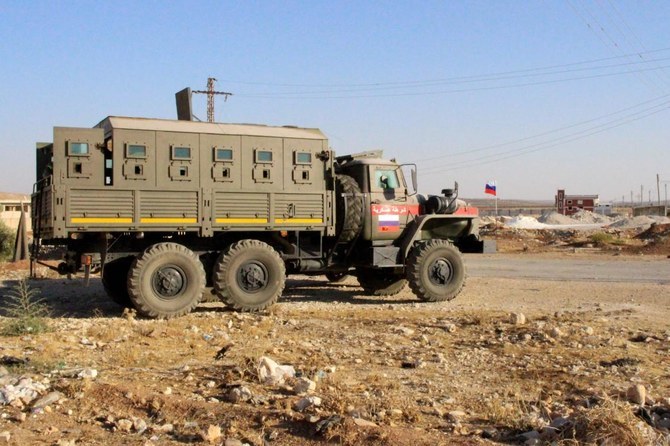
A military vehicle belonging to the Russian and Syrian coalition troops in Daraa. A Daesh group leader blew himself up Daraa after being surrounded by government forces on Wednesday. (AFP/File)
Short Url
Updated 10 August 2022
Follow

Syria says Daesh leader killed in south

  • Security forces carried out a "special operation" in the Daraa area that led to the death of "the terrorist Abu Salem al-Iraqi"
  • The security source said Iraqi had been the military chief of the extremist group in the country's south

DAMASCUS: A leader of Daesh group blew himself up in southern Syria after being surrounded by government forces, state media reported on Wednesday, citing a security source.
The official SANA news agency said security forces carried out a “special operation” in the Daraa area that led to the death of “the terrorist Abu Salem Al-Iraqi.”
Iraqi “triggered his explosive belt after being surrounded and wounded,” the agency said.
The security source said Iraqi had been the military chief of the extremist group in the country’s south.
The Britain-based Syrian Observatory for Human Rights war monitor, which has a vast network of sources on the ground, said Iraqi died on Tuesday.
It said he had been hiding out in the area since 2018, and had taken part in killings and attacks there.
Daraa province has mostly been under regime control since 2018, but rebel groups still control some areas under a truce deal agreed with Russia, an ally of Damascus.
After a meteoric rise in 2014 in Iraq and Syria that saw it conquer vast swathes of territory, Daesh saw its self-proclaimed “caliphate” collapse under a wave of offensives.
It was defeated in Iraq in 2017 and in Syria two years later, but sleeper cells of the extremist Sunni Muslim group still carry out attacks in both countries.
Syria’s war began in 2011 and has killed nearly half a million people and forced around half of the country’s pre-war population from their homes.


Syrian leader to meet Putin, Russia seeks deal on military bases

Updated 28 January 2026
Follow

Syrian leader to meet Putin, Russia seeks deal on military bases

  • Russia’s continued sheltering of Assad and his wife since their ouster remains a thorny issue

MOSCOW: Syrian President Ahmed Al-Sharaa will meet Russian counterpart Vladimir Putin in Moscow on Wednesday, as the Kremlin seeks to secure the future of its military bases in the country.
Putin and Sharaa struck a conciliatory tone at their previous meeting in October, their first since Sharaa’s rebel forces toppled Moscow-ally Bashar Assad in 2024.
But Russia’s continued sheltering of Assad and his wife since their ouster remains a thorny issue. Sharaa has repeatedly pushed Russia for their extradition.
Sharaa, meanwhile, has embraced US President Donald Trump, who on Tuesday praised the Syrian leader as “highly respected” and said things were “working out very well.”
Putin, whose influence in the Middle East has waned since Assad’s ouster, is seeking to maintain Russia’s military footprint in the region.
Russia withdrew its forces from the Qamishli airport in Kurdish-held northeast Syria earlier this week, leaving it with only the Hmeimim air base and Tartus naval base on Syria’s Mediterranean coast — its only military outposts outside the former Soviet Union.
“A discussion is planned on the status of bilateral relations and prospects for developing them in various fields, as well as the current situation in the Middle East,” the Kremlin said of the upcoming meeting in a statement on Tuesday.
Russia was a key ally of Assad during the bloody 14-year Syrian civil war, launching air strikes on rebel-held areas of Syria controlled by Sharaa’s Islamist forces.
The toppling of Assad dealt a major blow to Russia’s influence in the region and laid bare the limits of Moscow’s military reach amid the Ukraine war.
The United States, which cheered Assad’s demise, has fostered ever-warmer ties with Sharaa — even as Damascus launched a recent offensive against Kurdish forces long backed by the West.
Despite Trump’s public praise, both the United States and Europe have expressed concern that the offensive in Syria’s northeast could precipitate the return of Islamic State forces held in Kurdish-held jails.