


NEW YORK: Despite territorial defeats and leadership losses, the threat posed by Daesh has been rising since the start of the COVID-19 pandemic and continues to persist, underlining the importance of implementing non-military measures to counter terrorism, the UN said on Tuesday.
Daesh affiliates continue to exploit conflicts and social inequalities to incite unrest and plan terrorist attacks, the organization added. Pandemic-related restrictions and the shift to the digital space have provided the group with opportunities to intensify its recruitment efforts and attract more funding, and for the past year it has increasingly been using drones in attacks, as seen in northern Iraq.
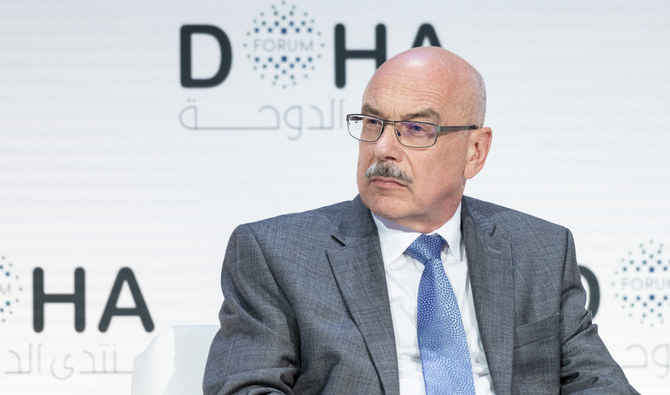
Vladimir Voronkov, the under-secretary-general for counter-terrorism and head of the UN Office of Counter-Terrorism, told the Security Council that Daesh’s upward trend has been possible in part as a result of the group’s adoption of a decentralized internal structure based around a “general directorate of provinces” and associated “offices.” These are designed to manage and finance terrorist operations around the globe, from central, southern and western Africa to Europe and Afghanistan, and make it clear that the terror group has long-term goals and aspirations, he added.
“Better understanding and continued monitoring of this structure are indispensable for countering and preventing the threat posed by Daesh,” Voronkov said.
He was speaking during a meeting of the Security Council to discuss the UN secretary-general’s 15th report on the threat posed by Daesh to international peace and security. It states that this threat remains particularly high in conflict zones. However it warns that it might soon spread to more stable areas where the extremist group and its affiliates are trying to “incite fear and project strength” as they constantly work to exploit “security gaps and conditions conducive to the spread of terrorism to recruit and to organize and execute complex attacks.”
The situation, the report adds, is further exacerbated by the downturn in the global economy and rising inflation, together with the measures adopted by governments to address them.
“Resolving the conflicts in which Daesh and its Al-Qaeda forebear thrive is necessary for creating the conditions to bring about their defeat,” said Voronkov.
“But if we are to rid ourselves of this scourge, we must also address the vulnerabilities, social grievances and inequality exploited by the group in the first place, as well as promoting and protecting human rights and the rule of law.”
In Iraq and Syria, Daesh retains its ability to organize complex operations, such as the Jan. 20 attack on Ghwaryan prison in Al-Hasakah, Syria. Voronkov said that up to 10,000 fighters are operating in the area along the border between the two countries, from which the group in April launched a global campaign to avenge senior leaders killed during counterterrorism operations.
Daesh has suffered significant losses among its leadership in both countries, including the death of Maher Al-Agal, the group’s leader in Syria, who was killed by the US military.
Despite these losses, however, the UN report notes that there has been “no significant change of direction for the group or its operations” in Iraq and Syria.
Voronkov also once again highlighted the issue of suspected Daesh fighters from other countries who are being held in detention in northeastern Syria, as well as women and children associated with them, whose circumstances have “further deteriorated.” Dozens of assassinations have been carried out in camps and prisons, he said, and there have been reports of increased violence and killings in Al-Hawl camp.
About 30,000 children being held in northeastern Syria are under the age of 12 and at risk of indoctrination by Daesh, including its “Cubs of the Caliphate” program, according to the UN.
Voronkov emphasized the importance of the voluntary repatriation, prosecution, rehabilitation and reintegration of these fighters, and the women and children associated with them, by the authorities in their home countries. He expressed deep concern about the “limited progress” that has been achieved on this front.
“Tens of thousands of individuals, including more than 27,000 children from Iraq and some 60 other countries (who) did not choose to be there (remain) deprived of basic rights and are at a very real risk of radicalization and recruitment,” Voronkov told council members.
“It is imperative that member states urgently consider the long-lasting implications of not taking prompt action to address this dangerous situation.”
The secretary-general’s report also estimated that Daesh controls $25 million in funds and has the ability to funnel money to its affiliates worldwide.
“The diversity of sources, both licit and illicit, that are used by Daesh to finance terrorist activities and exert control over affiliated groups and fighters underlines the importance of sustained efforts to counter the financing of terrorism,” Voronkov added.


