
LVIV: Russian forces bombed areas of the Ukrainian capital Kyiv on Wednesday, a month into their assault, while Western leaders gathered in Brussels to plan more measures to pressure Russian President Vladimir Putin to halt his campaign.
Putin, responding to a welter of Western sanctions that have hit Russia’s economy hard and frozen its assets, said Moscow planned to switch its gas sales to “unfriendly” countries to rubles — a move that alarmed international markets.
And in a sign of cracks in Moscow’s ranks, a veteran aide to Putin, Anatoly Chubais, resigned over the Ukraine war and has left Russia with no intention to return, two sources said. He was first senior official to break with the Kremlin since Putin launched his invasion on Feb. 24.
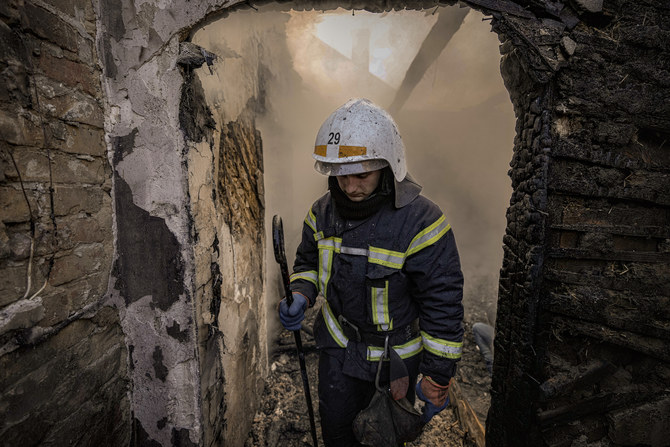
Although the invasion force has stalled in some areas and fierce Ukrainian resistance has thwarted its hopes for a swift victory, Russian artillery and air strikes maintained their bombardments on several cities, while civilians who have been unable or unwilling to flee sheltered underground.
“I have never seen such cruelty before,” said Kateryna Mytkevich, 38, who reached the Polish border transit hub of Przemysl with her child after fleeing the eastern city of Chernihiv. The city was “fully destroyed,” she said.
US President Joe Biden was flying to Europe for an emergency summit on Ukraine with NATO and European leaders at the Western military alliance’s headquarters in Brussels on Thursday.
The leaders are expected to roll out additional sanctions against Russia. They would also agree to bolster forces on the alliance’s eastern flank, NATO secretary-general Jens Stoltenberg told a news conference ahead of the summit.
However, he said NATO would not send troops into Ukraine.
“It is extremely important to provide support to Ukraine and we are stepping up. But at the same time it is also extremely important to prevent this conflict becoming a full-fledged war between NATO and Russia,” he said.
“Unfriendly countries”
Putin’s message was clear: If you want our gas, buy our currency. It remained unclear whether Russia has the power to unilaterally change existing contracts agreed upon in euros.
The ruble briefly leapt after the shock announcement to a three-week high past 95 against the dollar. It pared gains but stayed well below 100, closing at 97.7 against the dollar, down more than 22 percent since Feb. 24.
Some European wholesale gas prices up to 30 percent higher on Wednesday. British and Dutch wholesale gas prices jumped.
Putin’s announcement that Russia would switch certain gas sales to rubles sent European futures soaring on concerns the switch would exacerbate the region’s energy crunch and jam up deals that run to hundreds of millions of dollars every day.
Russian gas accounts for some 40 percent of Europe’s total gas consumption.
Moscow has drawn up a list of “unfriendly” countries, which corresponds to those that imposed sanctions. Deals with companies and individuals from those countries must be approved by a government commission.
The countries include the US, European Union member states, Britain, Japan, Canada, Norway, Singapore, South Korea, Switzerland and Ukraine. Some, including the US and Norway, do not purchase Russian gas.
“Russia will continue, of course, to supply natural gas in accordance with volumes and prices...fixed in previously concluded contracts,” Putin said at a televised meeting with government ministers.
“The changes will only affect the currency of payment, which will be changed to Russian roubles,” he said.
Western sanctions imposed on Russia for its actions have ostracized it from the world economy.
Putin sent his troops into Ukraine on Feb. 24 on what he terms a “special military operation” to demilitarise and “denazify” the country. The West says it is a war of aggression aimed at reasserting Russia’s sway over the former Soviet Republic.
But after a month of bloodshed, Russian forces have failed to capture a single major city.
Although the Kremlin says the operation is going to plan, they have taken heavy losses, been frozen in place on most fronts, and face supply problems and fierce resistance. They have turned to siege tactics and bombardment, causing massive destruction and many civilian deaths.
The conflict has also driven a quarter of Ukraine’s 44 million people from their homes.
Kyiv’s mayor, Vitali Klitschko, told reporters on Wednesday that 264 civilians in the city had been killed by Russian attacks. The noise of bombs falling could be heard in background as he spoke. But Ukrainian forces had retaken the nearby towns of Makariv and Irpin from Russian control, he said.
Klitschko said later that one person was killed and two seriously wounded on Wednesday when shells hit a shopping center parking lot in a northern part of Kyiv. “The enemy continues to fire at the capital,” Klitschko said in an online post.
Russia denies targeting civilians.
Smoke over the water
Worst hit has been Mariupol, a southern port surrounded by Russian forces, where hundreds of thousands of people have been sheltering since the war’s early days, under constant bombardment and with food, water and heating supplies cut.
Satellite photographs from commercial firm Maxar released overnight showed massive destruction of what was once a city of 400,000 people, with columns of smoke rising from residential apartment buildings in flames.
Despite its losses so far, Russia may still be hoping to make more gains on the battlefield, especially in the east, in territory including Mariupol that Moscow demands Ukraine cede to Russian-backed separatists.
British military intelligence said the entire battlefield across northern Ukraine — which includes armored columns that once threatened Kyiv — was now “static,” with the invaders apparently trying to reorganize.
But in the east, the Russians were trying to link troops at Mariupol with those near Kharkiv, Ukraine’s second city, in the hope of encircling Ukrainian forces. In the southwest they were bypassing the city of Mykolayiv to try to advance on Odesa, Ukraine’s biggest port, the British report said.
Ukrainian officials described sporadic shelling in other cities overnight, with two civilians killed in the Mykolayiv region, a bridge destroyed in the Chernihiv region. Reuters could not immediately verify these incidents.
Economic reformer
In Moscow, the Kremlin confirmed that Chubais, the senior official had resigned of his own accord.
Chubais was one of the principal architects of Boris Yeltsin’s economic reforms of the 1990s and was Putin’s boss in the future president’s first Kremlin job. He later ran big state businesses under Putin and held political jobs, lately serving as Kremlin special envoy to international organizations.
Chubais hung up the phone when contacted by Reuters. The sources did not say where he was.